Building a Small Business Agent with Pydantic + Vercel + Supabase: Is It Reliable?

Pydantic AI + Vercel + Supabase suits rapid validation of small business Agents, but reserve a migration path.
The article discusses a developer's practice of building a small business Agent with Pydantic AI, Vercel, and Supabase, analyzing the stack's applicability and boundaries. Pydantic AI provides type-safe structured output; Vercel offers excellent deployment but its Serverless time limits clash with Agents' long tasks; Supabase handles data and vector retrieval but needs connection management. It highlights observability and rollback needs, and signals for migrating off Vercel.
Why This Tech Stack Is Worth Paying Attention To
A developer shared his experiment on Reddit: building a small business–oriented Agent with Pydantic AI + Vercel + Supabase. His goal was clear—not to buy an off-the-shelf product, but to learn and test by building it himself. After comparing multiple options, he chose this combination, with the core requirements being flexibility, fast deployment, and low maintenance cost.
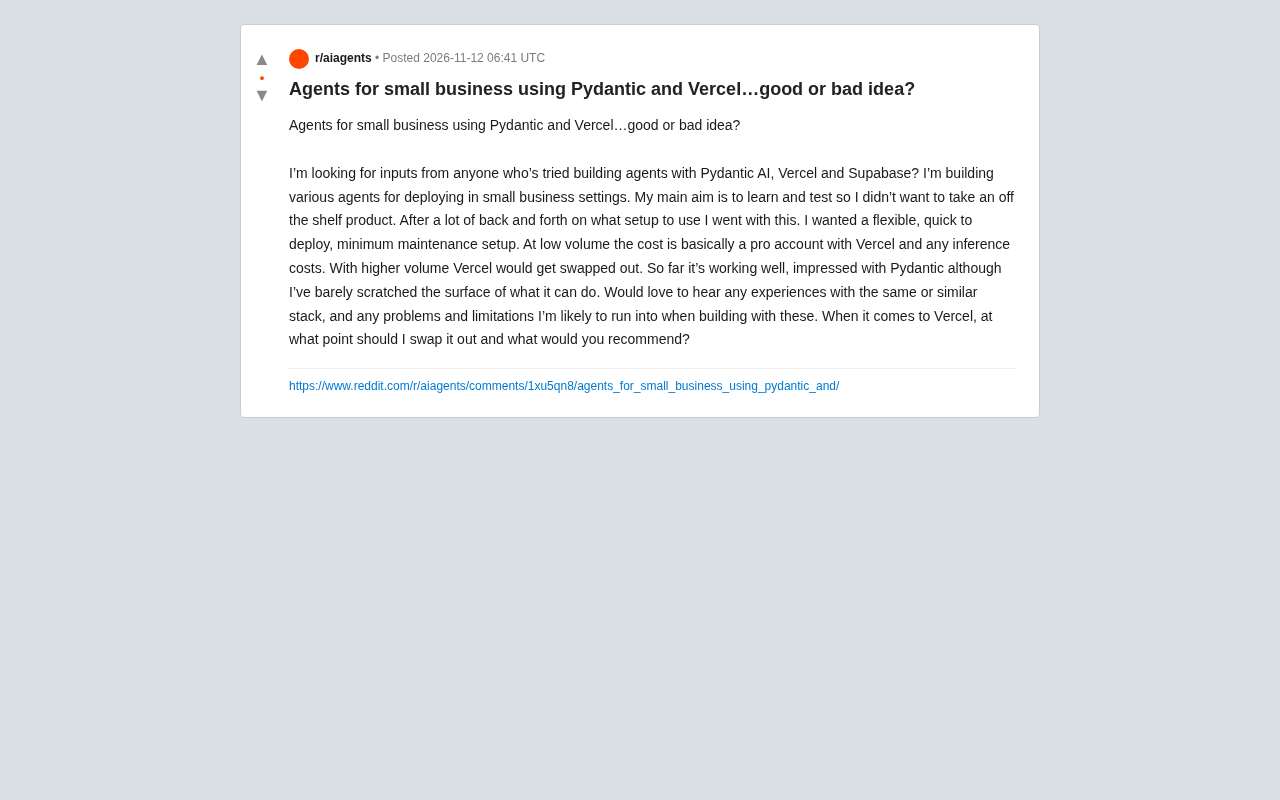
There's a clear cost logic behind this choice: at low usage, the overhead is essentially just the Vercel Pro account fee plus inference costs; once usage picks up, then consider replacing Vercel. It's currently running well, and he's impressed with Pydantic's performance, but he also admits he has "barely scratched the surface." What he really wants to know is what pitfalls this stack will encounter in real-world use, and at what point Vercel should be replaced.
The Role and Potential Weaknesses of Each of the Three Components
Pydantic AI: A Type-Safe Agent Framework
Pydantic is known in the Python ecosystem for data validation, and Pydantic AI brings that strength to Agent building. It lets developers define tools and output structures with type annotations, reducing runtime errors. For small business scenarios—such as customer service Q&A, order lookup, and appointment management—this strong constraint can significantly lower debugging costs. But Pydantic AI is relatively young, and its community size and ready-made integrations still lag behind established frameworks like LangChain; when encountering niche requirements, you may need to build things yourself.
Pydantic is the most widely used data validation and serialization library in the Python ecosystem, whose core capability is defining data models through type annotations and automatically validating them at runtime. Pydantic AI is an Agent framework built by the official team on top of this foundation, designed to constrain the unstructured text output by LLMs into instances that conform to Pydantic models, thereby giving tool-call parameters, final replies, and state objects both static type checking and runtime validation. Compared with LangChain's chain-based abstraction, Pydantic AI emphasizes "the model is the contract": once developers define input and output types, the framework handles prompt injection, parsing, and retries, reducing handwritten parsing code and exceptions caused by hallucinated formats. It is currently at a relatively early stage, and ecosystem integrations (such as vector stores and observability platforms) are still being improved.
Vercel: Quick to Start, But Where's the Ceiling?
Vercel's advantage is an excellent deployment experience and seamless integration with frontend frameworks, making it suitable for rapid idea validation. But Agent applications often involve long-running tasks, streaming responses, and background jobs, while Vercel's Serverless functions have execution time limits. The developer himself realizes that "higher volume Vercel would get swapped out." The question is the trigger point for replacement: when request volume causes frequent cold starts, when a single inference approaches the function limit, or when a persistent process is needed to handle queues, it's time to consider migrating to a platform that supports long-lived connections, such as Fly.io, Railway, or simply a cloud server.
Serverless functions are Vercel's core execution model: code is triggered per request, runs in an isolated instance, and the instance may be reclaimed after execution ends. Their advantages are on-demand scaling and zero operations, but the cost is an execution time limit (typically ranging from seconds to tens of seconds depending on the plan), cold start latency, and the inability to retain memory state between requests. A single request in an Agent application often includes multiple rounds of tool calls and LLM inference, and may take far longer than a typical API, making it easy to hit the time limit; although streaming responses can be mitigated through Edge or streaming APIs, persistent workloads such as background queues and scheduled tasks are not suited to this model. Understanding these boundaries is a prerequisite for judging when migration to containers or a VPS is needed.
Supabase: Database and Vector Storage in One
Supabase provides a Postgres database, authentication, and storage, and also supports the pgvector extension, making it well suited for an Agent's memory layer and knowledge base retrieval. For small business applications, it saves the trouble of separately maintaining a vector database. The limitation is that optimization of complex queries and connection pool management require extra attention, especially in Serverless environments, where the number of database connections can easily become a bottleneck.
pgvector is an extension for PostgreSQL that adds a vector type and approximate nearest neighbor search capabilities (supporting indexes such as IVFFlat and HNSW). This means that without introducing a separate vector database (such as Pinecone or Weaviate), you can store both business relational data and embeddings in the same Postgres instance and use SQL to perform hybrid queries combining "structured filtering + semantic search." For an Agent, this exactly covers the two needs of memory storage and knowledge base RAG. Note that in a Serverless environment, each function call may create a new database connection, which can easily exhaust Postgres's connection limit; this is usually addressed with a connection pool (such as Supavisor provided by Supabase) or an HTTP-based database client.
The Real Constraints of Small Business Agents
The biggest difference between small business scenarios and general-purpose Agents is that there is little room for error. If a customer-facing Agent gives irrelevant answers, real orders and reputation are at stake. Therefore, evaluating this stack cannot focus only on development efficiency; it must also consider observability and rollback capability. Pydantic AI's structured output helps constrain reply formats, but complete monitoring, logging, and human takeover processes still need to be built separately.
Another practical issue is maintenance effort. Small businesses usually don't have dedicated operations staff, so the developer's pursuit of "minimum maintenance" is reasonable. The managed nature of Vercel and Supabase reduces operational burden, but once you migrate off Vercel, operational complexity rises—a trade-off that needs to be weighed in advance.
Observability refers to the ability to observe the internal operating state of a system through logs, metrics, and tracing. For LLM Agents, it is even more critical than for traditional applications: a single request goes through prompts, multiple model calls, tool execution, and result assembly, and an error in any link may manifest as a "strange answer" rather than a clear error. In practice, it is usually necessary to record the input and output of each call, token consumption, tool call chains, and latency distribution, and to set up human takeover or fallback paths so that the Agent can hand off to a human when confidence is low or a tool fails. Such capabilities often require additional integrations (such as OpenTelemetry, Langfuse, etc.); frameworks themselves usually provide only basic hooks.
When Should You Replace Vercel?
Combining this developer's questions with common community experience, several signals are worth noting:
- Longer inference chains: multi-step tool calls cause a single request to approach or exceed the function limit
- Rising concurrency: cold starts and instance scaling bring noticeable latency fluctuations
- Need for background tasks: scheduled tasks and long queue processing are unnatural under the Serverless model
- Changing cost structure: function invocation and bandwidth costs exceed self-hosting costs
There is no standard answer for the direction of replacement. If you still want to keep a managed experience, consider platforms that support containers; if you want more control, migrate to a VPS or Kubernetes. The key is to decouple Agent logic from the deployment platform architecturally, for example by wrapping the Agent service in a standard HTTP interface, so that migration only requires changing the deployment layer rather than rewriting business code.
Conclusion: Worth a Try, But Leave Yourself a Way Out
This combination is suitable as a starting point for learning and small-scale validation. Pydantic AI provides a solid type foundation, Supabase covers data and retrieval needs, and Vercel makes going live simple. The risk is that each component has clear boundaries of applicability, especially the inherent tension between Vercel's Serverless model and the long-task characteristics of Agents.
If you plan to take this path, it is advisable to keep the deployment layer replaceable from day one and to incorporate monitoring and human fallback into the design. That way, even if one link needs to be replaced in the future, the entire system won't be overturned.
One-line Summary
Pydantic AI + Vercel + Supabase is suitable for rapid validation of small business Agents, but a migration path should be reserved.
Paragraph Summary
The article centers on a developer's practice of building a small business Agent with Pydantic AI, Vercel, and Supabase, analyzing the applicability and boundaries of this tech stack. Each of the three components plays its role: Pydantic AI provides a type-safe Agent framework that lowers the debugging cost of structured output; Vercel brings an excellent deployment experience, but its Serverless function execution time limits are in inherent tension with Agents' long tasks, streaming responses, and background jobs; Supabase uses Postgres plus pgvector to handle both data storage and vector retrieval, but connection management in Serverless environments requires attention. The article points out that small business scenarios have little room for error and lack dedicated operations staff, so observability and rollback capability are crucial, and it gives several trigger signals for migrating off Vercel, emphasizing that Agent logic should be decoupled from the deployment platform.
Related articles

ChatGPT Plus Subscription Pitfall Guide: Go/Plus/Pro Tier Comparison and Quick Activation
A complete ChatGPT Plus subscription guide based on a Bilibili tutorial: from registering an account, comparing Go/Plus/Pro tiers, to the practical steps for quickly completing your subscription.

GPT-6.2 Sol/Astra Released! A Step-by-Step ChatGPT Plus Subscription Guide and Tier Comparison
GPT-6.2 Sol/Astra is out—here's a ChatGPT Plus subscription guide: register an account, compare Go/Plus/Pro tiers, and subscribe in a minute.

Comparing Three Channels for Subscribing to GPT Plus in China: Is Website Top-Up the Easiest?
How to subscribe to GPT Plus in China? This article compares website top-up, credit card, and mobile top-up channels—process, cost, and risk—with steps and tips to help you choose wisely.