Gemini 4 Neon Hands-On: 25% Cheaper and Beats Claude Opus?
Gemini 4 Neon edges out Claude Opus on leaderboards and is cheaper, but real-world performance varies—use it as a supplement, not a replacement.
The video compares Google's Gemini 4 Neon and Claude Opus across real projects. Neon excels at visual generation (3D modeling, physics simulation, interactive scenes) and bug fixing, with 95% accuracy in million-token retrieval, a leaderboard score of 61 vs Opus's 59, and a 25% lower price. But real task costs aren't always lower, since Neon may generate more tokens. The author's API tests show stylistic differences outweigh superiority, recommending Neon as a supplement for visual-intensive and long-document tasks rather than a full Claude replacement—and testing on your own tasks before signing.
Google's newly released Gemini 4 Neon scored 61 on the Artificial Analysis leaderboard, beating Claude Opus's 59 while being 25% cheaper. This video compares the two models' real-world performance across several projects and offers advice on whether to switch.
Visual Building: Neon's Strength
The video first showcases Neon's visual generation capabilities. A developer provided only an image of a robotic dog carrying a railgun and asked for a 3D model. Neon not only completed the modeling but also implemented a 240Hz physics simulation, calculating the forces on all legs and applying inverse kinematics so the feet land realistically, supporting three gaits: walk, trot, and gallop. The post garnered 150,000 views in a single day.
In another example, a user provided only a static image and asked it to be animated with 3D.js. Neon autonomously downloaded a depth model from Hugging Face to run locally, determined near/far relationships, layered the image, and generated an interactive scene with real-time rain effects, puddles you can step in, and curtains you can part—even automatically adding rain sounds.

Inverse Kinematics (IK) is a technique in computer graphics and robotics: given the target position of an end effector (such as a foot), it works backward to determine the rotation angles of each joint. Forward kinematics computes end-effector position from joint angles, while IK does the reverse—hence the name. In 3D character animation, IK lets feet automatically conform to uneven terrain and hands grasp objects accurately, without animators adjusting every joint frame by frame. Neon's use of IK in the robotic dog case allows the three supporting legs to automatically adjust their posture based on ground height—a key reason its physics simulation looks "real."
Debugging and Fixing: Pinpointing Errors
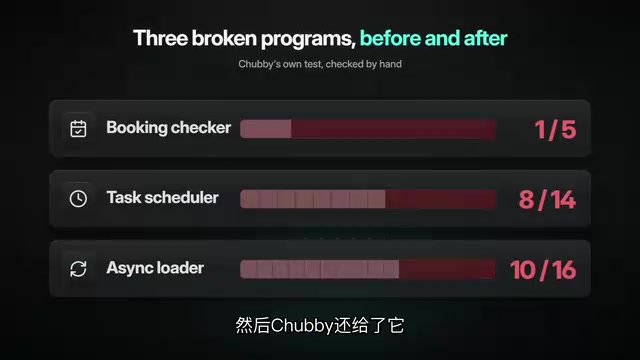
Neon also excels at debugging. User Chubby tested three buggy programs, and Neon fixed them all: the reservation checker went from a 20% pass rate to 100%, the task scheduler from 8/14 to 100%, and the async loader from 6/10 to 100%.

In Power's test, five bugs were planted in two real code repositories. Neon scored 63 at its highest setting, slightly above Astra 6.2's 62.7 and far above Fable 5.2's 58. A developer on Hacker News commented that Neon solved a low-level graphics problem in 20 minutes that had stumped him for two weeks and that other models couldn't crack.
Long Documents and Cost: Impressive Numbers, but Stay Rational
Neon has a million-token context window. Google's official data shows 95% accuracy in finding buried information in very long texts, versus 67% for Opus. Though this is Google's own benchmark, the gap is significant.
On cost, the Artificial Analysis leaderboard shows Neon costs $6.44 per task to run the test suite, versus $10 for Opus 5.5 and $26 for Fable 5.2. Neon's intelligence is close to the smartest model, Fable, at a quarter of the price.

However, real-world task costs aren't simply calculated by per-token price. In a watch configurator test, Opus spent $2.74 to build a 42-part watch, while Neon spent $1.86 to build a 90-part watch—but the interactions were broken. In another test, Neon cost $3.50 versus Opus's $7.20, but the tester preferred Opus's output. In a city test, Neon generated 23,000 tokens versus Opus's 1,000, making Neon cost 37 cents per minute versus Opus's 32 cents.
Context Window refers to the total number of tokens a model can process in a single inference, including input prompts and output. A million-token context means the model can read roughly 750,000 English words or dozens of long documents at once, without chunked summarization. But "fitting it in" doesn't equal "using it accurately"—information in very long contexts can be overlooked due to attention dilution. This is what the so-called "Needle in a Haystack" test measures: locating and recalling specific information amid large amounts of irrelevant text. Google's reported 95% accuracy is based on its own test set; real-world performance varies with document structure, information position, and question phrasing, so the figure should be treated as a reference rather than an absolute guarantee.
Personal Comparison: Style Differences Outweigh Superiority
The author tested Neon and Opus 5.5 via API with identical prompts. The first prompt was "a 3D seaside city at sunset with a lighthouse, waves, and cars." Neon produced a highly atmospheric image with sun, water, and hills; Opus leaned toward a realistic city with a street grid, cars, and a sweeping lighthouse beam. The styles differ, and it's hard to declare a winner.
The second prompt was a dashboard for a coffee subscription company. Both looked like real products, with consistent card numbers. On a trap question (a nonexistent pandas method), both correctly pointed out the method doesn't exist—no hallucination.
Should You Switch? Depends on Your Use Case
The author suggests most users don't need to fully replace Claude, but should use Neon as a supplement. For visual-intensive tasks (prototypes, landing pages, interactive demos), Neon is worth trying; when stuck on a bug or dealing with large volumes of documents, Neon is also a good choice; when running many API tasks, batch pricing can halve the cost ($1.50 per million input tokens, $7.50 per million output tokens).
But the author himself still uses Claude Code as his main tool for long-running agent tasks, and recommends having different models review each other's work—e.g., Codex reviewing Claude's work, Gemini reviewing Codex's work.

On pricing, within the Gemini 4 series, Carbon currently has a promotional price, but next month it doubles to $4 and $20, while Neon stays at $1 and $15. So Neon will become the cheapest way to get Carbon-level scores from Google.
Finally, the author emphasizes: don't be fooled by leaderboard rankings—before signing anything, be sure to test the model on your own actual tasks.
Batch Pricing is a discount mechanism cloud providers offer for asynchronous, non-real-time inference requests. After a user submits a batch of tasks, the provider processes them during idle compute periods, so the price is typically about 50% of the real-time API—at the cost of latency increasing from seconds to minutes or longer. For scenarios that don't need immediate responses—such as bulk test-case generation, offline data analysis, or large-scale document processing—batch pricing can significantly reduce costs. The mentioned $1.50 per million input tokens and $7.50 per million output tokens fall into this discount category, but note it doesn't apply to latency-sensitive workflows like interactive coding assistants.
One-line Summary
Gemini 4 Neon edges out Claude Opus on leaderboards and is cheaper, but real-world performance varies by task—use it as a supplement, not a replacement.
Paragraph Summary
The video compares Google's Gemini 4 Neon and Claude Opus across several real projects. Neon stands out in visual generation (3D modeling, physics simulation, interactive scenes) and bug fixing, with 95% accuracy in million-token retrieval, a leaderboard score of 61 versus Opus's 59, and a 25% lower price. But real task costs aren't always lower, since Neon may generate more tokens, bringing per-minute cost close to or even slightly above Opus. The author's own API testing found stylistic differences outweigh superiority, and recommends most users use Neon as a supplement for visual-intensive and long-document tasks rather than a full replacement for Claude—and stresses testing on your own tasks before signing any contract.
Related articles

Building a VR Starship with an AI Agent Team: A Multi-Agent Collaboration Chronicle
A creator built Star Trek's Enterprise-D in VR from scratch using an AI agent team of Claude Code and Codex—breaking down roles, rules, and bottlenecks.
Airbot: The Proactive AI Chief of Staff That Messages You First, So You Can Escape Notification Overload
Airbot is a proactive AI chief of staff that aggregates email, Slack, calendar, and CRM, pushing priority items with drafted replies and meeting briefs to WhatsApp or iMessage for one-tap approval.

Schumer's Leadership Controversy: Tactics or Communication?
Based on a YouTube video, this explores Senator Schumer's leadership controversy: is it a matter of tactics or communication? It covers taxes, healthcare policy, and primary interventions.