Building an AI Agent from Scratch: A Beginner's Guide to Developing Your Own Intelligent Agent

A beginner's guide to AI Agent development, covering why Agents matter and how to learn with LangChain.
While most people still view ChatGPT as the endpoint of AI, the industry has moved toward AI Agents — systems that shift AI from "what it can say" to "what it can do." From Stanford's multi-agent Smallville experiment to automated enterprise data analysis, Agents are filling deep personalization gaps that generic chatbots can't address. With a projected CAGR exceeding 42% and AI roles commanding 20–30% salary premiums, the timing is strong. This article outlines a three-stage learning path: industry context, LangChain framework fundamentals, and a hands-on capstone project — all in Python.
What comes after the current wave of AI? While most people still view ChatGPT-style chatbots as the endpoint of AI, the industry has already shifted its focus to AI Agents (autonomous AI systems). Bilibili creator Tommy systematically breaks down the value and learning path for this direction in his zero-to-hero Agent development course. Drawing on his content, this article explores why AI Agents are a worthwhile technical investment — and how beginners can get started.
Why AI Agents Are the Next Form of AI
Bill Gates once argued on his personal blog that existing software remains fundamentally clumsy, and that the future of software lies in intelligent agents — AI Agents. He predicted that within a few years, everyone will have their own AI assistant, and that every piece of software today is worth rebuilding in an Agent-first way.
The core logic behind this prediction is a fundamental shift in how we interact with computers. Gates describes a world where you no longer need to open different apps to draft a document, build a spreadsheet, or send an email — you simply tell your device in plain language what you want done. He calls this transition from "type commands and click icons" to "express intent in natural language" the biggest computing revolution since the graphical user interface.
The essential difference between an Agent and a traditional ChatGPT interaction is that Agents evolve AI from what it can say to what it can do. Ordinary chatbots can only respond passively to specific prompts, while Agents are proactive — they remember user activity, recognize behavioral patterns and intent, offer suggestions before users even ask, and execute tasks across multiple applications.
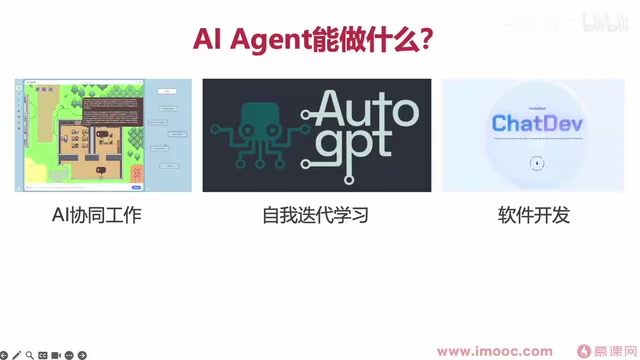
A classic example is Stanford University's "Smallville" project, where researchers assigned different personality attributes to individual Agents in a virtual town and let them evolve freely in a shared environment, achieving remarkable collaborative behavior among the group. The ChatDev project, developed by a Chinese team, takes a similar approach — virtualizing the entire software development pipeline and leveraging multi-agent collaboration to achieve far more powerful results than any single agent could.
The "Smallville" project's formal title is Generative Agents: Interactive Simulacra of Human Behavior, published in 2023 as a collaboration between Stanford University and Google. The 25 virtual characters each operate on three layers: a memory stream that continuously logs what each character sees and experiences, a reflection layer that periodically distills fragmented memories into higher-level insights, and a planning layer that uses those insights to determine the next action. This combination enables emergent behaviors — like spontaneously organizing a Valentine's Day party or spreading gossip — that far exceed the capabilities of single-turn dialogue models, making it a landmark reference for academic research on multi-agent coordination.
Agents Solve Problems Traditional AI Tools Can't
Many business owners who follow AI news feel confused about what AI can actually do for them. That's precisely where Agents shine. Take a business consulting firm as an example: there's a constant flow of data tables to process — raw database data needs to be cleaned, extracted into spreadsheets, statistically analyzed, and ultimately synthesized into business insights. General-purpose ChatGPT simply can't handle this kind of workflow.
The ideal solution is to build an Agent tailored to your own business using AI capabilities — connect your database to it, enter the insight question you want answered, and the report generates automatically. You can even chain it to email for direct delivery.

This level of deep personalization applies equally to travel planning. An Agent that knows your preferences understands not just your schedule, but also whether you tend to explore new destinations or revisit favorites — recommending places, arranging activities, and booking restaurants based on your interests. This used to require paying a travel agent and going through multiple rounds of back-and-forth communication.
Looking at market data, this space is growing rapidly. According to Grand View Research figures cited in the course, the autonomous AI agent market is projected to expand at a compound annual growth rate of over 42%. Another report forecasts the market growing from $5 billion to $29 billion, with a CAGR of 43%.
Is Now a Good Time to Learn Agent Development?
The course draws an analogy between learning Agent development today and learning mobile app development in the early days of the mobile internet. The industry's current focus is on foundational infrastructure — large models, compute, and so on. But once that foundation matures, the application layer — Agents — will be what truly transforms the software industry, and demand will explode.

From an employment perspective, an Indeed report cited in the course indicates that AI-related roles command 20% to 30% higher average salaries than traditional tech positions. For companies and individuals who already possess deep domain expertise and proprietary industry data, learning Agent development unlocks the ability to build purpose-built Agents that multiply the impact of existing business operations.
That said, there are real barriers to entry. Chinese-language resources are scarce, and English resources evolve rapidly. Knowledge is scattered across large models, tool calling, vector databases, AI engineering, and other domains — with little systematic synthesis. Most available courses focus on tool usage with insufficient hands-on coding; and there aren't many practical projects suited to verification through real implementation.
A Practical Learning Path
To address these challenges, the course lays out a path centered on the LangChain framework, taught in Python, organized into three main parts spanning roughly ten to eleven chapters.
Part One focuses on industry context — starting from the history of large language model development, introducing mainstream LLMs and their limitations via platforms like Hugging Face, then presenting fine-tuning and LangChain as solutions, with guidance for front-end and back-end developers looking to transition into this space.
Part Two dives deep into LangChain's seven core modules, covering local environment setup, the Model I/O concept, prompt template usage, as well as building external knowledge bases for LLMs, Retrieval-Augmented Generation (RAG), text chunking, and vector databases.
Part Three is hands-on project work. The course uses a complete end-to-end virtual project as the throughline — an Agent modeled after a "feng shui fortune teller" (inspired by the character Chen the Blind from the novel Ghost Blows Out the Light). This Agent has its own distinct personality, can hold general conversation, and can call external tools to extend its capabilities — including real-time search for current events, email and SMS integration, continuous learning of feng shui knowledge, real-time text-to-speech (TTS), and emotional analysis based on user input to provide contextually appropriate responses.

The design intent behind this virtual project is clear: walk through the complete cycle from product requirements analysis and architecture design to code implementation and engineering practices, so learners can apply the same thinking to their own business contexts. The course also covers extended topics including instant messaging integration, intelligent digital avatars, and voice TTS.
A word of caution: this article is based on a course introduction session, which is largely an overview of Agent's value and the course structure — it doesn't go into specific code implementation details. For developers who genuinely want to get started, treat it as directional guidance and supplement it with the official LangChain documentation and real projects to validate your learning hands-on. As the course creator puts it: AI isn't replacing people — it's replacing people who don't know how to use AI. Rather than worrying about being displaced, the better move is to actively connect your domain expertise with AI capabilities.
LangChain is currently one of the most widely used Agent development frameworks, released by Harrison Chase in late 2022. Its core idea is to chain large language models (LLMs) together with external tools and data sources through composable "chains." Its most important abstractions include: Chain (combining multiple steps into reusable pipelines), Tool (giving models the ability to call external capabilities like search, code execution, and database queries), Memory (persisting context across conversation turns), and Agent (enabling the model to autonomously decide which tools to call and in what order). RAG (Retrieval-Augmented Generation) is one of LangChain's most common use cases: private documents are chunked and stored in a vector database, and on each query, relevant segments are retrieved first before being passed to the model for response generation — giving the model access to proprietary enterprise knowledge without requiring retraining. Understanding these core concepts helps learners quickly build mental structure when reading the official documentation.
Related articles

Chain of Thought Isn't Just for AI: How Humans Can Use CoT to Improve Thinking Quality
Chain of Thought isn't just a prompt trick for large models. Starting from a Hacker News discussion, this article analyzes why CoT works for human thinking too, breaks down actionable ways to transfer it, and highlights the key differences between human CoT and machine CoT.
Cloudflare Teams Up with OpenAI: Closi…
Cloudflare Teams Up with OpenAI: Closing the Loop from Vulnerability Discovery to Defense with AI
Cloudflare uses OpenAI Daybreak to investigate security vulnerabilities and generate reviewable remediation plans, while developers use Codex to boost coding efficiency and quality.

Orca Multi-Agent Orchestration in Practice: A Guide to Parallel Collaboration with Claude and Codex
Orca is Stable AI's free open-source agent workbench supporting 34 agents like Claude Code and Codex in parallel. Learn its Git worktree isolation, multi-model orchestration, and mobile management.