Building an AI Public Opinion Monitoring Platform with 7 Agents: A Full-Stack LangGraph Deep Dive

A full-stack LangGraph multi-agent platform for automated public opinion monitoring, analysis, and reporting.
This article analyzes a production-grade AI public opinion monitoring system built with LangGraph and LangChain, integrating 7 collaborative agents across data crawling, sentiment analysis, topic clustering, alerting, and report generation. Key highlights include a three-tier storage design using ES for hybrid vector/full-text search, idempotent duplicate detection, and one-click LLM-powered report export — making it a strong portfolio project for AI application developer roles.
Project Overview: An AI Public Opinion Monitoring System Built for Production
As large language model technology accelerates its adoption in enterprise settings, AI Agent-driven automation is becoming one of the hottest areas in the job market. An AI Agent is an intelligent program capable of perceiving its environment, autonomously planning, and executing tasks. Unlike traditional single-turn LLM calls, agents operate in a closed "perceive → reason → act" loop and can invoke external tools (search engines, databases, APIs), decompose complex tasks, and execute them iteratively. Multi-agent systems take this further by delegating subtasks to specialized agents that collaborate to handle workflows too complex for any single agent.
Bilibili creator 花菜 recently shared a complete AI-powered automated public opinion monitoring and analysis platform — a system integrating 7 collaborative agents that covers the full pipeline from data collection and sentiment analysis to topic clustering, alert delivery, and report generation. It's a compelling full-stack AI engineering case study worth a deep dive.
This isn't a simple demo. It's a cleanly architected opinion analysis system built close to real-world business requirements. Starting from keyword monitoring, the system automatically crawls relevant content from across the web, applies LLM-based semantic analysis and insight summarization, and ultimately produces a visual dashboard with automated alerts. For developers targeting AI application development or Agent engineering roles, this type of project carries strong resume weight.
Core Feature Modules
The system consists of the following main modules:
- Overview Dashboard: Data statistics, real-time Agent status monitoring, sentiment trend charts, sentiment distribution pie charts, and platform breakdowns
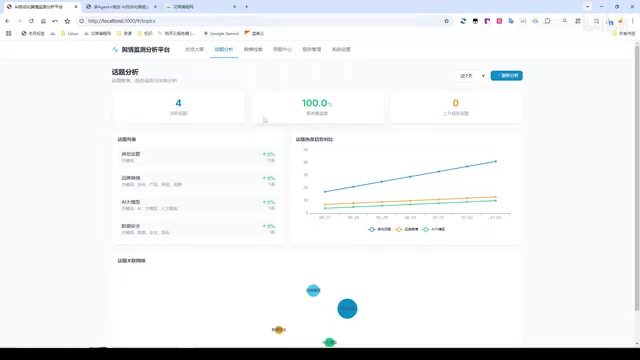
- Topic Analysis: Active topics, cluster coverage, trending topics, topic network graph
- Opinion Search: Filter crawled news by positive/neutral/negative sentiment, with links to original articles
- Alert Center: Custom alert rules with automatic email notifications on trigger
- Report Management: One-click daily/weekly report generation with Markdown and PDF export
- System Settings: Configure custom monitoring keywords
Key Tech Stack: LangGraph + LangChain + Elasticsearch
The technology choices here are what make this project especially worth studying — they cover the mainstream AI application development toolchain.
A Three-Tier Storage Architecture
The system uses multiple storage solutions in parallel, each handling a different data type:
- MySQL: Persistent storage for structured data
- Elasticsearch (ES): Serves dual roles as both a full-text index and a vector database, enabling semantic search
- Redis: Caching and message queue for task scheduling performance
This "structured storage + full-text/vector search + cache queue" three-tier architecture is a classic design pattern for opinion monitoring systems. Notably, since version 8.x, Elasticsearch natively supports vector fields (dense_vector) and approximate nearest neighbor (ANN) search via the HNSW algorithm. This allows ES to handle both traditional keyword full-text search (BM25) and vector-based semantic search (cosine similarity) within a single system. Using ES for both avoids introducing dedicated vector databases like Pinecone or Milvus, reducing operational complexity while satisfying both keyword matching and semantic similarity requirements — a pragmatic engineering trade-off worth borrowing.
AI Orchestration: LangGraph vs. LangChain
For multi-agent collaboration, the project uses LangGraph to build the AI workflow (Agent Workflow), orchestrating the 7 agents and managing state communication between them. LangChain handles LLM integration for natural language tasks such as sentiment analysis, semantic extraction, and report summarization.
LangGraph is a stateful multi-agent orchestration framework from the LangChain team, built on directed graph structures (supporting both DAGs and cyclic graphs) — each node represents an agent or processing step, and edges represent state transition paths. Compared to traditional chain-based calls or LangChain's native AgentExecutor, LangGraph's key advantage is finer-grained control over state persistence, error retries, and human-in-the-loop intervention points across multi-step tasks. It natively supports conditional branching, loops, and multi-agent collaboration, making it an excellent fit for complex scenarios like opinion monitoring that require multiple steps and roles.
Automated Collection and Alerting
Dual-Mode: Scheduled and On-Demand Collection
The system supports two data collection modes: scheduled automatic collection runs every 20–30 minutes by default (configurable); manual collection and analysis lets users pull the latest content on demand.
The collection scope is fully driven by the monitoring keywords configured in the system settings. The demo uses pre-set keywords including "autonomous driving, solid-state batteries, large models, new energy, carbon neutrality," and live-demonstrates the system immediately incorporating "Tesla" after it's added — showing solid flexibility.
Engineering the Email Alert System
The Alert Center is the module closest to real business value. Users define alert rules, and the system automatically sends email notifications when matching opinion events are detected.

The demo uses QQ Mail to deliver alerts, and successfully receives email summaries including items like "High Risk: Negative sentiment detected for solid-state batteries" and "Carbon neutrality topic heat rising." Worth highlighting is the system's built-in duplicate collection merge logic, which prevents the same event from being pushed multiple times. This reflects careful attention to idempotency — a core principle in distributed systems, meaning that executing the same operation multiple times produces the same result as executing it once. In scheduled task scenarios, network jitter or overlapping runs can cause duplicate data ingestion. By building a unique index on source URLs or content hashes, the system auto-detects and merges duplicates at write time, preventing duplicate alerts and data distortion in reports. This is an engineering detail that adds real credibility.
Intelligent Automated Report Generation
The Report Management module supports one-click generation of daily and weekly reports. Since report generation requires LLM calls for semantic extraction and content summarization, there's a brief wait.

Generated reports are well-structured, covering the date, total collection volume, opinion overview, hot topics, platform distribution, alert summary, trend insights, and a final summary. They can be exported as Markdown or PDF, supporting both further editing and formal publishing.
The pipeline of "data collection → LLM analysis → auto-generated structured report" is one of the most practical AI applications in enterprise workflows — automating what would otherwise take hours of manual work to compile into an opinion briefing.
Value as an AI Job-Hunt Portfolio Project
The author specifically emphasizes that this project is well-suited for a resume and provides a comprehensive set of supporting materials.

Included materials:
- Interview Question Collection: 30 high-frequency interview questions with reference answers
- Resume Templates: Example write-ups covering backend development, AI applications, web crawling and data collection
- Technical Challenges & Solutions: Debugging approaches for real engineering issues like "sentiment analysis results not written back to the database"
- System Architecture Design Document: Over 3,000 lines, available in both Xmind mind map and Markdown formats
For candidates targeting Agent or AI application development roles, interviewers will frequently probe "what technical challenges did you face in this project?" Real engineering problems — like data pipeline debugging, inter-layer state communication, and vector search optimization — are exactly the kind of material that demonstrates technical depth.
Summary: Extracting Real Competence from Architectural Trade-offs
This AI public opinion monitoring platform presents a complete picture of modern LLM application development: from LangGraph's multi-agent orchestration and LangChain's model integration, to a layered storage architecture spanning ES vector search, MySQL persistence, and Redis cache queues, through to a closed business loop of automated collection, email alerts, and intelligent reports.
One notable aside: the author mentions the entire project was "built with the assistance of AI coding tools" — itself a signal of the broader trend that AI programming tools can now help developers rapidly build full-stack applications of meaningful complexity.
For learners, what's more valuable than the feature demo is deeply understanding the architectural trade-offs behind the design: Why use ES for vector storage instead of dedicated options like Pinecone or Milvus? The core reason is ES's hybrid search capability satisfying both keyword matching and semantic similarity in one system while reducing the number of operational components. How do you design state transitions between agents so that intermediate states in LangGraph nodes are persisted and support checkpoint-based recovery? How do you ensure idempotency in scheduled tasks through duplicate collection merging to prevent alert storms? The answers to these questions are what can genuinely translate into personal technical capability.
Key Takeaways
Related articles

Black Forager Alexis Nelson: From Foraging to Publishing, Happy Snacking, Don't Die
Black Forager Alexis Nikole Nelson visits Talks at Google, sharing her journey from childhood plant walks with her mother to publishing the cookbook Happy Snacking, Don't Die!, revealing the racial and land history behind foraging's rise and fall in America.

How to Present Your Ideas Effectively: Three Types of Revelation Talks
Revelation talks are the most direct way to convey ideas. This article breaks down three types — Wonder Walk, Dynamic Demo, and DreamScape — with classic examples from David Gayo, Michael Pritchard, and Sylvia Earle.

Modern Web Guidance: Letting AI Write Native Declarative Dialog Popovers
Google's Modern Web Guidance makes AI coding assistants prefer native declarative dialog capabilities over repetitive JavaScript event listeners, measurably cutting boilerplate code.