Building an HR Resume Screening Workstation with Zero Code: A Hands-On Review of AI Luxiaofei
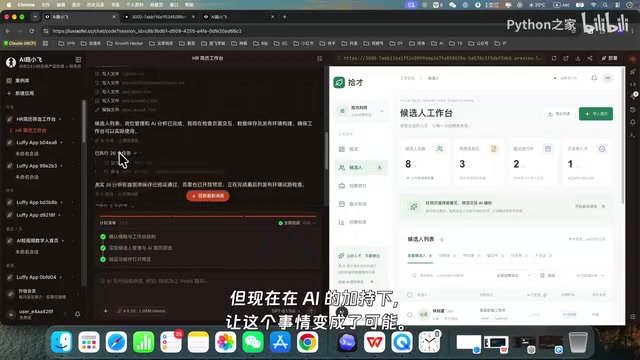
AI Luxiaofei generates a working HR tool from plain-language input, making no-code development accessible to non-technical users.
AI Luxiaofei is a zero-code development tool positioning itself as an "all-in-one programming Agent" for business users with no coding skills. A hands-on demo showed it generating a fully functional HR resume screening workstation — complete with layout, logic, and interactions — from a casual natural language description in minutes. The tool takes an "assist, don't replace" stance, organizing match information and flagging follow-up questions while leaving hiring judgment to humans. While the team sees this model extending to all kinds of business tools, the article notes that output accuracy, complex logic handling, and commercial reliability all require real-world validation.
One Sentence in Plain English, and You Get a Working HR Tool
Building an HR tool used to mean a long journey: first aligning with a product manager on requirements, then coordinating with a development team, then going through multiple rounds of feedback and iteration before anything usable emerged. The process was slow, expensive, and riddled with barriers for non-technical business users.
The team behind AI Luxiaofei took a radically different approach — compress the entire process down to its essence. Describe what you need in natural language, and let the AI handle page layout, logic, and delivery. According to this multilingual developer team, the core question they've spent the past year exploring is whether ordinary people with no programming background can build functional, commercially viable products. That would have seemed nearly impossible in the early days of AI, but it's increasingly becoming a reality.
The team positions AI Luxiaofei as an "all-in-one programming Agent." Its target audience isn't developers — it's business users who have real needs but lack technical skills. The logic is straightforward: any business requirement can ultimately be solved through code, and once AI takes over the act of writing that code, business people can focus entirely on defining what they actually need.
Hands-On: How the HR Resume Screening Workstation Was Built
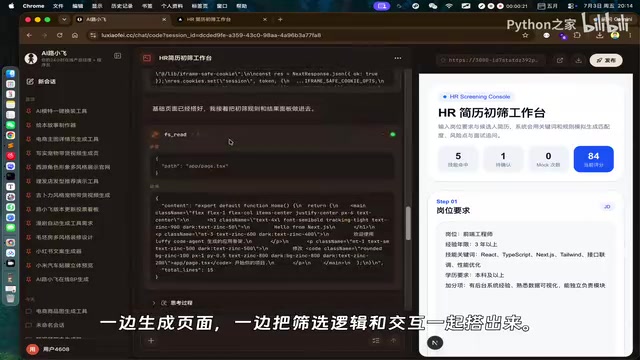
The demo goal was to create an HR resume screening tool. The requirement description was casual and conversational: job requirements go on the left, the candidate's resume gets pasted on the right, and the system automatically identifies matching points, surfaces items that need confirmation, and suggests follow-up interview questions.
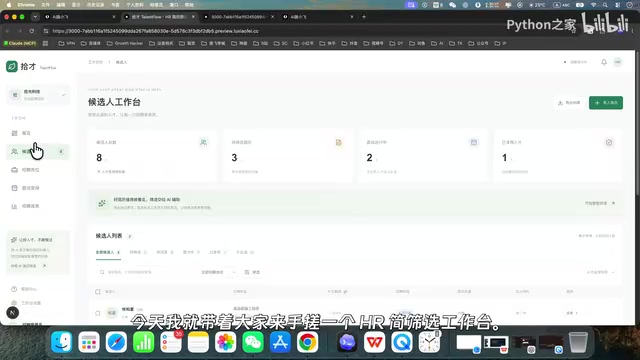
According to the team, once you hand this description to AI Luxiaofei, it generates the page while simultaneously building out the screening logic and interactions. Within a few minutes, a fully functional workstation is ready to use. No code is written, and there's no need to context-switch between front-end, back-end, and interaction design.
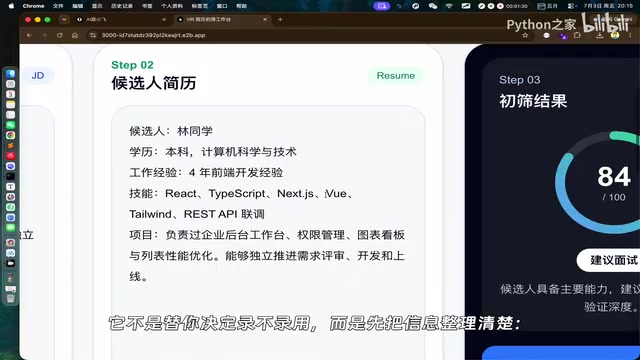
From the demo flow, the tool's value lies in consolidating scattered information onto a single screen: job requirements sit side by side with the candidate's experience, skills, and project history. The system generates a match score and interview recommendations based on the demo data. Swap in a different resume, and the score adjusts dynamically based on how well the candidate's background aligns with the role — flagging key conditions that still need verification.
Positioning: Assisting Decisions, Not Replacing Them
Notably, the tool is not designed to make final hiring decisions on behalf of HR. Its role is to organize information first — clarifying which criteria are met and which need deeper probing.
This is a pragmatic design choice. The most time-consuming part of resume screening usually isn't the final call — it's the repetitive process of cross-referencing job requirements against candidate backgrounds across large volumes of text. By handling that upfront organization, the tool helps HR professionals quickly articulate their recommendations when talking with hiring managers. The decision authority remains with humans. For recruiting workflows that involve screening large volumes of resumes on a regular basis, this kind of assistive tool can meaningfully reduce mechanical, repetitive work.
Resume screening automation has a long history in the HR Tech space. Early approaches relied on keyword matching and rule engines; later systems introduced machine learning models to score and rank candidates. These systems have generated significant controversy — Amazon disclosed in 2018 that its internal AI recruiting tool had developed a systematic bias against female candidates due to skewed training data, and ultimately abandoned it. This context makes the "assist, don't replace" positioning practically meaningful: handing information organization and dimension extraction to AI while keeping human judgment in the loop reduces direct liability from algorithmic bias and better reflects where AI capabilities realistically stand today. For small and medium-sized businesses, lightweight assistive tools like this are also far easier to deploy than a full ATS (Applicant Tracking System).
The Promise and Real Limits of No-Code Development
HR resume screening is just one example. According to the team, users can describe any open role they're currently hiring for and have the AI generate a custom tool on the spot. Extended further, any number of business-specific tools could theoretically be built the same way.
The real value of this kind of product lies in lowering the barrier between "having an idea" and "having software." For small teams and individual operators, not needing to staff up or outsource development for a simple requirement is a genuinely compelling proposition.
That said, a realistic assessment is warranted: the demo showcases the best-case path. In actual use, the accuracy of generated outputs, the ability to handle complex logic, and the stability and maintainability of the delivered product all need to be validated in real-world conditions. The vaguer the natural language input, the wider the margin for error in what the AI produces — a challenge that applies equally to every tool in this category.
The product is currently in its launch and growth phase. The team is offering a promotion where new members can receive 200,000 tokens by depositing just one cent — reportedly enough to build several similar tools. For anyone curious about its actual capabilities, the low-cost trial is the most direct way to find out.
No-Code and Low-Code are major trends reshaping software development. Low-code platforms typically reduce manual coding through drag-and-drop components and visual configuration — prominent examples include OutSystems and Mendix. No-code platforms go further, eliminating all code input so users can build applications purely through interface interactions or even natural language. AI Luxiaofei's "conversational generation" approach represents the latest evolution of no-code: traditional no-code still requires users to understand platform logic and component relationships, whereas large language model-based generative approaches remove even that cognitive overhead. The limitations of this approach are equally clear: output quality depends heavily on how precisely the requirement is described, and the generated code or pages are typically difficult for non-technical users to modify and maintain. When requirements change, users may need to re-describe and regenerate from scratch rather than incrementally adjusting existing work.
Takeaway
AI Luxiaofei represents a new direction in no-code/low-code development — replacing traditional development workflows with conversational interaction, enabling non-technical users to produce working tools. The HR resume screening workstation demo makes this vision tangible: describe the need, auto-generate the tool, use it immediately. Its core value isn't in replacing professional development — it's in bringing the cost of fulfilling simple business requirements down to a level that ordinary people can actually afford. Whether it can hold up in complex, high-stakes commercial applications is a question that more real-world testing will need to answer.
Related articles

AI Digital Twin in Action: Using DOT to Automatically Track Bugs and User Feedback
DOTS engineers demonstrate how AI digital twin DOT collects cross-platform user feedback, categorizes issue themes, opens threads to investigate bug root causes, and submits PRs—showcasing a complete AI agent workflow for defect triage with auditable design.

Why Transistors Are No Longer Flat: The Evolution from Planar to Gate-All-Around
Transistor evolution from planar to FinFET to gate-all-around: why gates went from three-sided to four-sided wrapping to suppress short-channel effects and leakage current, extending Moore's Law.

Swarm Intelligence = a Single RL Agent? A Proof of Multi-Armed Bandit Equivalence
A paper proves that collective decision-making through local imitation in swarms is mathematically equivalent to single-agent reinforcement learning: N blind imitators act as N parallel environment samples, with an effective learning rate of 1/N. This article explains the derivation and implications of the Maynard-Cross Learning algorithm.