Building Enterprise-Grade AI Agents from Scratch: A Three-Stage Learning Path from Bilibili's Comprehensive Tutorial

Bilibili's 748-episode AI Agent course bridges the tutorial gap through three stages: cognition, advanced, and hands-on.
The article introduces a Bilibili AI Agent course advertised as 748 episodes. The creator believes over 90% of related tutorials share common flaws: either they pile up buzzwords like autonomous planning and tool calling without getting hands-on, or they dump code directly and skip problem definition. The course progresses through three sections: cognition uses everyday analogies to explain the essential difference between Agents and LLM conversations and runs the first demo; advanced covers LangChain, AutoGen framework practice, multi-Agent collaboration, Function Calling, and hybrid architectures, and puts evaluation/debugging and security boundaries earlier; hands-on provides three enterprise-grade scenarios: intelligent customer service ticket routing, Excel automated data analysis, and a multi-Agent collaboration production line. The course includes source code, courseware, Prompt templates, and a learning roadmap. The article also notes that the 748-episode volume should be viewed rationally, promotional phrases are the creator's self-descriptions, and it's advisable to first run through the cognition section demo before deciding whether to continue.
A series of AI Agent courses on Bilibili, advertised as "748 episodes," has drawn attention. The creator claims to have scoured nearly all Agent-related content on Bilibili and YouTube, finding that over 90% of tutorials share common flaws: either they pile up buzzwords like "autonomous planning" and "tool calling" without getting hands-on, or they dump code directly and skip problem definition. This course attempts to bridge that gap with a "first understand how Agents think, then start building" approach, progressing through three sections—cognition, advanced, and hands-on—and includes source code, courseware, Prompt templates, and a learning roadmap.
Cognition Section: First Clarify the Essential Difference Between Agents and LLM Conversations
The course doesn't rush into coding at the start; instead, it builds foundational understanding. There's only one core question: what exactly is the difference between an Agent and an LLM conversation? The creator uses everyday analogies to break down concepts like the ReAct framework, planning and reasoning, and memory mechanisms, aiming to make zero-basis learners "get it instantly," then run their first Agent demo to personally experience what it's like for an agent to do work.
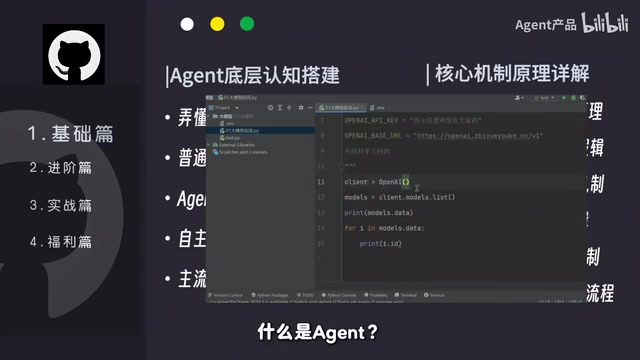
This design targets a structural flaw in current Agent tutorials. Most content treats "planning" and "memory" as established terms used directly; learners can repeat the nouns but can't explain why an Agent needs these components. Establishing the "why" before moving to the "how" is a more reasonable sequence for beginners and gives subsequent framework learning a foundation.
ReAct (Reasoning and Acting) is one of the most fundamental paradigms in the Agent field, proposed by Shunyu Yao et al. in 2022. Its core idea is to have the LLM alternate between "reasoning" and "acting": the model first outputs a thought (Thought) to judge what should be done; then executes an action (Action), such as calling a search tool or calculator; then observes the result returned by the action (Observation), and continues the next round of thinking based on it. This loop continues until the task is complete. Unlike ordinary conversation that generates an answer in one shot, ReAct gives the model the ability to "think while doing and adjust based on feedback," which is also the key to an Agent's ability to handle multi-step complex tasks. Understanding this loop helps clarify why an Agent needs components like planning, tool calling, and memory to work together.
Advanced Section: Framework Practice and Security Boundaries
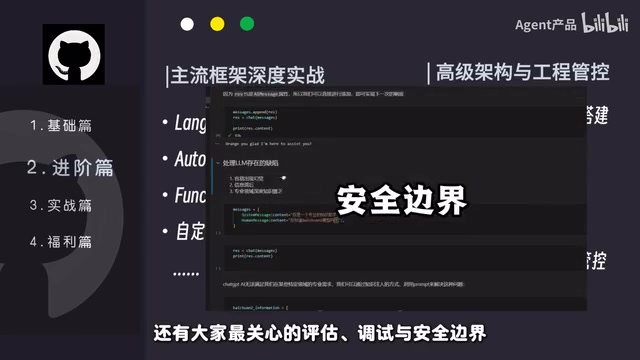
The advanced section moves into engineering, covering LangChain and AutoGen framework practice, multi-Agent collaboration, Function Calling tool invocation, and hybrid architectures of Regi plus Agent. You may not have noticed that the course lists evaluation and debugging and security boundaries separately, rather than only covering building.
From an engineering practice perspective, an Agent's controllability is often harder to handle than feature richness—tool calling errors, overlapping responsibilities among multiple Agents, and unpredictable outputs are all high-frequency problems in the implementation phase. Putting evaluation and debugging earlier in the advanced stage, with code courseware for each lesson, shows the course attempts to establish engineering discipline before learners enter enterprise projects, rather than just getting things running first.
Function Calling is the standard mechanism for LLMs to interface with external tools. Developers pre-describe a set of available functions to the model (name, purpose, parameter structure); the model determines during conversation whether a function needs to be called and outputs the call intent and parameters in a structured format (usually JSON); the application executes the function and passes the result back to the model, which then generates the final reply. It decouples "the model decides what to do" from "the program actually executes," and is the underlying channel for Agents to call search, databases, and business APIs. The tool-calling capabilities of frameworks like LangChain and AutoGen are mostly built on this mechanism, so understanding the request-response flow of Function Calling is a prerequisite for understanding framework encapsulation and troubleshooting tool-calling errors.
Hands-on Section: Three Enterprise-Grade Implementation Scenarios
The hands-on section provides three projects that map directly to business needs: an intelligent customer service Agent system, from intent recognition to automatic ticket routing; an automated data analysis Agent that uploads Excel files and automatically generates reports and charts; and a multi-Agent collaboration production line that lets multiple agents divide work like a team.
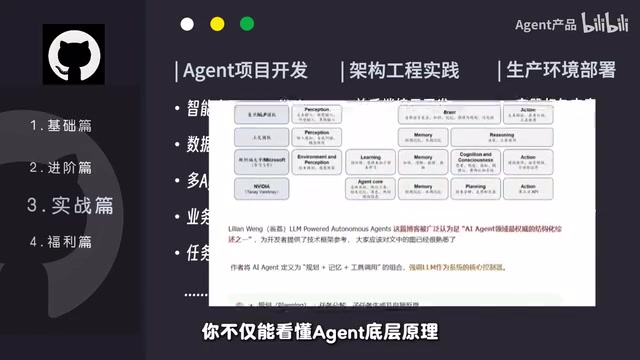
What the three scenarios share is defining Agent capabilities in reverse from business problems, rather than looking for scenarios based on framework capabilities. The course's goal statement also focuses on "independently designing and developing agent applications that solve real business problems," rather than stopping at reproducing demos. For job seekers, this kind of complete project chain is more persuasive than scattered API call examples, which is also the realistic basis for the promotional phrase "job-ready upon completion."
Multi-Agent collaboration refers to having multiple agents, each with specific roles or responsibilities, work together to complete a task. Common patterns include: pipeline-style division of labor (e.g., one Agent handles retrieval, one handles analysis, one handles writing), a manager-executor structure (a coordinating Agent breaks down tasks and assigns them to executor Agents), and debate-style collaboration (multiple Agents review each other's outputs to improve quality). Compared with a single Agent, multi-Agent can split complex responsibilities and process subtasks in parallel, but it also brings new problems: overlapping responsibility boundaries, rising message-passing costs, and errors accumulating and amplifying through the chain. Frameworks like AutoGen provide conversation orchestration and message routing support for this kind of collaboration, which is also why the course emphasizes evaluation and debugging in the advanced section.
Accompanying Resources and Selection Advice
The creator's welcome gift includes all source code and courseware, Prompt templates, and an AI Agent developer learning roadmap. For learners who want a systematic introduction, the value of such packaged resources lies in reducing the overhead of environment setup and material filtering.
What needs to be viewed rationally is that the 748-episode volume means completing it requires considerable time investment. Promotional phrases like "avoid 99% of detours" and "the most thorough on the internet" are the creator's self-descriptions; actual results depend on content density and personal foundation. It's advisable to run through the demo in the cognition section first before deciding whether to follow the subsequent sections, avoiding the cycle of "bookmarking equals learning."
One-line Summary
Bilibili's 748-episode AI Agent course bridges the tutorial gap through three stages: cognition, advanced, and hands-on.
Paragraph Summary
The article introduces a Bilibili AI Agent course advertised as 748 episodes. The creator believes over 90% of related tutorials share common flaws: either they pile up buzzwords like autonomous planning and tool calling without getting hands-on, or they dump code directly and skip problem definition. The course progresses through three sections: the cognition section uses everyday analogies to explain the essential difference between Agents and LLM conversations and runs the first demo; the advanced section covers LangChain and AutoGen framework practice, multi-Agent collaboration, Function Calling, and hybrid architectures, and puts evaluation/debugging and security boundaries earlier; the hands-on section provides three enterprise-grade scenarios: intelligent customer service ticket routing, Excel automated data analysis, and a multi-Agent collaboration production line. The course includes source code, courseware, Prompt templates, and a learning roadmap. The article also notes that the 748-episode volume should be viewed rationally, promotional phrases are the creator's self-descriptions, and it's advisable to first run through the cognition section demo before deciding whether to continue.
Related articles

The Truth Behind Titanic's Sinking: Key Decisions and Communication Failures in the National Geographic Documentary
National Geographic's The Unsinkable Ship uses survivor testimony to reconstruct Titanic's fatal decisions—from the missing MSG telegram prefix and the broken boiler-room-to-bridge link to how 'unsinkable' thinking delayed damage control and evacuation.

74M-Parameter Open-Source Model Partially Outperforms Jev AI in Testing
Fastino AI's Glider 2.5 models, with just 74M–300M parameters, reportedly outperform Jev AI in some guardrail benchmarks per YouTube testing, run on consumer hardware, and even play Doom. We analyze small models' competitiveness and deployment value on specific tasks.

Gemini 4 Argon Hands-On: Aggressive Pricing, 3D Capabilities Need Coaching
Gemini 4 Argon hands-on: limited-time $2/$10 pricing, million-token output, strong 3D and reverse-engineering work, but weak front-end aesthetics and zero-shot ability need coaching.