Building Personal Automation Tools with Claude Code: Real-World Cases That Save Time and Stress

Ordinary users automate parenting chaos and business proposals with Claude Code, cutting friction costs and reclaiming time.
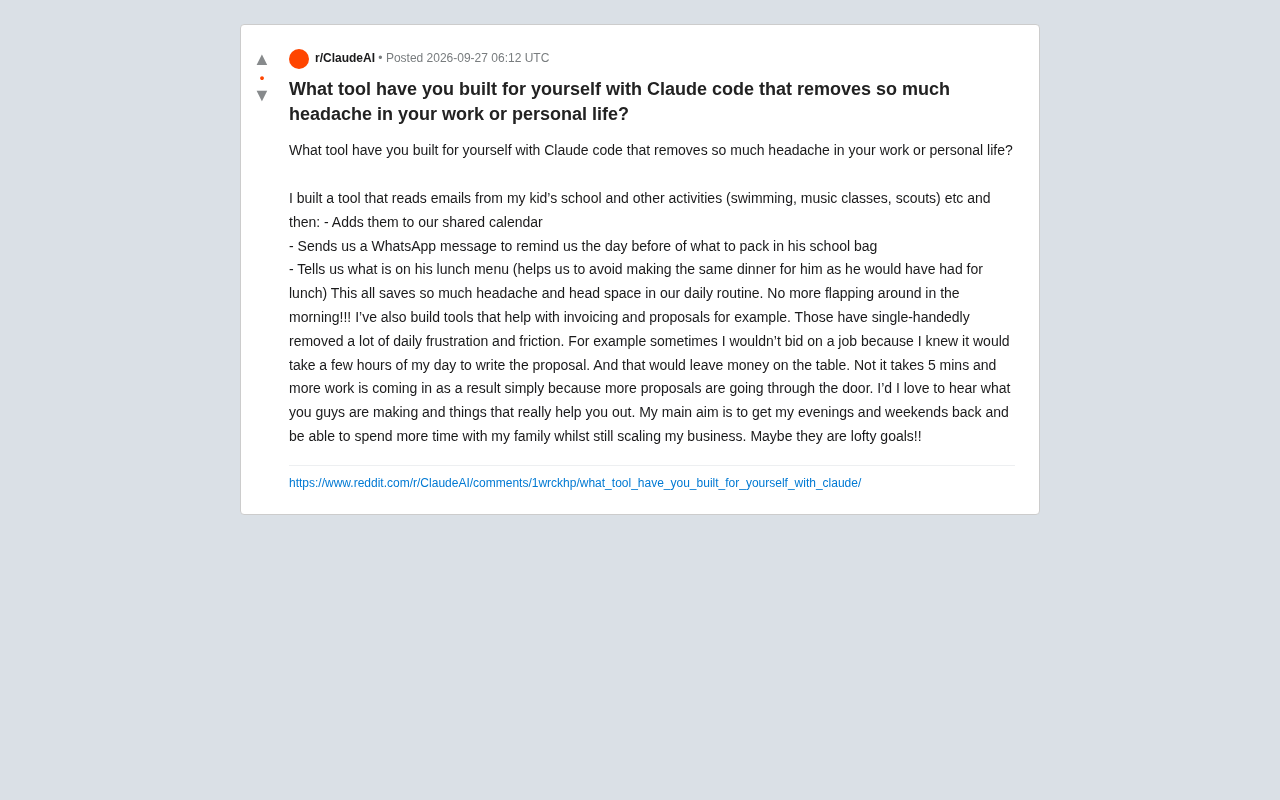
A Reddit user shared personal automation tools he built with Claude Code: a system that parses school emails, syncs family calendars, sends WhatsApp bag-packing reminders, and avoids dinner-lunch menu overlap — plus a tool that cut proposal writing from hours to 5 minutes, directly generating more business. The deeper insight is that automation's real value isn't just saving time, but eliminating "friction costs" that stop people from acting on high-value opportunities in the first place.
When AI Coding Tools Enter Everyday Life
When most people think of AI coding assistants, they picture tools that help developers write code or fix bugs. But a widely discussed Reddit post reminds us that tools like Claude Code offer far more than that — they're becoming a powerful way for ordinary people to automate the tedious parts of daily life.
The poster asked a question that struck a nerve: "What tools have you built with Claude Code that have genuinely reduced your workload or made life easier?" The examples he shared reveal the enormous potential of personal automation.
Claude Code is a terminal-based AI coding assistant developed by Anthropic. Users can describe tasks in natural language on the command line, and Claude will directly read and write files, execute commands, call APIs, and complete entire programming workflows. Unlike traditional IDE plugins that suggest code completions, it functions more like an autonomous agent capable of completing tasks end-to-end: you tell it "write me a script that parses school notification emails from Gmail each morning and adds them to Google Calendar," and it will break down the steps, generate the code, debug, and run it until everything works. This makes it accessible to non-professional programmers — users don't need to review every line of code logic, only verify that the final output meets their expectations.
Family Schedule Automation: Turning Parenting Chaos into Order
The poster's most representative project was a tool for handling emails from his kids' school and extracurricular activities. With children involved in swimming, music lessons, Scouts, and more, notification emails piled up constantly and were easy to miss. The tool he built with Claude Code automatically does three things:
- Reads email content and adds activities to a shared family calendar
- Sends a WhatsApp reminder the day before, letting the family know what to pack in the school bag
- Parses the school lunch menu to avoid serving the same food for dinner that the kids already had at lunch
This workflow might seem trivial, but it precisely targets the moments where parenting households are most prone to chaos. As he put it, "No more frantic scrambling in the mornings." The core value of this kind of tool isn't its technical sophistication — it's that it consolidates information scattered across multiple channels, which would otherwise require constant manual checking, into proactive push reminders that free up mental bandwidth.
Business Applications: How Automation Directly Generates Income
Beyond household management, the poster also built tools for invoicing and writing business proposals — with even more tangible results. These tools brought in real, measurable income growth.
He admitted that in the past, he would skip bidding on certain projects simply because writing a proposal took hours. That meant leaving potential business on the table. Now, with his automation tool, a proposal takes just 5 minutes. The result: more proposals submitted, more work coming in.
"Sometimes I wouldn't bid on a job because I knew writing the proposal would eat up half my day — that's just leaving money on the table. Now it takes 5 minutes, and more work keeps rolling in because of it."
This example highlights an underappreciated dimension of personal automation: it's not just about "saving time" — it's about eliminating the friction costs that prevent you from acting in the first place. When the barrier to completing something drops from "a few hours" to "a few minutes," you start doing the things you previously abandoned as too much trouble — and those are often the things with real value.
Behavioral economics has a concept called Friction Cost — the extra effort required to complete an action, including time, energy, and attention. Even when an action has a positive expected return, high friction costs cause people to opt out. Economists call this "efficiency loss due to friction." The poster's decision to skip bids because writing proposals was too time-consuming is a textbook example of friction cost blocking value creation. By compressing that friction from "hours" to "5 minutes," the automation tool fundamentally changed the cost-benefit calculation and unlocked action that had previously been shelved. This mechanism — lower barrier → activated behavior → accumulated returns — explains the deeper value of personal automation far better than "saving time" alone.
From Tool to Lifestyle Shift
The poster's goal is simple and deeply relatable: "Get my evenings and weekends back, grow my business, and still have more time for my family." He half-jokingly wondered if that was too idealistic a target.
But looking at his actual practice, it's far from wishful thinking. The real meaning of personal automation is handing repetitive, mechanical cognitive labor off to machines so people can focus their energy on what truly matters. A few key principles stand out from his approach:
Start from Real Pain Points
Every tool he built addresses a specific, recurring frustration — the morning rush, repetitive dinners, time-consuming proposals. None of it is about showing off technical skills; it's all about solving genuine problems. This is both the easiest path to personal automation success and the one most likely to yield immediate results.
Break Down Information Silos
Whether it's converting emails into calendar events and WhatsApp reminders, or using lunch menu data to inform dinner decisions, these tools share a common thread: cross-system information integration. Modern life scatters information across email, calendars, chat apps, and countless other platforms. AI-assisted coding is uniquely well-suited to connecting these isolated islands.
Information Silo refers to a state where data cannot flow between different systems or platforms. People's daily information is typically spread across Gmail, Google Calendar, WhatsApp, school apps, and more — none of which communicate with each other. Every time you need to synthesize this information to make a decision, you're manually switching between multiple interfaces and piecing things together, which creates invisible cognitive load. Bridging these silos technically requires calling each platform's API (Application Programming Interface). In the past, calling multiple APIs and writing integration logic demanded considerable development experience. AI coding assistants have dramatically lowered that barrier — the workflow of "describe what you need → generate integration code → debug and run" is now accessible to non-developers, enabling anyone to build their own information pipeline.
The Compounding Effect
The proposal tool example shows that the returns from automation accumulate over time. Time saved can be reinvested into taking on more business or spending more time with family, creating a positive feedback loop.
AI Automation That Anyone Can Try
What's most encouraging about this discussion is that it lowers the psychological barrier to "automation." You don't need to be a senior engineer. With AI coding assistants like Claude Code, you can describe what you need in plain language and build small tools that solve real problems.
From parsing emails and managing calendars to generating business documents, automating these kinds of scenarios is increasingly within reach. The real challenge may no longer be technical — it's identifying the repetitive, energy-draining parts of your own life and then actually doing something about them.
As the poster noted at the end, he's also curious to hear what others have built. Real user stories like these ultimately say more about the value of AI tools than any product pitch ever could.
Related articles

Free Unlimited Claude Code Solution: Agnes AI + CC Switch Setup Guide
No paid subscription needed — pair the free AI platform Agnes AI with the open-source tool CC Switch to provide a backend for Claude Code, enabling unlimited free calls to text, image, and video models. This guide covers the full setup, test results, and usage boundaries.

A Complete Zero-Cost Guide to Getting Started with Claude Code for Beginners in China
A beginner's guide to Claude Code for users in China: two installation methods (command line and IDE plugin), full configuration steps for replacing the official API with the free domestic LongCat model, and a hands-on demo of building a small tool with natural language, plus tips.

When the NSA Gets Involved: The AI Supply Chain Crisis Behind Open-Source CVEs and API Key Hijacking
Multiple open-source projects disclosed severe CVEs in one day, PHP flaws alarmed the FBI, and Railway and OpenCode were breached with API keys stolen. This article breaks down the vulnerability window, AI-accelerated exploitation, and the AI supply chain crisis behind the API key black market, with a developer defense checklist.