Building the Perfect Lead Engine with n8n: AI Lead Scoring and Automation in Practice

A seven-step n8n lead engine using AI scoring with rules-based fallback and automation up to human approval.
The article breaks down an n8n demo workflow published by The Curious Loop, showing how a lead engine should work. The core problem is that leads go cold too fast and are hard to distinguish from spam. The flow has seven steps: unified Webhook intake, normalization and validation, AI scoring (with rules-based fallback), Switch routing into Hot/Warm/Cold/Invalid, building a structured data package ready for any CRM, generating tiered follow-up suggestions, and finally sending only after human approval. The author distills three transferable principles: handle dirty data at the entrance rather than patching it at the exit, AI must have a degraded path, and automation should stop at approval. Breaking the abstract "lead engine" into seven independently verifiable steps is a pragmatic starting point for small teams entering sales automation.
The speed at which leads are lost determines why automation must exist
A new lead comes in. Dana runs a dental clinic and wants to ask about dental implants. Within seconds, an n8n workflow completes cleaning, validation, intent scoring, prioritization, and prepares the next action—all without anyone touching a keyboard.
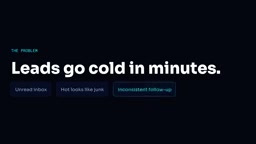
This is a demo workflow published by The Curious Loop on YouTube, used to show how a lead engine should operate. It solves a very simple but painful problem: leads go cold too fast. If a message goes unseen for an hour, interest fades; and when hundreds or thousands of messages pour into the same inbox, genuinely high-value leads look exactly like spam.
The author's goal is clear: every lead is processed in a completely consistent way, and the best one automatically rises to the top.
Seven-step breakdown: the complete skeleton of a lead engine
Step 1: Trigger—funnel every entry point into one place
The workflow starts with a Webhook node. A web form or external system pushes raw data over: name, email, phone, message, source.
The key point is that the author deliberately emphasizes that this data is dirty—extra spaces, inconsistent capitalization, missing fields. That is the norm in real scenarios. A good workflow does not assume the data is clean; it treats cleaning as a required stage.
A Webhook is an event-driven reverse API call mechanism: rather than having this system actively poll an external service, the external system pushes an HTTP POST request to a preconfigured URL when an event occurs. In this workflow, whether it is a web form, ad platform, chat tool, or third-party system, as long as it POSTs lead data to that Webhook address, n8n immediately wakes up the workflow and starts execution. Compared with scheduled polling, Webhook latency is usually only a few hundred milliseconds, which is exactly the response speed needed for the problem of "leads go cold too fast." The tradeoff is that the URL must be public and accessible, so it usually needs to be paired with signature verification, a secret key, or an IP allowlist to prevent forged requests; otherwise anyone can dump spam data into your lead engine.
Step 2: Normalization and validation—block dirty data before scoring
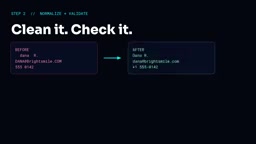
Here a Set node plus a Code node are used: trim spaces, convert emails to lowercase, format phone numbers. Then comes validation: is the email format correct? Is the message empty?
Leads that fail validation are immediately marked invalid and never enter the scoring step. The value of this step is often underestimated—what it protects is not this workflow, but the downstream CRM. Once dirty data gets mixed into the customer database, subsequent reporting, follow-up, and automation all become distorted.
Step 3: AI scoring—let the model give a score from 0 to 100
The cleaned lead is sent to a language model with an explicit prompt, and the model returns a score from 0 to 100 plus a short reason.
Because the dental lead Dana asks about implants and proactively mentions budget, she receives 86 points and lands directly in high priority.
But here the author adds a design that many demo workflows overlook: a fallback mechanism. The AI call may time out, or it may return unparsable content. When that happens, a rules-based scoring system immediately takes over—keyword matching, budget mentions, urgency—and can still calculate a usable score.
This idea is worth expanding on. If you put AI on the critical path, you must assume it will fail. The advantage of tools like n8n is precisely that AI nodes and rule nodes can be freely combined, so that "intelligence" and "determinism" back each other up, and the workflow never gets stuck.
The "prompt" here refers to a piece of instruction text sent to a language model, used to constrain its task, output format, and evaluation criteria. In production workflows, a scoring prompt usually spells out three things: role (you are a sales lead evaluator), dimensions (purchase intent, budget clarity, urgency, information completeness), and output structure (for example, return JSON containing score and reason fields). Constraining the output structure is especially critical, because downstream nodes need to programmatically read the score and make interval-based decisions; if the model improvises and writes a prose paragraph, parsing will fail. This is also why the author designs a fallback mechanism—the model may time out, be rate-limited, or return text that cannot be parsed as JSON, and any one of these failures can halt the entire pipeline. Writing prompts with "parsability first" rather than "literary flair first" is the dividing line for whether AI scoring can be implemented reliably.
Step 4: Routing—use a Switch node to split into four lanes
After scoring, the Switch node routes leads by score range:
- Hot: high intent, act immediately
- Warm: interested, follow up the same day
- Cold: low intent, nurture slowly
- Invalid: data problem, log it and set it aside
Dana enters the Hot lane. The essence of routing is to bind "handling method" to "lead quality"—leads of different quality should not consume the same human resources.
The Switch node is a conditional branching component in n8n; it receives an input value and directs it to one of multiple output ports according to preset rules. Unlike the IF node, which only supports true and false paths, Switch can be configured with any number of branches, making it well suited to mapping a continuous score into discrete customer tiers. The implementation usually assigns a numeric range to each branch: a score of 86 falls into Hot, 60 to 85 falls into Warm, below 60 falls into Cold, and records that fail validation are tagged invalid and sent down a separate path. This mapping from "score range to handling strategy" essentially moves operational rules out of people's heads and into workflow configuration, making each lead's destination reproducible and auditable. When the business side wants to adjust thresholds, they only need to change one number rather than retrain the entire sales team.
Step 5: Build a CRM-ready data package
This step packs clean name, standardized contact information, score, category, scoring reason, source, ID, and timestamp into a structured JSON object.
It can be pushed directly to any CRM, spreadsheet, or database through an API. The point of structure is portability: if you switch CRMs, the main workflow does not need to be rewritten.
Step 6: Generate follow-up recommendations
Based on the category, the workflow drafts recommended next actions:
- Hot leads: human reply within one hour, with a short draft mentioning dental implants
- Warm leads: a friendly email sequence
- Cold leads: one newsletter email per month
Note the wording here is "recommendation," not "execution." This leads directly to the final step.
Step 7: Human approval—the most important part of the entire design
The workflow does not send anything on its own. It pushes the draft to you, with two options: approve and edit.
AI prepares the work; humans make the decision. The author explicitly states that this is the part he values most in the entire process. This judgment is very pragmatic: in highly sensitive scenarios such as customer communication, the risk of fully automatic sending far outweighs the small amount of time saved. Keeping one approval gate preserves AI efficiency while also protecting the safety boundary of the brand and relationships.
Human-in-the-loop refers to explicitly setting a human confirmation node in an automated process, causing the system to pause and wait for human judgment before continuing. In n8n, this can be implemented through wait nodes, approval forms, or integration with channels such as Slack or email: after the workflow generates a draft, it suspends, pushes the content to the responsible person, and the person chooses to approve or edit; only then is workflow execution resumed. The value of this pattern is that it separates the benefits and risks of automation—high-frequency, low-risk stages such as cleaning, scoring, and drafting are fully automated, while irreversible, highly sensitive actions such as outbound sending retain a human gate. It also naturally creates an audit trail: who approved which message and when is all recorded and searchable. For regulated industries such as healthcare and finance, this traceability is often not optional but a compliance requirement.
Three design principles from this workflow truly worth learning from
After the full breakdown, setting aside the specific node configuration, there are three principles that can be transferred to almost any lead automation project:
First, handle dirty data at the entrance, not as a remedy at the exit. Validate up front and mark failures immediately, so data quality issues are isolated before entering the CRM.
Second, AI must have a degraded path. When the language model times out or returns anomalies, rule-based scoring takes over. This is not overengineering, but a basic requirement for using AI in production.
Third, automate up to approval, and no further. Let machines do what they are good at—cleaning, scoring, drafting; let people do what only people can do—judgment and sending. Where to draw this boundary depends on the business's risk tolerance, but not setting any boundary at all is usually not a good choice.
At the end of the video, the author mentions that he takes on custom automation projects covering n8n, Python, APIs, and AI automation. The value of this demo workflow itself is that it breaks an abstract concept—the "lead engine"—into seven steps that can each be verified independently, and each step can be replaced, extended, or deployed separately.
For small teams considering adding automation to their sales process, this is a good starting point: begin with triggering and validation, get the data flow working, and then gradually connect AI scoring and routing.
One-line Summary
A seven-step n8n lead engine that uses AI scoring with rules-based fallback, automating only up to human approval.
Paragraph Summary
The article breaks down an n8n demo workflow published by The Curious Loop to show how a lead engine should operate. The core problem is that leads go cold too quickly and are hard to distinguish from spam. The process has seven steps: Webhook intake, normalization and validation, AI scoring (with rules-based fallback), Switch routing into Hot/Warm/Cold/Invalid, building a structured data package that can be pushed to any CRM, generating tiered follow-up recommendations, and finally sending only after human approval. From this, the author distills three transferable principles: handle dirty data at the entrance rather than patching it at the exit, AI must have a degraded path, and automation should stop at approval. The article emphasizes that breaking the abstract "lead engine" into seven independently verifiable steps is a pragmatic starting point for small teams entering sales automation.
Related articles

The Chaotic Aesthetics of Apple's HomeView Ad: A Marketing Code Only Parents Can Read
Apple's HomeView smart display ad ditches minimalist style for chaotic family mornings to win over parents. We analyze why it confuses most viewers but resonates instantly with families — and the trade-offs and risks of Apple's targeted marketing.

Cerebras CEO Pushes Back on AI Doomerism: Stop Spreading Panic
Cerebras CEO Andrew Feldman publicly pushes back on AI doomerism at TechCrunch Disrupt, arguing excessive risk focus drowns out AI's real opportunities.

Retooling in Minutes: Industrial Next Redefines Factory Robot Flexibility
Industrial Next aims to let factory robots retool in minutes instead of weeks, automating complex delicate tasks and advancing flexible manufacturing and small-batch production.