Bump: The AI Collections Engine That Automatically Recovers Overdue Payments

Bump automates accounts receivable collections via AI across email and WhatsApp, turning overdue invoices into recovered payments.
Bump is an AI agent product targeting accounts receivable collections for SMBs. Its core value prop is automating the entire collections workflow across email and WhatsApp — from sending overdue reminders and reading customer replies, to logging payment promises and autonomously escalating when customers go silent or default. By prioritizing WhatsApp alongside email, Bump targets emerging markets where WhatsApp dominates business communication. At its core, it uses LLMs to automate the kind of nuanced collection conversations that previously required human judgment. The product is in early stages, and real-world effectiveness and compliance boundaries remain to be proven.
An AI Team Dedicated to Chasing Payments
Accounts receivable collection is a persistent pain point for many small and medium-sized businesses. When invoices go overdue, someone has to repeatedly follow up, send reminders, log customer payment promises, and decide when to escalate. The work is tedious and highly repetitive — yet it directly impacts a company's cash flow health.
Bump, which launched on Product Hunt, offers an automated solution. Its positioning is straightforward: "your AI collections team," covering both email and WhatsApp, with the goal of automating the entire journey of every overdue invoice from "unpaid" to "paid." As the team puts it, it's like "adding a collections team without actually hiring one."
What Bump Actually Does
Based on the official description, Bump is an AI collections engine for accounts receivable. Its core capabilities break down into several stages:
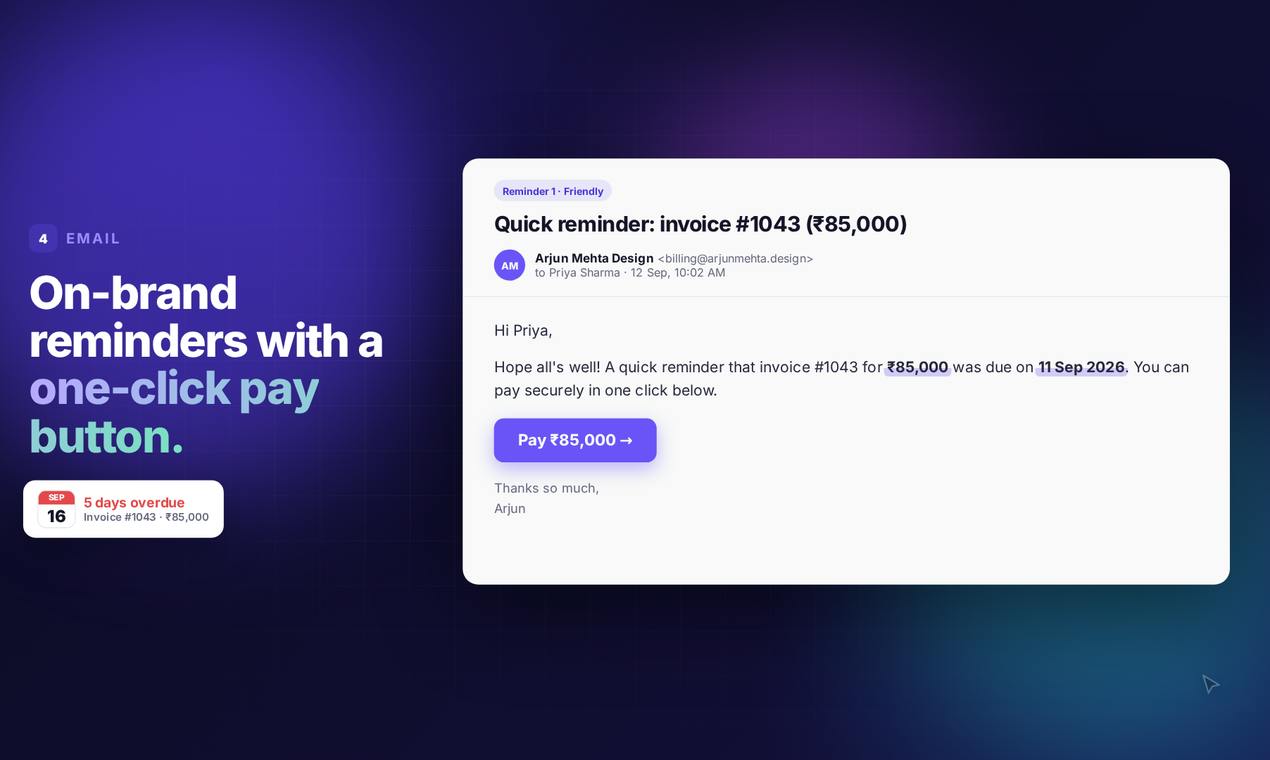
- Multi-channel outreach: Contacts overdue customers simultaneously via email and WhatsApp, reaching them through whichever channel they actually use — improving contact rates.
- Reading replies: Rather than just sending one-way reminders, Bump understands the content of customer responses and interprets their intent and attitude.
- Tracking promises and payment plans: When a customer replies with "I'll pay next Monday" or proposes an installment plan, Bump logs those commitments and schedules follow-ups accordingly.
- Autonomous escalation: When a customer goes silent or fails to pay as promised, the system can escalate its strategy on its own — no human monitoring required.
The value of this workflow is transforming collections from a labor-intensive process into a system-driven one. Under the traditional approach, finance staff or dedicated collectors maintain long overdue lists and manually call, email, and document each case. Bump attempts to chain all those actions into a single automated pipeline.
Why WhatsApp?
One notable design decision is treating WhatsApp as equally important as email. In many markets — particularly Latin America, India, Southeast Asia, and the Middle East — WhatsApp is the primary tool for day-to-day business communication, and reply rates are often far higher than email.
In a collections context, reachability is essentially equivalent to collection efficiency. A payment reminder email sitting unopened in an inbox is nearly worthless. By integrating WhatsApp into the automated collections workflow, Bump aligns more closely with the real communication habits of these markets, and differentiates itself from traditional accounts receivable tools that rely on email alone.
Positioning and Market Opportunity
Bump is categorized on Product Hunt under Productivity, Fintech, and Artificial Intelligence — a crossover that reflects its core thesis: using AI to solve a specific, high-frequency operational inefficiency in financial management.
Accounts receivable management is a mature and large-scale domain, historically handled by ERP modules, dedicated AR software, or outsourced collection agencies. What Bump aims to do is use large language models' comprehension and generation capabilities to automate tasks like "understanding customer replies and dynamically adjusting strategy" — tasks that previously required human judgment. This is the shared direction of the current wave of "AI Agent" products: no longer just question-and-answer chatbots, but end-to-end execution of tasks with concrete business value.
In terms of traction, the product currently has modest numbers on Product Hunt (10 upvotes, 5 comments, ranked 16th), indicating it's still in early-stage growth. Whether tools like this can truly prove themselves comes down to two things: first, the accuracy of AI judgment in real collections conversations — avoiding false steps that alienate good-faith customers or strike the wrong tone; and second, how well it integrates with existing financial systems and invoice data.
The core advantage of large language models (LLMs) in a collections context lies in natural language understanding and generation. Traditional rule-based engines can only send fixed reminders based on preset templates — they can't "read" the true intent behind a customer's reply. For example, they can't distinguish between "I'm short on cash this week, I can pay next Wednesday" and "We have a dispute about this invoice" — two situations that call for completely different responses. An LLM-based agent can parse unstructured natural language replies, extract key information (such as promised payment dates or the nature of a dispute), and dynamically select the next action — for instance, pausing collections and routing to a human, or automatically setting a review date based on the promised payment day. This "perceive–reason–act" loop is precisely what distinguishes current AI agents from traditional automation scripts, and it forms the technical foundation of what Bump claims to deliver.
A Few Observations
Bump represents a typical example of AI agents being deployed into vertical business workflows. Collections is unglamorous, high-stress work — highly standardized and emotionally taxing — which makes it exactly the kind of task that automated systems are most motivated to replace. If Bump can reliably recover payments while maintaining a professional tone, it will be genuinely attractive to cash-strapped small and mid-sized businesses.
That said, collections also touches on legal compliance, customer relationships, and the subtle calibration of communication tone — all areas where pure automation must tread carefully. The product's real-world effectiveness still needs validation from users across actual business contexts.
Compliance requirements in the collections space vary significantly across jurisdictions — a very real constraint that any AI automation system must confront. In the United States, for example, the Fair Debt Collection Practices Act (FDCPA) sets explicit limits on collection timing, frequency, and language, with violations potentially triggering lawsuits. The EU's GDPR imposes additional requirements on how debtor personal data can be processed through third-party platforms like WhatsApp. For enterprise customers operating in emerging markets like Latin America or Southeast Asia, local debt collection regulations are equally inconsistent. This means that for tools like Bump to achieve genuine commercial scale, they need to build configurable compliance rules into the system itself — rather than offloading compliance responsibility entirely onto the businesses that use them. This is an important moat that needs to be built beyond pure technical capability.
Related articles

Bilibili's Hit Dify Tutorial: A Practical Guide to Building 20+ AI Apps from Scratch
A distilled guide to Bilibili's top-rated Dify tutorial: Windows + Docker deployment, MySQL connection, five app types, model integration strategy, and publishing.

Agent Skills Beginner's Guide: From Concepts to Multi-Agent Collaboration in Practice
A comprehensive guide to Agent Skills: core concepts, components, the importance of Description, standardization, beginner learning paths, and multi-agent collaboration.

One Neuron Detects Both Cats and Cars? We Reproduced It and Found a New Explanation
The cat-car neuron reinterpreted: researcher Cammarata argues it distinguishes pointy from round, not cats from cars. We reproduced the experiment and found the new explanation holds on most inputs—but cars are the exception. The interpretability debate continues on language models.