Bun: The All-in-One High-Performance JS Toolkit — Runtime, Bundler, and Package Manager

Bun is an all-in-one JavaScript toolkit — runtime, bundler, test runner, and package manager in a single binary.
Bun unifies four JavaScript toolchain roles — runtime, bundler, test runner, and package manager — into a single executable. Built on the JavaScriptCore engine and written in Zig, it achieves extremely fast cold starts, native TypeScript/JSX support, and strong Node.js ecosystem compatibility, making it a compelling alternative for modern JS development.
One Tool, Four Roles
In the JavaScript ecosystem, developers have long grown accustomed to piecing together toolchains: Node.js as the runtime, Webpack or esbuild for bundling, Jest for testing, and npm or pnpm for dependency management. This fragmentation didn't happen by accident — since Node.js debuted in 2009, the community built its culture around the Unix philosophy of composing small, focused tools, gradually assembling the sprawling tooling matrix we know today: Webpack arrived in 2012 to solve module bundling, Babel in 2014 let developers use next-generation syntax today, and Jest — open-sourced by Facebook that same year — unified testing conventions. Each new layer patched the pain points of the one before it, but the accumulated configuration complexity, version conflicts, and performance overhead became pain points in their own right. Every layer carries its own config files, version constraints, and performance bottlenecks. Bun was created to break this fragmented reality.
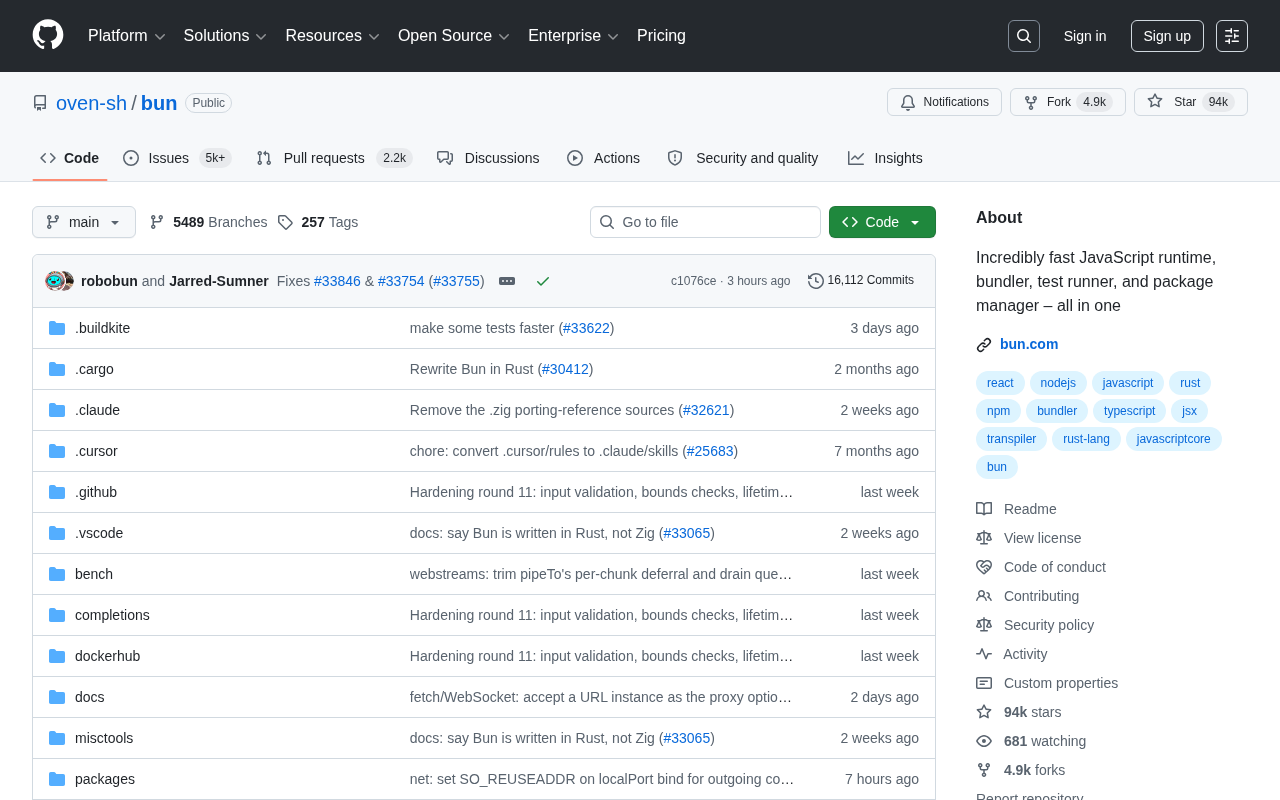
Bun merges a JavaScript runtime, bundler, test runner, and package manager into a single executable. Developers no longer need to juggle configurations across multiple tools — one CLI entry point handles the entire workflow from development to deployment. The project has accumulated nearly 94,000 GitHub Stars with steady daily growth, a clear signal that the community has broadly embraced this vision.
Why Bun Is So Fast
A Different Engine Under the Hood
Bun's most prominent label is "Incredibly fast." That speed stems from a fundamental architectural choice at the lowest level — unlike Node.js, which runs on Google's V8 engine, Bun is built on JavaScriptCore (JSC), the same JS engine that powers Safari.
JSC is Apple's JavaScript engine developed for the WebKit browser engine, originally shipped with Safari in 2002. Rather than V8's JIT compilation strategy, JSC uses a tiered compilation architecture (LLInt → Baseline JIT → DFG JIT → FTL JIT), forming an "on-demand warm-up" execution model: LLInt (Low Level Interpreter) handles cold-start interpretation with zero latency; Baseline JIT generates foundational machine code after a function has been called a few times; DFG (Data Flow Graph) JIT performs data-flow analysis on hot functions; and FTL (Faster Than Light) JIT invokes LLVM or the B3 backend to produce the most aggressively optimized code. This design means scripts don't need to wait for full compilation on their first execution — startup latency is extremely low, striking a balance between fast startup and peak throughput. This is especially beneficial for short-lived CLI processes. V8, by contrast, wins in long-running server-side scenarios through more aggressive optimization. Bun's choice of JSC over V8 is a deliberate engineering trade-off targeting startup-sensitive use cases like CLI tools and script execution, where its cold-start advantage is most pronounced.
Bun's core code is primarily written in Zig, a systems programming language created by Andrew Kelley in 2016 and positioned as a modern successor to C. Zig has no implicit memory allocation, no runtime exceptions, and no hidden control flow — the compiler produces highly predictable machine code. Zig's defining characteristic in systems programming is its "no hidden allocations" principle: every memory allocation must explicitly receive an Allocator, giving developers precise control over when and where each allocation occurs. This allows buffer reuse on I/O-intensive hot paths and reduces GC pressure. Zig also provides comptime (compile-time computation), enabling lookup table generation and loop unrolling at compile time, shifting runtime cost to build time. Zig can also seamlessly call C/C++ code, allowing Bun to integrate WebKit/JSC's C++ libraries directly without FFI overhead. Taken together, these features allow Bun to bypass V8's GC constraints, manage memory directly, and hand-optimize hot paths like file I/O and module resolution — delivering significant acceleration on file reads/writes and module parsing.
A Qualitative Leap in Package Installation Speed
The most immediately noticeable performance gain in Bun comes from its built-in package manager. In real-world testing, bun install is often several times — sometimes over ten times — faster than npm.
Traditional npm's slowness stems from three main stages: serial dependency resolution, per-package network requests, and the repeated I/O of writing to node_modules on every install. Bun's package manager uses a global content-addressable store: each package is stored in a global directory indexed by its content hash, and a project's node_modules points to cached files via hard links rather than copying the files themselves — hard links share the same inode at the filesystem level, occupy no additional disk space, and are created almost instantaneously. This approach is conceptually similar to pnpm, but Bun rewrites the entire pipeline in Zig, eliminating the startup and parsing overhead of the Node.js process itself. Bun also implements highly concurrent DNS resolution and HTTP connection reuse at the Zig level. Dependency metadata is stored in the binary-format bun.lockb file, avoiding the CPU cost of JSON serialization/deserialization and parsing far faster than JSON-based package-lock.json — a difference that becomes especially significant in large monorepo setups. For modern frontend projects with thousands of dependencies, this acceleration translates into real, tangible time savings.
Complete Capabilities Out of the Box
Native TypeScript and JSX Support
Bun provides native support for TypeScript and JSX. There's no need to install ts-node, configure Babel, or introduce additional compilation steps — just run .ts and .tsx files directly. Bun handles transpilation internally, dramatically lowering the barrier to entry for TypeScript projects.
High Compatibility with the Node.js Ecosystem
Bun is deliberately designed to be highly compatible with Node.js APIs and npm packages, aiming to let existing projects migrate with minimal changes. This compatibility isn't implemented through simple polyfills — Bun reimplements the Node.js built-in module ABI (Application Binary Interface) at the Zig level. For core modules like fs, path, crypto, and http, Bun provides implementations with signatures identical to Node.js, allowing the vast majority of npm packages that depend on these modules to run without modification. Both CommonJS and ES Modules are supported through a unified internal module graph, avoiding the "dual instance" problem that arises when the two systems run in parallel under Node.js. This "progressive migration" strategy is a key reason Bun has gained community traction so quickly.
Built-In Everyday Tooling
Beyond its core runtime and bundling capabilities, Bun includes many features needed for day-to-day development:
- Test runner: Jest-compatible API, no separate testing framework required
- Bundler: packages code into browser-ready or server-side output
- Hot reload:
--hotmode automatically refreshes on code changes - Environment variables: automatically reads
.envfiles, nodotenvdependency needed
These out-of-the-box capabilities further reduce a project's reliance on third-party tools.
A Balanced View: Opportunities and Challenges
Despite Bun's impressive performance and integration story, production adoption at scale still warrants careful evaluation. As a relatively young project, it has some subtle compatibility gaps with Node.js — support for native addons written with Node-API (formerly NAN) (.node files) is still being incrementally developed, and some npm packages that rely on lower-level APIs may behave unexpectedly. Node.js also benefits from substantial corporate backing, mature documentation, and a massive community knowledge base — areas where Bun is still catching up.
For new projects, small services, or scenarios with strict requirements around startup speed and build performance, Bun is a highly compelling choice. For large systems already running stably in production, the recommended approach is to thoroughly validate Bun on non-critical paths before considering a gradual migration.
Summary
Bun represents an important direction in the evolution of JavaScript tooling: from fragmentation toward integration, from "good enough" toward extreme performance. It's not just a faster drop-in replacement for Node.js — it's a rethinking of the entire JavaScript development workflow. Every layer has clear engineering logic behind it: the choice of engine (JSC's tiered JIT), the choice of system language (Zig's precise memory control), and the content-addressable cache in the package manager. As the ecosystem continues to mature and compatibility issues are progressively resolved, Bun is poised to occupy an increasingly important position in JavaScript development. For engineers focused on frontend and server-side development efficiency, it's well worth investing the time to explore it seriously.
Key Takeaways
Related articles

PGP-Clinical-TimeKAN: A Detailed Guide to the Multivariate Physiological Indicator Joint Prediction Framework
An in-depth analysis of the PGP-Clinical-TimeKAN framework for joint probabilistic prediction of multivariate physiological indicators, covering trajectory-first paradigm, KAN message passing, MIMIC-IV validation, and ablation studies.
CriticGen: A New Framework That Transforms AI Evaluation into Actionable Improvement Feedback
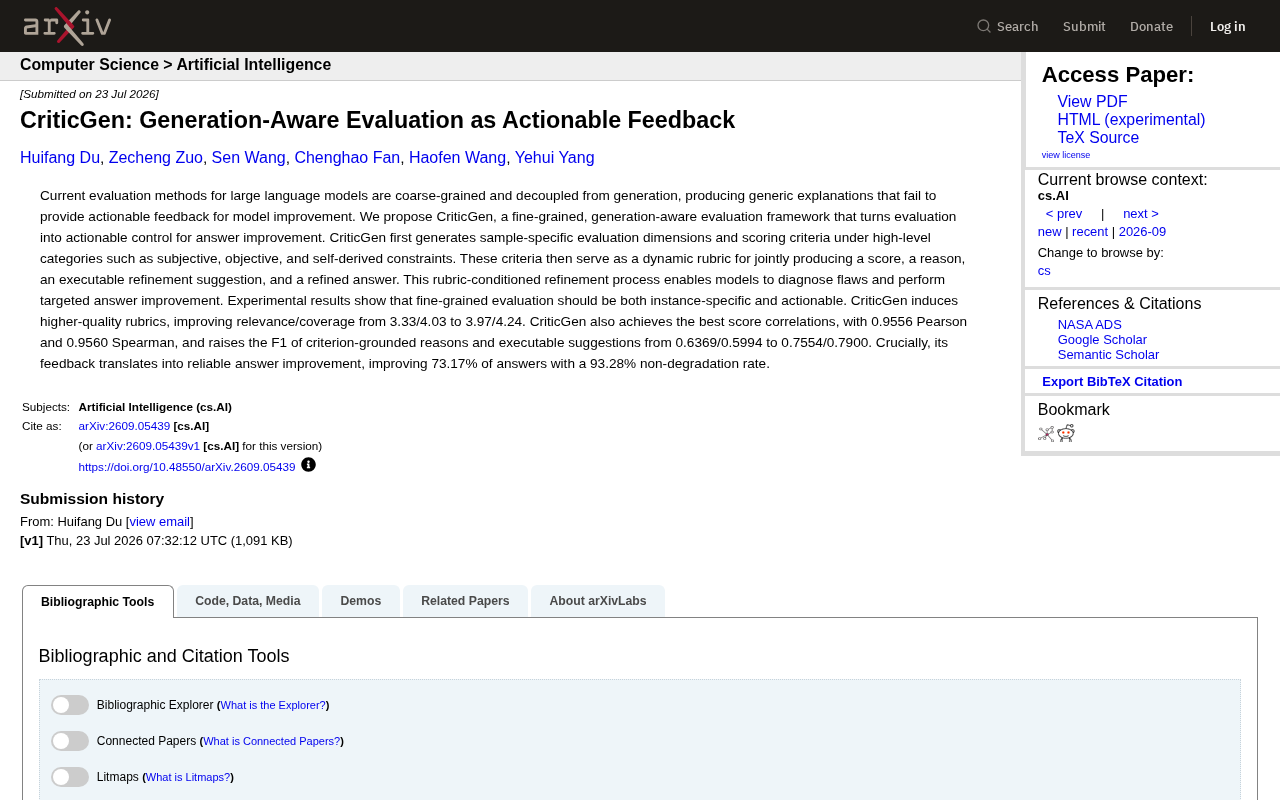
CriticGen proposes a generation-aware evaluation framework that transforms AI assessment from passive scoring to an active optimization loop, achieving 73.17% answer improvement and 93.28% non-degradation rate.
Vercel AI SDK workflow-harness Update Analysis
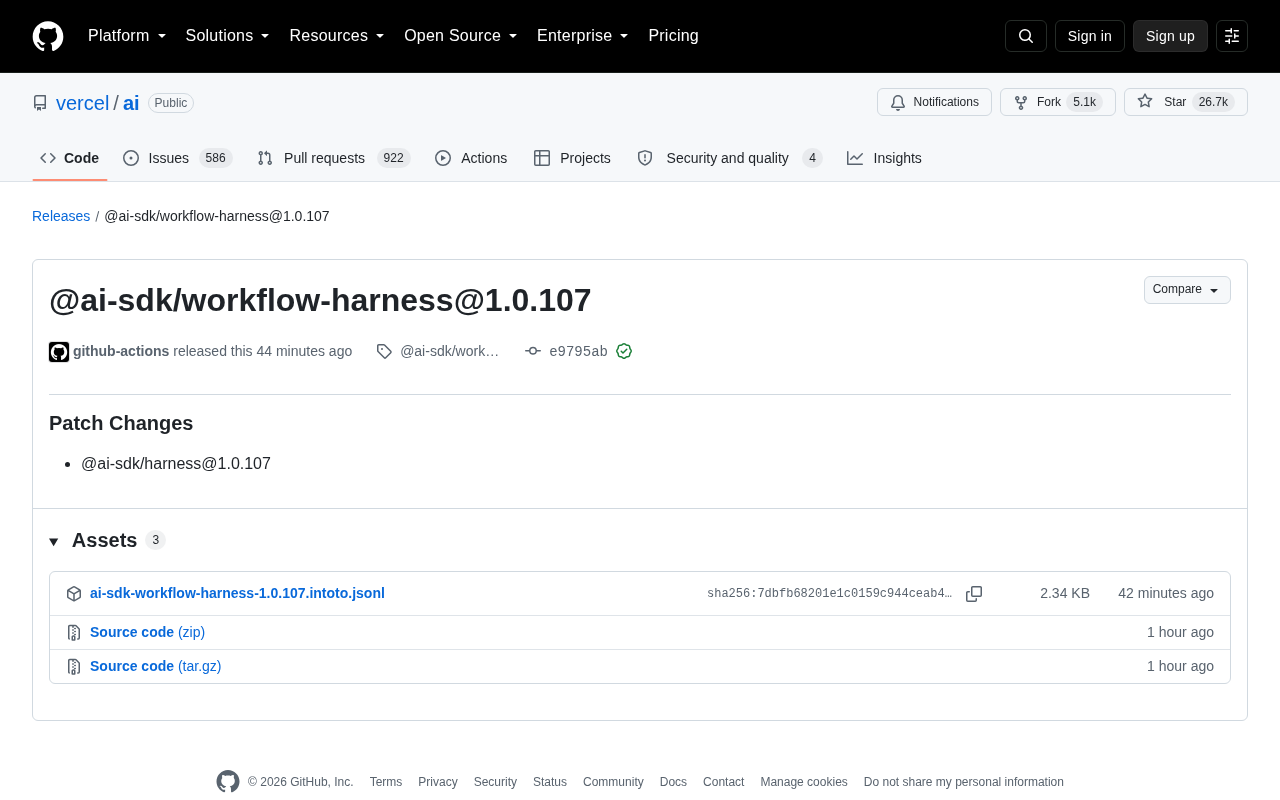
Deep analysis of Vercel AI SDK workflow-harness 1.0.107 update: architecture design, engineering practices, and developer value for building reliable AI apps.