C++ Implementation of Asymmetric Multi-Head AlphaZero: Dual Drones Self-Learn Pincer Maneuvers
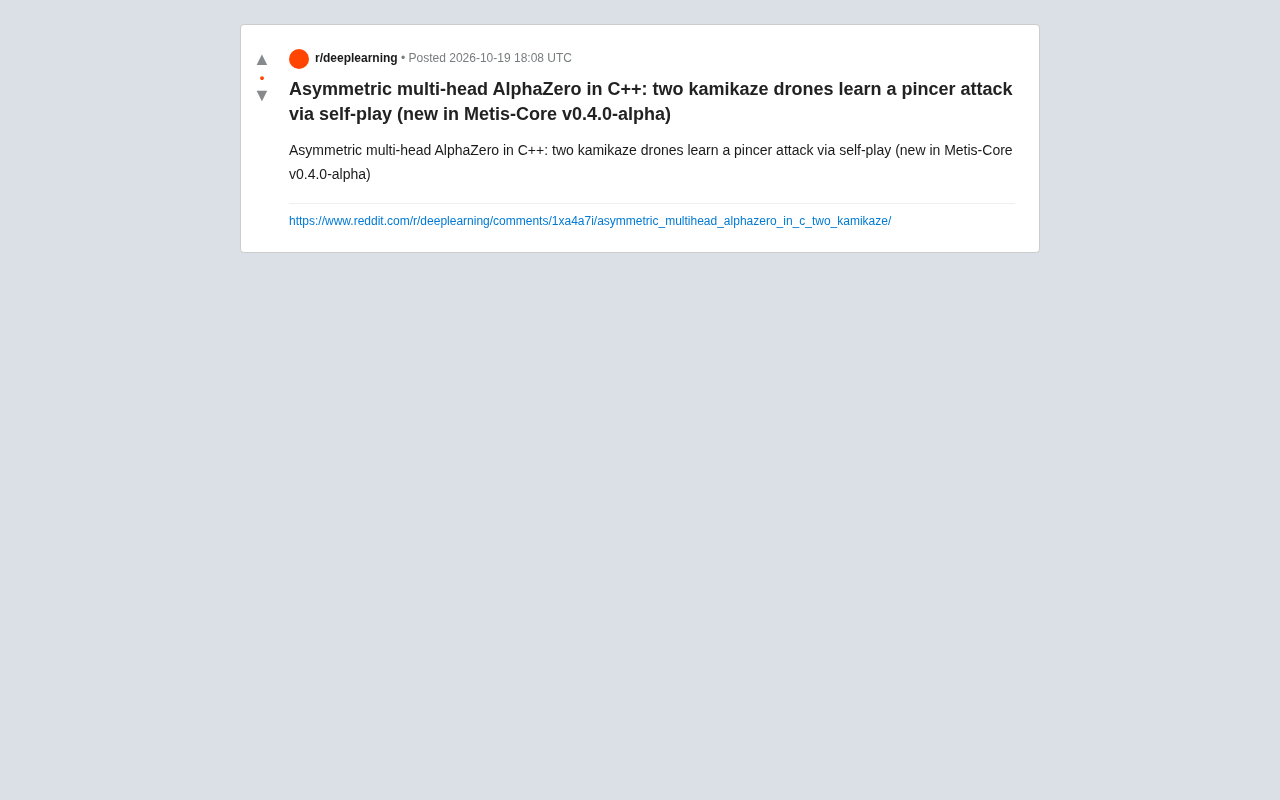
A C++ asymmetric multi-head AlphaZero enables two drones to develop emergent pincer coordination tactics through self-play.
Metis-Core v0.4.0-alpha implements asymmetric multi-head AlphaZero in C++, keeping independent policy heads for two non-equivalent kamikaze drones with shared value signals. Through millions of self-play games, agents spontaneously learn pincer coordination—separate maneuvering, forming an angle of attack, synchronized penetration—from rewards rather than hard-coded rules. This validates multi-agent AlphaZero's potential in continuous control and tactical coordination, with C++ emphasizing low-latency inference for real-time drone simulation. However, self-play convergence in asymmetric games, reward design pitfalls, and sim-to-real transfer remain key challenges; the current version is only a technical validation.
An interesting technical demo has recently emerged in the reinforcement learning space: an asymmetric multi-head AlphaZero architecture implemented in C++ that enables two "kamikaze" drones to learn coordinated pincer attacks through self-play. Released as a new feature in Metis-Core v0.4.0-alpha, this project showcases a combat scenario distinct from traditional symmetric games.
Design Philosophy of the Asymmetric Multi-Head Architecture
Traditional AlphaZero typically handles fully symmetric zero-sum games (such as chess and Go), where both sides share the same set of rules and action space. Here, however, the two drones have non-equivalent roles—they may possess different sensor configurations, maneuverability, or attack angles—thus requiring an "asymmetric multi-head" network to separately output policy and value.
The multi-head design means the network maintains independent policy heads for each agent, while value heads may be shared or partially shared to capture global situational awareness. Implemented in C++, this structure emphasizes low-latency inference and self-contained deployment, making it suitable for drone simulation environments with real-time requirements.
AlphaZero is a general reinforcement learning algorithm proposed by DeepMind in 2017. Its core idea is to use a single neural network to simultaneously output policy (action probability distribution) and value (position evaluation), and to iteratively train through Monte Carlo Tree Search (MCTS) combined with self-play data. In traditional implementations, both sides share the same network because games like chess are fully symmetric. The asymmetric multi-head architecture breaks this assumption: when two agents have inconsistent observation spaces, action spaces, or role objectives, each agent needs its own independent policy head, while value heads can be shared to learn joint state values. This design is known in multi-agent reinforcement learning as the "parameter sharing vs. separation" trade-off, commonly seen in heterogeneous agent cooperation or adversarial scenarios.
How Self-Play Gives Rise to Pincer Tactics
The pincer movement is a classic coordinated encirclement tactic requiring two units to approach a target simultaneously from different directions. In self-play, two drones starting from random initial positions gradually discover through millions of simulated games that: separate maneuvering, forming an angle of attack, and synchronized penetration yield higher win rates than a single-unit frontal charge.
The core value of this demo lies in the fact that the tactics are not hard-coded but emerge from reward signals. According to the original post, the agents learned to coordinate actions temporally—one unit draws attention while the other flanks from the side. This validates the potential of multi-agent AlphaZero in continuous control and tactical coordination.
Pincer tactics (pincer movement) is a classic military encirclement maneuver requiring two forces to advance toward a target simultaneously from different directions, forcing the opponent to split defenses or fall into a crossfire. In reinforcement learning, this coordinated behavior is an "emergent behavior": the agents were not explicitly told to "split forces and strike together," but discovered the strategy through extensive trial and error by maximizing a shared reward (e.g., hitting the target, reducing mission time). Self-play here serves as curriculum learning—the opponent continuously strengthens, forcing the agents to explore more complex coordination patterns. Notably, under asymmetric roles, the two drones' policy heads update independently, but the shared value signal guides them toward complementary rather than competitive behavior.
Technical Positioning of Metis-Core v0.4.0-alpha
Metis-Core is a reinforcement learning framework written in C++, and this alpha version introduces asymmetric multi-head AlphaZero as a new feature. Choosing C++ over Python means the project targets performance-sensitive scenarios: drone simulation, embedded inference, or real-time adversarial training. For researchers interested in multi-agent self-play, this is a reproducible lightweight starting point.
As a caveat, the current version is alpha, so interfaces and stability may not yet be mature. The original source material only provides title-level information, lacking training curves, hyperparameter settings, and specific network architecture details. Therefore, the above analysis is based on general principles of AlphaZero and multi-agent reinforcement learning; specific implementation details should be referenced from the project code or subsequent documentation.
Advantages of C++ in reinforcement learning deployment are mainly reflected in deterministic memory management and low inference latency. Python training frameworks (such as PyTorch and TensorFlow) are typically used for prototyping, but inference requires export via TorchScript or ONNX, and interpreter overhead is significant. Metis-Core's choice of a pure C++ implementation means that network forward propagation, MCTS search, and simulation loops can all complete within a single process at microsecond-level latency, which is critical for real-time drone control. Additionally, self-contained deployment (no Python dependency) facilitates embedding into onboard computing platforms. However, the C++ ecosystem lacks mature automatic differentiation and distributed training tools, so the project may only cover inference and lightweight training, or rely on external tools to generate weights.
Potential Applications and Limitations
This type of asymmetric multi-agent self-play method can be extended to scenarios such as drone swarm combat, robotic cooperative transport, and asymmetric faction balancing in game AI. The limitations are equally obvious: convergence of self-play in asymmetric games is harder to guarantee than in symmetric games, and improper reward design may lead one side to learn to "give up" or exploit rule loopholes. Furthermore, sim-to-real transfer remains an unsolved challenge.
Overall, this demo is closer to a technical validation than a product-grade system, but it clearly demonstrates a feasible path for multi-agent AlphaZero within the C++ ecosystem.
One-line Summary
A C++ implementation of asymmetric multi-head AlphaZero enables two drones to develop emergent pincer coordination tactics through self-play.
Paragraph Summary
Metis-Core v0.4.0-alpha implements asymmetric multi-head AlphaZero in C++, maintaining independent policy heads for two non-equivalent kamikaze drones while sharing value signals. Through millions of self-play games, the agents spontaneously learn pincer coordination tactics—separate maneuvering, forming an angle of attack, and synchronized penetration—from reward signals rather than relying on hard-coded rules. This demo validates the potential of multi-agent AlphaZero in continuous control and tactical coordination, while the C++ implementation emphasizes low-latency inference suitable for real-time scenarios such as drone simulation. However, self-play convergence under asymmetric games, reward design pitfalls, and sim-to-real transfer remain major challenges, and the current version is only a technical validation.
Related articles

M&M's Spent Millions Replacing Artificial Blue Dye — Why Is It So Hard?
Mars spent millions trying to replace artificial blue dye in M&M's with spirulina, but thick material clogs pipes and residue risks mold, forcing a full production-line rebuild. Here's the engineering behind the reformulation.
Teammate Wanted for Meta Global AI Developer Hackathon: Computer Vision & Medical AI
A Reddit developer seeks teammates for the Meta Global AI Developer Hackathon, focusing on computer vision and medical AI. This article analyzes the track logic, skills-complementarity needs, and topic selection strategy behind this teaming signal.
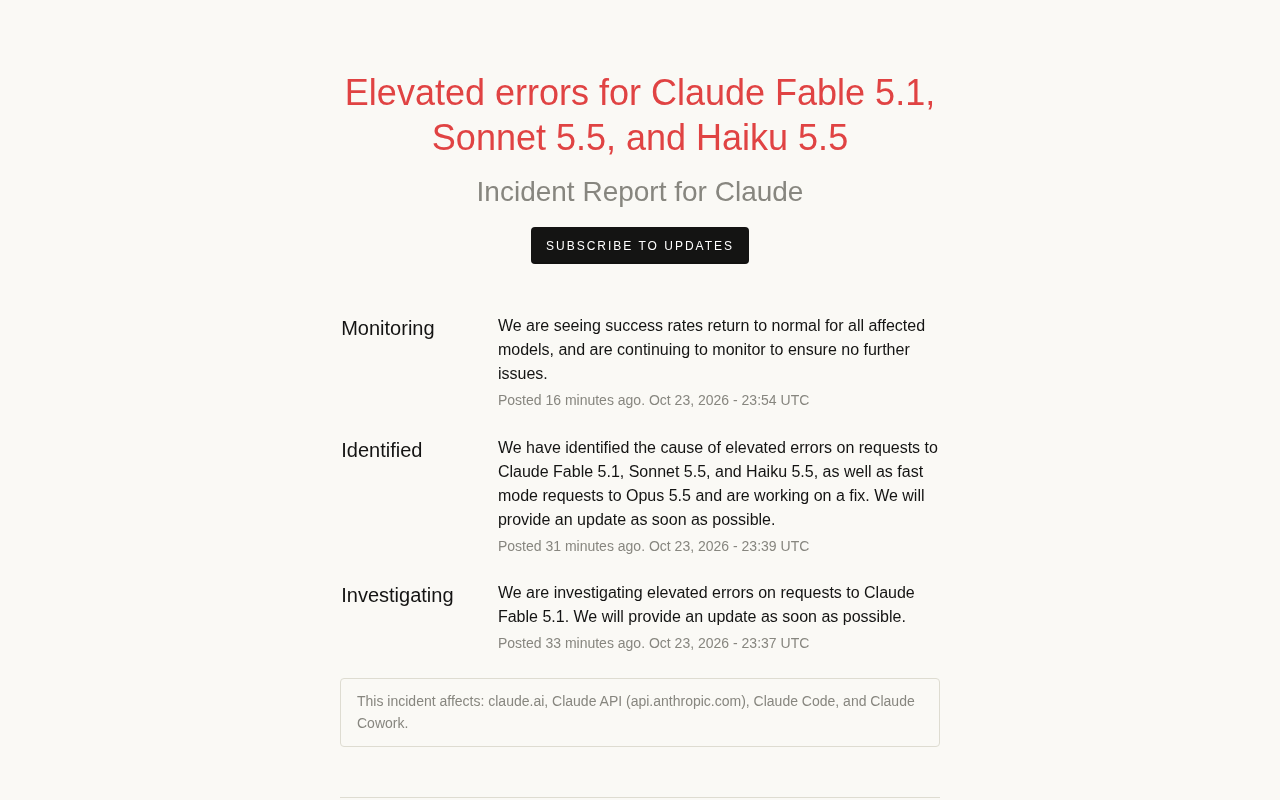
Multiple Claude Models Hit by Errors: A Postmortem of Fable 5.1, Sonnet 5.5, and Haiku 5.5
Claude Fable 5.1, Sonnet 5.5, Haiku 5.5, and Opus 5.5 fast mode saw elevated errors; Anthropic identified and resolved the issue in 17 minutes. This postmortem covers the timeline, the technical reasons for the multi-model cascading failure, and practical lessons for retry and degradation strategies.