California Legislation Cracks Open the Data Center 'Black Box': The Battle for AI Infrastructure Transparency

California mandates data center transparency on power and water use, pulling AI infrastructure out of the 'black box.'
As AI computing demand surges, data centers' massive consumption of electricity and water has sparked community protests across the US, yet affected residents have had little access to data or decision-making power. California Governor Newsom has signed a package of bills requiring greater operational transparency from data centers and giving communities more say over energy and water impacts. The move signals to the broader tech industry that the hidden costs of the AI boom — long borne silently by local communities — are entering the public and regulatory spotlight.
Data Centers Are No Longer a 'Black Box'
As demand for AI computing power explodes, the data centers powering it all are quietly transforming communities across the United States. For years, however, these massive facilities have been essentially a "black box" to the outside world — ordinary residents had no way of knowing how much electricity they consumed, how much water they drew, or how they were affecting their utility bills.
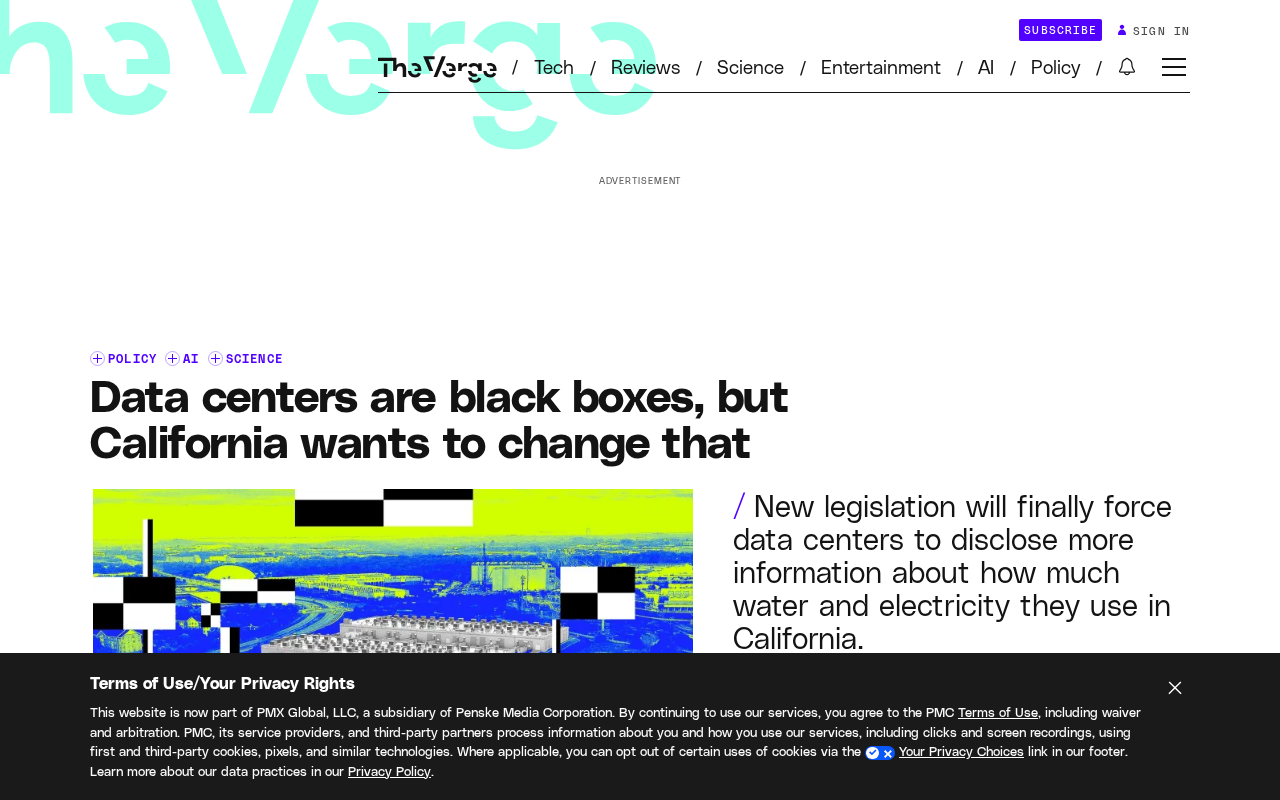
A package of bills signed by California Governor Gavin Newsom is trying to change that. The new legislation is designed to give communities access to better data and more say over how data centers affect their electricity bills and water supplies.
The Real Tensions Behind Community Protests
Data centers are increasingly moving into communities across America. As the foundational infrastructure underpinning AI, these facilities have already sparked protests in multiple locations. The tension centers on two resources: electricity and water.
A single large data center can consume as much power as a small city, while the cooling water required to keep servers from overheating is staggering in volume. When these resources are consumed at scale, ordinary residents often face rising utility bills and increasingly strained water supplies — with neither access to information nor any meaningful voice in the decision-making process.
This information asymmetry is at the heart of the "black box" problem: the communities most affected are precisely those with the least access to data.
To put the scale in concrete terms: a mid-sized hyperscale data center typically consumes between 100 and 500 megawatts of electricity per year — equivalent to the combined usage of tens of thousands to hundreds of thousands of homes. On the cooling water side, evaporative cooling towers can consume millions of gallons of freshwater per day. Tech giants like Google and Microsoft have disclosed in their financial reports that their data center operations consume billions of gallons of freshwater globally each year. This figure is especially sensitive in arid regions — yet tech companies, when selecting sites, often favor inland areas with cheap electricity, which tend to have relatively scarce water resources. The concentrated computing demands of training large AI models have further spiked peak resource consumption at individual facilities in short periods, suddenly concentrating pressure that was once dispersed across specific grid nodes and water sources.
Why Transparency Is the Critical First Step
The significance of California's legislation lies in its use of "transparency" as the lever for governing data center expansion. Only when communities have access to real data on electricity and water usage can they begin to assess impacts, participate in decisions, and negotiate from an informed position.
For the AI industry, this is also a signal worth heeding. Over the past few years, tech giants have generally enjoyed a relatively permissive environment when siting and building data centers, with minimal transparency requirements. As public awareness grows and local governments step in, the expansion of AI infrastructure is facing new social and regulatory constraints.
As the bellwether for both technology and legislation in the United States, California's approach is likely to be adopted by other states. This means that future data center construction will need to account not just for economics, but for what might be called the "environmental ledger" and "social ledger" — the real costs to local power grids and water resources.
Prior to this, information disclosure requirements for data centers in the United States were extremely fragmented and weak. There is no unified federal mandatory reporting mechanism, and state-level regulations vary widely. Some states have even offered tax incentives to attract investment, further undermining local governments' bargaining power. By contrast, the European Union passed amendments to its Energy Efficiency Directive in 2024, requiring data centers above a certain size to mandatorily disclose energy consumption, water usage, and carbon emissions data, which is then incorporated into a public database. California's legislative approach closely mirrors the EU's, marking a trend in the United States toward aligning with European regulatory models for data center environmental governance. For companies, transparency requirements will also indirectly drive investment in energy efficiency technologies, since publicly available data will expose inefficient operations to dual pressure from public opinion and regulators.
The Hidden Costs of the AI Boom
At its core, this legislative battle reflects the hidden costs behind the AI boom. Every training run and inference request from generative AI comes with real electricity and water consumption — costs that have long been silently borne by communities with no voice in the matter.
California's new laws may not solve every problem immediately, but they take a critical first step: making the "black box" visible. When data is made public and communities have the right to be heard, AI infrastructure development can move toward a more sustainable and equitable path.
For the industry as a whole, how to expand computing capacity while addressing community concerns will become an unavoidable long-term challenge.
Related articles

Frontend to AI Agent Development: A Frontline Architect Explains Career Paths and Opportunities
A frontline AI architect explains the industry changes and practical paths for frontend developers transitioning to AI Agent development: why pure frontend jobs are disappearing, why Agent + full-stack has become mainstream in hiring, and three transformation routes—Agent development engineer, FDE, and remote contracting—along with corresponding learning strategies.

How to Choose an AI Agent Development Course: Five Pitfall-Avoidance Guidelines
A mechanical-engineering career changer's two-year pitfall-tested checklist for screening AI Agent development courses: complete delivery pipeline, resume-worthy projects, real development perspective, update frequency, and coaching feedback—with concrete judgment methods and pitfall-avoidance tips.

Coze AI Agent Building for Beginners: A Zero-Code AI Agent Development Guide
Coze, ByteDance's one-stop AI application development platform, supports zero-code drag-and-drop AI agent building. This article outlines Coze's core concepts, three advantages, differences between the domestic and international versions, and the distinction between agents and apps, helping beginners quickly get started with AI Agent development.