Can a Hash-Only Sender Beat Classic Compression? A Pre-Registered Experiment Maps the Boundary

A pre-registered study shows the hash-only sender costs 18.4 bits more than PPM order-1 for short texts and fails the equivalence test.
A pre-registered study used 1,000 English utterances from Taskmaster-1 to compare a hash-only sender with an in-domain PPM order-1 compressor. Requiring 100% delivery and counting hash bits, NACK, and fallback, the hash sender succeeded first-try on 857 messages at 192.8 bits on average, 18.4 bits more than PPM, failing the one-byte equivalence test. It had the lowest bits only in the 8,190–24,844-byte memory range (45–46 bits below smaz2 and Unishox2) but lagged in airtime due to failure retransmissions; a wider receiver search recovered half the failures at 7.7 bits below PPM but took about three minutes per failure.
Experimental Background: The Cost Question for Hash-Only Senders
In communication systems, the sender typically needs a complex encoding or compression model to reduce transmission costs. A natural question arises: if the sender only computes a hash while the receiver uses a large language model to decode, can short texts be transmitted with fewer bits? A recent pre-registered study rigorously tested this, using 1,000 English user utterances from the Taskmaster-1 dataset to compare a hash-only sender against an in-domain PPM compressor.
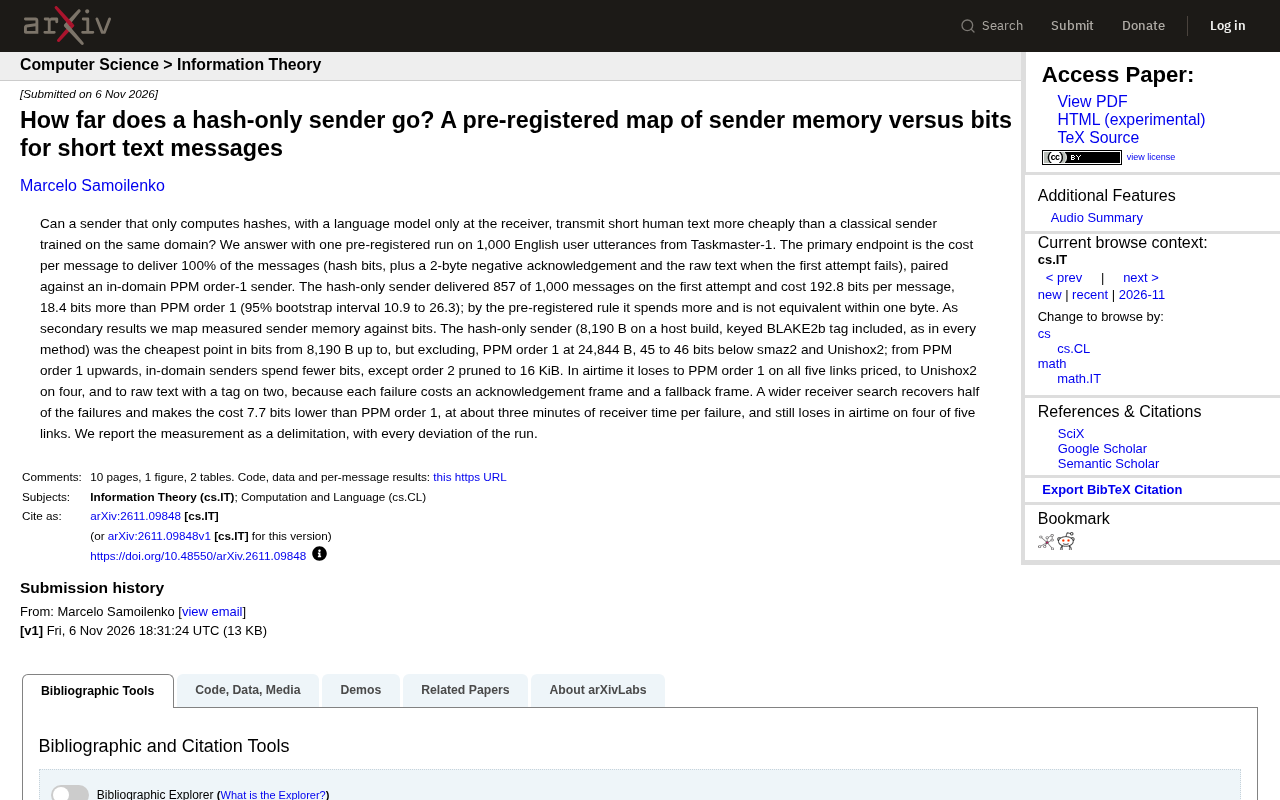
The primary endpoint was "transmission cost per message," requiring 100% message delivery, with costs including hash bits, a 2-byte negative acknowledgment (NACK), and raw-text fallback on first-attempt failure. The control was an in-domain PPM order-1 model. This design places the trade-off between "sender memory" and "bits" within a measurable framework.
PPM (Prediction by Partial Matching) is a classic lossless compression algorithm whose core idea is to predict the next symbol based on the historical frequency of contexts and encode prediction deviations. "Order-1" PPM means using only the previous symbol as context, yielding low model complexity and small sender memory footprint, and is therefore often used as an in-domain compression baseline. PPM performs robustly in text compression, especially suited to short-text scenarios: it requires no large-scale pretraining and can approach the empirical entropy of the domain with only a small amount of statistics. In this study, the PPM order-1 model represents the control condition of "the sender holds domain knowledge," and its 24,844-byte memory footprint also serves as the reference point dividing the costs of the hash-only sender and the classic compressor.
Main Results: The Hash-Only Sender Did Not Win
Under the pre-registered rules, the hash-only sender successfully delivered 857/1000 messages on the first attempt, at an average cost of 192.8 bits per message. By comparison, the PPM order-1 model cost 18.4 bits less (95% bootstrap interval 10.9 to 26.3 bits). Under the pre-registered equivalence rule (within one byte), the hash-only sender costs more and is not equivalent to PPM.
This result directly answers the question in the title: in short-text messaging scenarios, a hash-only sender is not cheaper than a classic in-domain sender. The extra overhead from the failure-retransmission mechanism offsets the potential advantage of the hash representation.
A pre-registered study refers to publicly registering the hypothesis, primary endpoint, sample size, and analysis plan before the study begins, then strictly following the registered plan and reporting all results. Its purpose is to prevent post-hoc selection of favorable results (such as p-hacking or HARKing), thereby enhancing the credibility of conclusions. This study set "transmission cost per message" as the primary endpoint and specified in advance an equivalence boundary of within one byte (8 bits); this means that even if the hash-only sender were only slightly more expensive than PPM, it would be judged non-equivalent. The pre-registered rules also constrained how failed retransmissions were handled, ensuring comparisons between schemes were made under a unified standard and avoiding bias from post-hoc metric adjustments.
Mapping Sender Memory to Bits
As a secondary result, the study plotted sender memory footprint against transmission bits. The hash-only sender (8,190 bytes in the host build, including a keyed BLAKE2b tag) is the lowest bit-cost point in the range from 8,190 bytes to 24,844 bytes (exclusive), 45 to 46 bits lower than smaz2 and Unishox2. However, from the PPM order-1 model (24,844 bytes) upward, in-domain senders cost fewer bits, with the exception of an order-2 model pruned to 16 KiB.
This means the hash-only sender's advantage is confined to a specific memory range and is not universally applicable. For extremely memory-constrained scenarios, the hash scheme may have some appeal, but once a larger sender model is allowed, classic compression methods become more efficient.
BLAKE2b is a cryptographic hash function in the BLAKE2 family, with a configurable output length (up to 64 bytes), known for its high speed and strong collision resistance, and commonly used for integrity verification and message authentication. The "keyed BLAKE2b tag" mentioned in the text is an HMAC-style construction: the sender computes a keyed hash of the message using a shared key, and the receiver uses it to search a candidate set for a match. The hash-only sender's memory overhead (8,190 bytes) mainly comes from storing this tag or the candidate-table structure, rather than the raw text itself. This also explains why its memory footprint, though small, is not zero: the keyed tag, while providing security (preventing forged matches), constitutes the lower bound of sender memory.
Airtime and Receiver-Side Search
Bit cost is not the only metric. In terms of airtime, the hash-only sender lost to the PPM order-1 model on all five priced links, lost to Unishox2 on four links, and lost to tagged raw text on two links. The reason is that each failure requires an acknowledgment frame and a fallback frame, significantly lengthening actual transmission time.
The study also tried a wider receiver-side search: this recovered half of the failures, bringing cost 7.7 bits below PPM order-1, but required about three minutes of receiver time per failure, and still lagged in airtime on four of the five links. This trade-off shows that increased receiver compute can partially offset bit cost but cannot resolve the fundamental airtime disadvantage.
Airtime refers to the time data actually occupies the channel on a physical link, depending on bit count, link rate, frame overhead, and retransmission count, and is a key metric for energy consumption and latency in wireless or low-power communications. Unlike pure bit cost, airtime includes acknowledgment frames (ACK/NACK), fallback frames, and protocol header overhead. Although the hash-only sender does not lead on average bit count, its failed retransmissions require additional negative acknowledgments and raw-text fallback, and each failure round lengthens channel occupancy, so it lags on all five priced links. This metric reminds us that the merits of a compression scheme cannot be judged by payload bits alone; the protocol-layer amplification from failure handling must also be considered.
Conclusions and Implications
The study provides a clear boundary in a pre-registered manner: a hash-only sender does not surpass classic in-domain compressors in short-text message transmission. Its value lies in providing a reproducible measurement framework and revealing the complex trade-offs among sender memory, bit cost, and airtime. For practical system design, if the goal is to reduce bits, classic compressors are better in most memory configurations; if sender compute is extremely constrained, the hash scheme can serve as an option within a specific range, but one must accept higher failure-retransmission overhead.
The study also reports all run deviations, enhancing the credibility of the results. Future work could explore more efficient receiver-side search strategies or hybrid schemes combining hashing with lightweight compression.
One-line Summary
A pre-registered study shows the hash-only sender costs 18.4 bits more than PPM order-1 in short-text transmission and fails the equivalence test.
Paragraph Summary
A pre-registered study used 1,000 English utterances from Taskmaster-1 to rigorously compare the transmission cost of a hash-only sender against an in-domain PPM order-1 compressor. The primary endpoint required 100% delivery, with costs including hash bits, NACK, and failure fallback. Results show the hash-only sender succeeded on the first attempt for 857 messages at an average of 192.8 bits, 18.4 bits more than PPM, failing the one-byte equivalence test. Secondary results found the hash scheme had the lowest bits only in the 8,190-to-24,844-byte memory range, 45 to 46 bits lower than smaz2 and Unishox2; it lagged across the board in airtime because failed retransmissions require extra acknowledgment and fallback frames. A wider receiver-side search recovered half of the failures and brought cost 7.7 bits below PPM, but required about three minutes of receiver time per failure.
Related articles

Anthropic Launches AI Office Suite, Making Another Move in the Enterprise Market
Anthropic launches an AI office suite, expanding from coding tools to an enterprise office platform. This article analyzes its product strategy, competitive landscape, and significance for enterprise users.

Indie Game Community Split Over AI and Big Walk
IGF judges declare they won't vote for any game using generative AI, and the Big Walk developer admits limited AI use in the final development stage, splitting the indie game community. This article analyzes the mismatch between award criteria and development reality, the transparency dilemma, and community identity anxiety.

Google Fi Launches Super Network: Dual 5G Auto-Switching Improves Coverage
Google Fi launches Super Network, enabling automatic switching between two 5G networks for better coverage. Learn how it works, device limits, and what it means for users.