Can a Personal Tweet Influence Elon Musk's Decisions? Reflections on Attribution Bias and Self-Efficacy
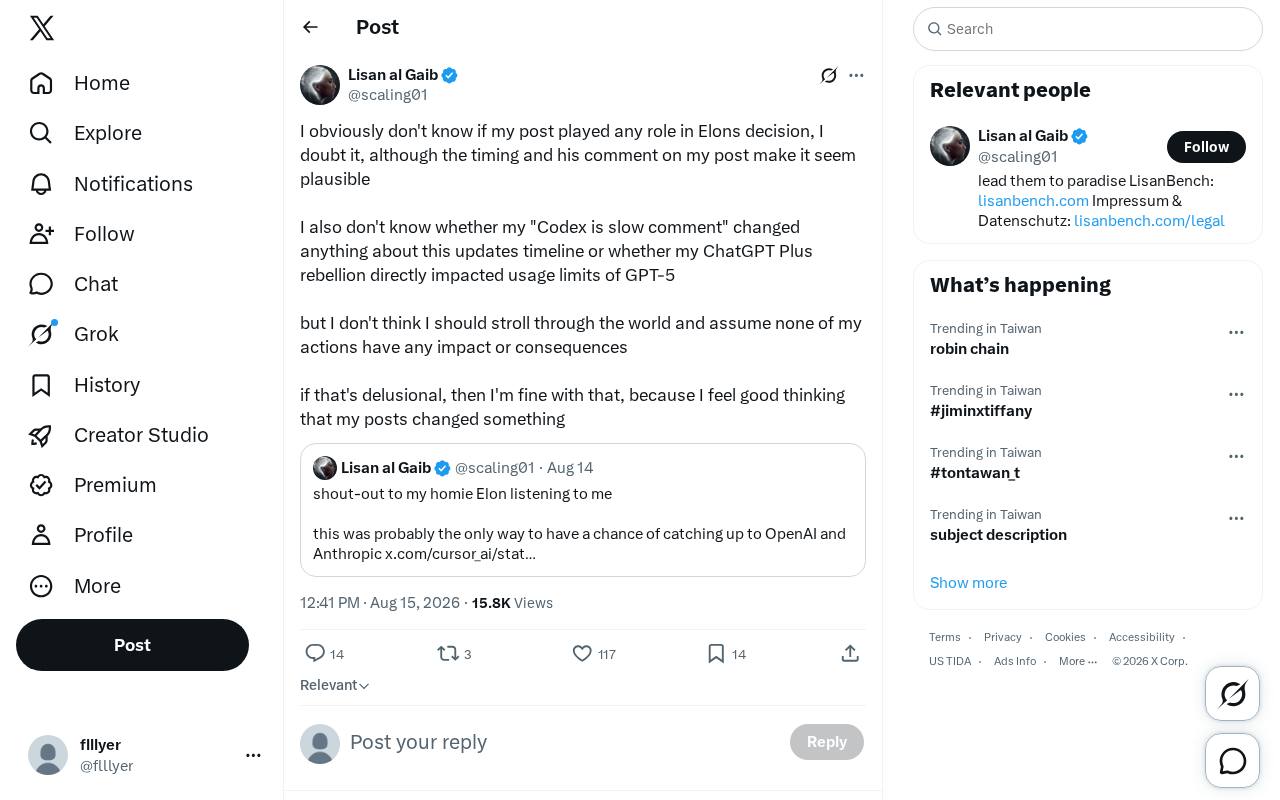
Exploring whether personal tweets can influence tech giants through the lens of psychology and collective action.
A Twitter user's candid reflection on whether their posts influenced Elon Musk's decisions opens a deeper discussion about attribution bias, self-efficacy, and the real power of individual voices in the social media age. From Codex performance issues to GPT-5 usage limits, the article examines how distributed influence works, why we overestimate our personal impact, and why maintaining a constructive belief in participation may be a psychologically healthy and rational choice.
A Tweet That Sparked Self-Reflection
In an era where social media dominates tech discourse, a Twitter user posted a thought-provoking piece of self-reflection. On the surface, the post discussed whether their tweets had influenced one of Elon Musk's decisions. But beneath that surface, it touched on a much deeper question: In an age dominated by tech giants, can the voice of an ordinary individual actually make a real difference?
In the original post, the author candidly wrote: "I obviously don't know if my post played any role in Musk's decision, and I doubt it, although the timing and his comments on my post make it seem somewhat possible." This blend of humility and refusal to abandon self-worth forms the central tension of the entire piece.
From Codex to GPT-5: Three Case Studies
The Blurry Boundaries of Influence
The author cited three specific scenarios to support their reflections. First was a comment about "Codex being slow" — the author wasn't sure whether this had changed the timeline of a particular update. As OpenAI's early code generation model (and the technical foundation of GitHub Copilot), Codex's performance issues had long been a focal point for the developer community.
For added context, Codex was a code-generating large language model released by OpenAI in 2021, fine-tuned on GPT-3. It could translate natural language descriptions into executable code across more than ten programming languages, including Python, JavaScript, and Go. GitHub Copilot was built with Codex as its core engine, embedded directly into mainstream IDEs like VS Code, boosting developer productivity through real-time code completion and generation. Codex's performance issues — including response latency, fluctuations in code accuracy, and context window limitations — were persistent topics of discussion in the developer community. As OpenAI later released GPT-4 and more powerful models, Codex's role was gradually superseded by newer architectures. Nevertheless, its landmark status as a pioneer in AI-assisted programming remains undeniable.
Second, the author mentioned their "ChatGPT Plus rebellion," questioning whether it directly influenced GPT-5's usage limits. This point carries considerable real-world relevance. ChatGPT Plus is OpenAI's paid subscription service launched in February 2023 at $20 per month, giving users priority access to the latest models (such as GPT-4 and GPT-4o) along with faster response times. However, usage limits have been a persistent point of contention. OpenAI adjusted GPT-4's hourly message cap multiple times — from an initial 25 messages to 40, then 50, and eventually differentiated quotas across models. Behind these limits lies the hard constraint of GPU compute costs: every GPT-4 inference call consumes significant computational resources, and OpenAI must strike a balance between user experience and infrastructure expenses. User dissatisfaction with these limits often erupts on social media, creating public pressure on product teams and prompting OpenAI to publicly respond and adjust its strategy on multiple occasions.
The Temptation of Timing and Coincidence
Interestingly, the author repeatedly emphasized the factor of "timing." When a personal tweet is posted shortly before a tech giant makes a related decision, the temporal coincidence easily triggers causal associations. In logic, this type of reasoning is known as the post hoc ergo propter hoc fallacy — inferring that A caused B simply because B occurred after A. The immediacy and traceability of social media make these temporal correlations more visible and, consequently, more seductive. Yet the author maintained a rare clarity: they explicitly stated "I doubt it," acknowledging an inability to confirm any causal relationship.
Attribution Bias and Self-Efficacy: A Psychological Perspective
Why We Always Think We Influenced the Outcome
From a cognitive psychology standpoint, the author's reflection is essentially a struggle against a common attribution bias. Attribution bias is a core concept in social psychology, first framed by Fritz Heider in his 1958 attribution theory, later developed further by Harold Kelley and Bernard Weiner. The most relevant variant here is "self-serving bias": people tend to attribute successes to internal factors (such as ability and effort) while blaming failures on external factors (such as luck and circumstances). In the social media context, this bias is further amplified — the platform's interaction mechanisms (likes, retweets, comments) create an "illusion of influence" that makes it easier to believe one's posts have produced tangible effects.
Humans are naturally inclined to overestimate the impact of their actions on the external world, especially when outcomes align with their expectations. The author clearly recognized this, which is why they repeatedly used qualifying phrases like "I don't know" and "I doubt it."
But what's more intriguing is the shift in attitude at the end: "I don't think I should walk around this world assuming that none of my actions have any impact or consequences." This represents a commitment to self-efficacy — the belief that individual actions can influence one's environment. Self-efficacy was formally proposed by psychologist Albert Bandura in 1977 as a core concept in his social cognitive theory. Bandura argued that self-efficacy is not mere self-confidence but rather an individual's belief in their ability to successfully execute a specific behavior in a given situation. It develops through four pathways: mastery experiences (past successes), vicarious experiences (observing others succeed), verbal persuasion (encouragement from others), and physiological and emotional states. Extensive empirical research shows that high self-efficacy is significantly associated with greater task persistence, higher goal-setting, and more effective stress-coping strategies. In the context of digital participation, users who believe their voice can make a difference are more likely to continue providing feedback and constructive suggestions, which at the group level does indeed generate greater influence — forming a self-fulfilling prophecy.
Balancing Between "Delusion" and "Meaning"
The author concluded: "If this is delusion, I'll take it, because thinking my posts changed something makes me feel good." While this may seem like self-consolation, it actually reveals a proposition worth deeper reflection: When causal relationships cannot be confirmed, is it reasonable to maintain a constructive belief?
Psychological research broadly agrees that a moderate sense of self-efficacy helps individuals sustain motivation for positive action. If a person believes all their efforts are meaningless, they are more likely to fall into learned helplessness. Learned helplessness is a phenomenon discovered by American psychologist Martin Seligman in 1967 through animal experiments: after repeatedly experiencing uncontrollable negative events, individuals give up trying even when circumstances change and escape becomes possible. This theory has since been widely applied to explain human depression, passive behavior, and low engagement. In the context of tech product user feedback, if users chronically feel their opinions are ignored — for example, repeatedly submitted bug reports that go unanswered, or feature requests that are never acknowledged — they may develop a kind of "digital learned helplessness," ceasing to participate in community discussions, stopping feedback submissions, and adopting a thoroughly pessimistic attitude toward product improvement. For tech companies, this represents a hidden loss, as a silent user base means the product team loses a valuable source of signals.
In this sense, the author's "delusion" may actually be a healthy psychological strategy.
The Restructuring of Voice in the Social Media Era
Do Individual Voices Really Not Matter?
This piece resonates because it touches on a genuine paradox of the social media era. On one hand, tech giants like Musk and OpenAI hold absolute resource and decision-making power; on the other, social platforms have given ordinary users unprecedented channels for expression.
In reality, tech companies are paying increasing attention to community feedback. Whether it's product pricing, feature iterations, or usage policies, the collective voice of users on social media can indeed generate public pressure sufficient to influence corporate decisions. The impact of a single tweet may be negligible, but when countless individual voices converge into a trend, their power becomes impossible to ignore.
Distributed Influence: From Individual Cases to Collective Mechanisms
The author's dilemma lies precisely here: they cannot decompose the macro-level phenomenon of "collective influence" into the micro-level unit of "individual contribution." This is exactly the hallmark of distributed influence — every participant contributes a piece, but no one can claim to be the decisive factor.
This phenomenon closely relates to the theory proposed by economist Mancur Olson in The Logic of Collective Action (1965). Olson pointed out that in large-scale groups, each individual's marginal contribution to the collective outcome is minuscule, leading to the "free-rider" problem — rational individuals lack the motivation to actively participate. However, social media has altered this dilemma to some extent: platforms have lowered the cost of expression (posting a tweet is virtually free) while making individual contributions quantifiable and perceptible through visible interaction metrics (retweet counts, trending topics). This creates a new model of collective action — without the need for organizational coordination, dispersed individual voices spontaneously converge through algorithmic recommendations and social network propagation effects, forming public pressure on companies or institutions. In recent years, from OpenAI's pricing adjustments to gaming companies rolling back controversial updates, we can see this distributed influence mechanism at work.
For observers of the AI industry, this offers an important insight: behind every adjustment a product team makes, there is often the combined result of thousands upon thousands of feedback signals. As users, we should neither overstate our individual influence nor completely dismiss the value of participation.
Conclusion: Finding Balance Between Humility and Confidence
This brief piece of self-reflection demonstrates a rare intellectual balance. The author neither fell into the grandiosity of "I changed the world" nor slid into the nihilism of "I can't do anything." They chose a middle path: acknowledging uncertainty while preserving a sense of meaning in action.
In today's world of rapidly advancing AI technology and increasingly concentrated tech giant influence, this attitude may be exactly the stance every digital citizen should adopt — maintaining a clear-eyed awareness of one's own limitations while never abandoning the effort to shape the future of technology through expression and participation. After all, as the author put it, if believing that your voice can change something makes you feel good and motivates you to engage more actively, then this "delusion" might just be a rational choice.
Related articles

A World First in Australia: Delivery Riders to Receive Minimum Wage Guarantee
Australia introduces the world's first minimum wage guarantee for delivery riders, balancing gig flexibility with income protection. Explore the agreement's details, platform impacts, and global regulatory trends.

DeepSeek Open-Sources Its First Vision Model, Dramatically Lowering the Bar for Multimodal Agents
DeepSeek open-sources V-Flash-Vision-XP, its first vision model rivaling top closed-source models; Alibaba launches multi-agent video creation; sub-$400 bipedal robot goes open-source.

ReactOS 0.4.16 Released: Graphical Installer, 3D Hardware Acceleration, and Broader Hardware Support
ReactOS 0.4.16 ships with a new graphical installer, real hardware GPU 3D acceleration, and broader hardware compatibility for this Windows NT-compatible open-source OS.