Can Agents Reliably Generate PDE Simulation Specifications? New Research Weighs In

AI agents raise PDE simulation specification correctness to 98.3% through scientific checks and explicit clarification.
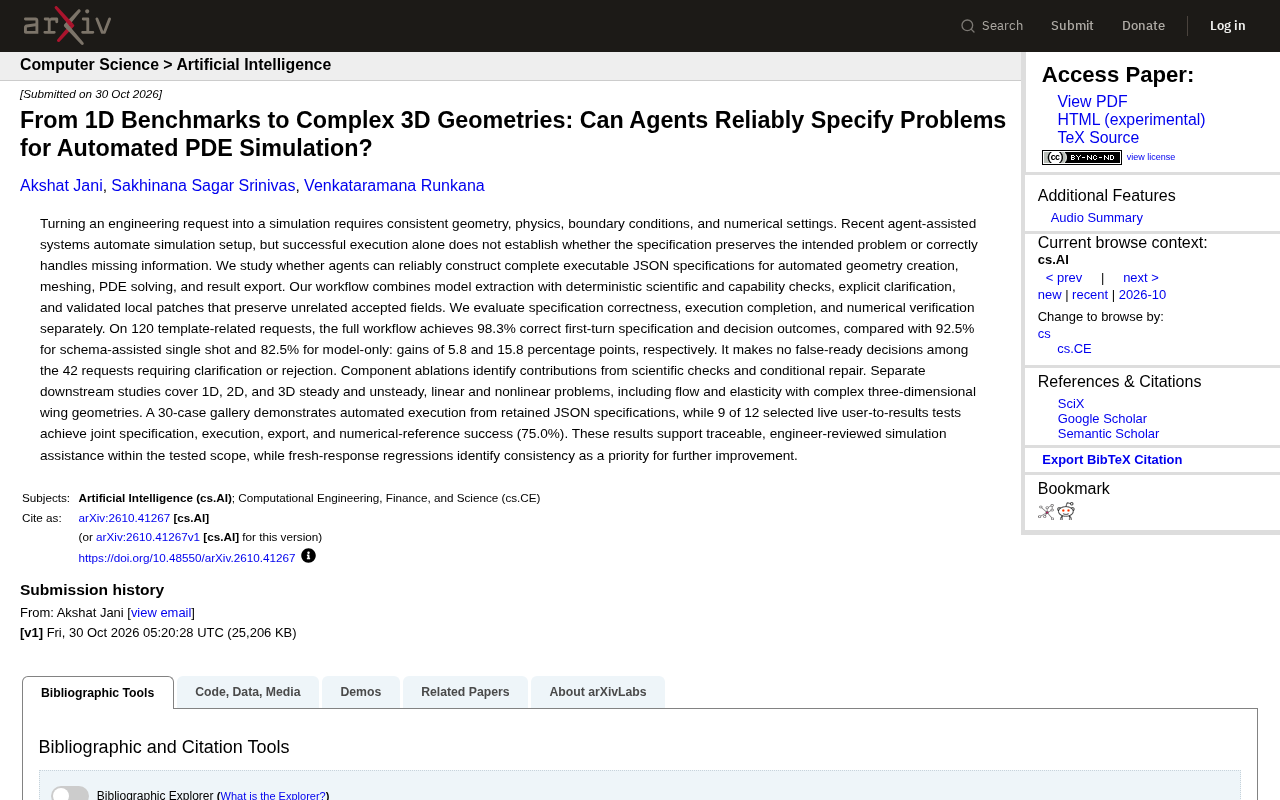
This study evaluated AI agents' ability to build complete JSON specifications for automated PDE simulation, distinguishing specification correctness from execution success and splitting evaluation into specification correctness, execution completeness, and numerical validation. The proposed workflow combines model extraction, deterministic scientific checks, and explicit clarification—asking rather than guessing when information is missing—and repairs accepted fields via local patches. On 120 template requests, the full workflow achieved 98.3% first-round specification and decision correctness, beating single-pass (92.5%) and model-only (82.5%) approaches, with no incorrect "ready" decisions among 42 clarification/rejection requests. Downstream tests span 1D to complex 3D geometry, with 9 of 12 live user tests achieving joint success (75.0%), though consistency regression remains an area for improvement.
Translating engineering requirements into executable simulations requires consistency across geometry, physics, boundary conditions, and numerical settings. A recent study systematically evaluated AI agents' ability to construct complete JSON specifications for automated PDE simulation, and proposed a workflow that combines scientific checks with explicit clarification.
Core Problem: Successful Execution Does Not Equal Correct Specification
The study points out that while agent-assisted systems can automate simulation setup, successful execution alone does not prove that the specification preserves the original problem's intent, nor can it determine whether the system properly handled missing information. To address this, the authors split evaluation into three independent dimensions: specification correctness, execution completeness, and numerical validation.
Partial differential equation (PDE) simulation is a core method in engineering and scientific computing, used to approximately solve PDEs that describe physical fields (such as fluid flow, structural deformation, and heat conduction). A complete simulation setup typically requires specifying the geometric domain, material properties, governing equations, boundary conditions, initial conditions, and numerical discretization parameters (such as mesh size, time step, and solver tolerance). Together these elements form the simulation's "JSON specification"—a structured configuration file used to drive simulation software. Any omission or error in the specification can cause simulation results to deviate from the true physical intent, even if the solver converges successfully and produces output. Therefore, the correctness of a simulation setup must be evaluated separately from execution status—this is the technical context behind the original text's emphasis that "successful execution does not equal correct specification."
Workflow Design: Model Extraction + Deterministic Checks + Explicit Clarification
The workflow combines model extraction with deterministic scientific and capability checks, and introduces an explicit clarification step. When information is insufficient, the system proactively asks rather than guesses; for accepted fields, it makes fixes through validated local patches, ensuring that unrelated fields are not accidentally modified. This design aims to enable traceable, engineer-reviewed simulation assistance.
Deterministic scientific checks refer to rule-based validation that does not rely on probabilistic models but on physical laws and numerical stability criteria. For example, checking whether boundary conditions cover all boundaries, whether material parameters are within physically reasonable ranges, whether the time step satisfies the CFL condition, and whether the mesh sufficiently resolves key gradients. Such checks can be executed automatically and are reproducible, complementing the probabilistic output of LLMs. Explicit clarification is an interaction design: when a request lacks necessary information (such as an unspecified inlet velocity or wall heat flux), the system does not guess default values but instead asks the user specific questions. Local patch repair means modifying only the fields in the JSON that have been confirmed incorrect by checks, rather than regenerating the entire specification, thereby avoiding accidental perturbation of already-correct fields and ensuring traceability of modifications.
Experimental Results: Full Workflow Significantly Outperforms Baselines
On 120 template-related requests, the full workflow achieved 98.3% first-round correctness for specifications and decisions, compared with 92.5% for schema-assisted single attempts and 82.5% for the model-only approach—improvements of 5.8 and 15.8 percentage points, respectively. Among 42 requests that required clarification or rejection, the workflow made no incorrect "ready" decisions. Component ablation experiments further confirmed the contributions of scientific checks and conditional repair.
Downstream Validation: From 1D to Complex 3D Geometry
Independent downstream studies covered steady and unsteady, linear and nonlinear problems in 1D, 2D, and 3D, including flow and elasticity problems with complex three-dimensional wing geometry. A gallery of 30 cases demonstrated automated execution based on retained JSON specifications. In 12 selected live user-to-result tests, 9 achieved joint success across specification, execution, export, and numerical reference—a success rate of 75.0%.
Steady versus unsteady problems differ in whether time-derivative terms are included: steady problems solve for equilibrium states, while unsteady problems require time advancement. Linear versus nonlinear problems depend on the relationships among unknowns in the governing equations; nonlinear problems (such as the convective term in the Navier-Stokes equations or large-deformation elasticity) typically require iterative solving and are sensitive to initial values. Flow and elasticity problems with three-dimensional wing geometry are multi-physics coupling scenarios involving structural deformation under fluid loads, placing extremely high demands on geometric fidelity, mesh quality, and coupled interface treatment. The diversity of these downstream cases was used to test whether the JSON specifications generated by the workflow could maintain executability and numerical credibility under real engineering complexity.
Limitations and Outlook
Despite positive results, new-response regression tests indicate that consistency remains a priority area for improvement. The authors believe that, within the scope of testing, these results support traceable, engineer-reviewed simulation assistance, but continuous optimization is still needed to reach full autonomy.
More details can be found in the original paper.
One-line Summary
AI agents raise PDE simulation specification correctness to 98.3% through a workflow of scientific checks and explicit clarification.
Paragraph Summary
This study evaluated AI agents' ability to construct complete JSON specifications for automated PDE simulation, noting that successful execution does not equal correct specification, and split evaluation into three dimensions: specification correctness, execution completeness, and numerical validation. The proposed workflow combines model extraction, deterministic scientific checks, and explicit clarification—proactively asking when information is insufficient rather than guessing—and repairs accepted fields through local patches. On 120 template requests, the full workflow achieved 98.3% first-round specification and decision correctness, outperforming single-pass schema-assisted (92.5%) and model-only (82.5%) approaches; among 42 requests requiring clarification or rejection, no incorrect "ready" decisions occurred. Downstream tests covered complex 1D to 3D geometry, with 9 of 12 live user tests achieving joint success (75.0%), though consistency regression issues still need improvement.
Related articles

9 AI Subscription Plans Compared: The Real Cost Per 100M Tokens Revealed
Bilibili creator tests 9 AI subscription plans from Volcano, Alibaba, Tencent, Baidu, Zhipu, Xiaomi, MiniMax and more, converting them all to real cost per 100M tokens, breaking down fixed-quota vs. three-tier coefficient billing and how caching, time-of-day discounts, and window limits affect actual quota.
Vibe Coding for Beginners: Expressing Intent Instead of Handwriting Code
What is Vibe Coding? A 137-episode Bilibili course defines it: the core is expressing intent, not writing code. This article analyzes Vibe Coding's productivity logic, target audience, and entry expectations to help beginners decide if it's worth learning.

LangChain Beginner's Guide: An Agent Development Roadmap from LangGraph to Deep Agents
Clarify the encapsulation relationship among LangChain, LangGraph, and Deep Agents, and master the learning path and selection logic for agent development frameworks—suitable for beginners in large model development.