Can Cloud-Native Agent Harness Free AI Agents from Desktop Dependency?

Two Kubernetes co-founders are driving Agent Harness toward cloud-native, solving the productionization bottleneck for agents.
The article explores why Kubernetes co-founders Craig McLuckie and Joe Beda are pushing Agent Harness toward cloud-native architecture. Current Agent Harnesses mostly run locally, which is convenient for prototyping but exposes three major production bottlenecks: lack of persistence, non-reproducible environments, and weak security isolation. Cloud-native architecture can provide persistent execution, elastic scaling, sandbox isolation, and unified observability, transforming agents from IDE scripts into production workloads. But implementation faces real challenges: agents are stateful, long-running, and highly non-deterministic, making traditional orchestration primitives difficult to apply directly. The article urges developers to plan ahead for state persistence, environment consistency, and security isolation.
Key Takeaways:
- Kubernetes co-founders Craig McLuckie and Joe Beda are pushing Agent Harness to the cloud
- The goal targets the reliability bottlenecks of current AI agents running locally
- Cloud-native architecture promises persistent, isolated, and scalable execution environments for agents
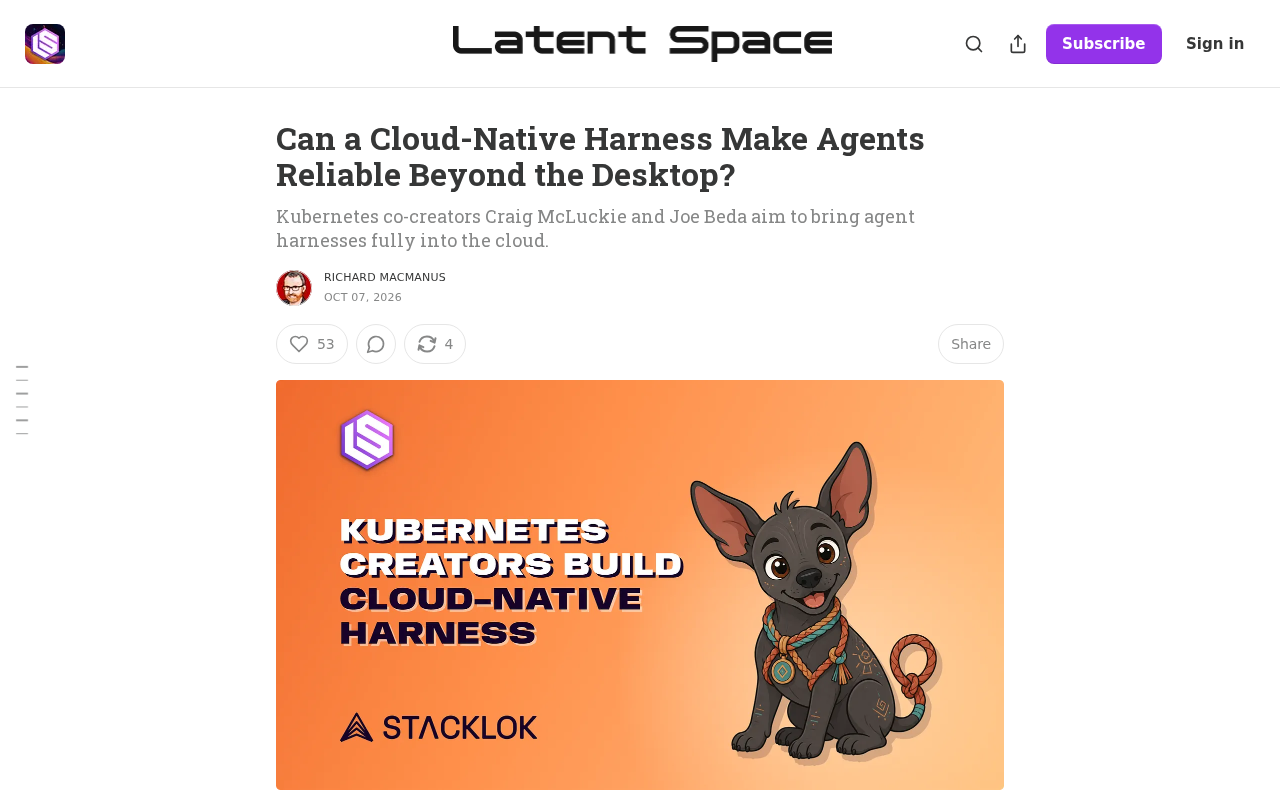
Craig McLuckie and Joe Beda — the two co-founders of Kubernetes — are tackling an increasingly prominent problem in AI engineering today: how to make AI Agent Harness truly run in the cloud, rather than being tethered to local desktop environments.
Why Are Current Agent Harnesses Stuck in the "Desktop"?
An Agent Harness is the middle layer connecting large language models to external tools, data sources, and execution environments. It handles prompt orchestration, tool invocation, state management, and error recovery. Most mainstream implementations today run as a lightweight process or container on the developer's local machine.
This model is highly efficient during prototyping, but once it enters production, problems surface quickly. A locally-run Agent Harness faces three core contradictions:
Lack of persistence. Local processes are interrupted when the developer's laptop sleeps or the terminal closes. For a task-oriented agent that needs to run continuously for hours or even days, this is a fatal flaw.
Non-reproducible environments. Different developers' local environments differ in dependency versions, operating systems, and available tools, causing the same Harness to behave inconsistently across machines.
Weak security isolation. Agents need to call external tools, execute code, and access sensitive data, but local environments often lack strict sandboxing and permission boundaries.
McLuckie and Beda's assessment is clear: Agent Harness needs to become a first-class citizen in the cloud-native ecosystem, just like any other infrastructure.
What Is an Agent Harness
The concept of Agent Harness gradually took shape around 2024 with the rise of Autonomous Agents, though the industry has yet to settle on a unified name. It can be understood as the agent's "runtime shell": the large language model itself is only responsible for reasoning and generation, while the Harness is responsible for translating model output into real-world actions. Its specific responsibilities include: parsing tool-calling instructions returned by the model, dispatching external tools according to agreed protocols (such as OpenAI's Function Calling or the MCP protocol), maintaining context and intermediate state across multiple reasoning steps, handling failure retries and timeouts, and recording complete execution traces. Common open-source implementations include LangChain's AgentExecutor, AutoGPT's main loop, and the command execution layers of various Coding Agents. Precisely because it simultaneously carries state, I/O, and scheduling logic, where the Harness is deployed — locally or in the cloud — becomes the critical dividing line for production readiness.
What Does a Cloud-Native Agent Harness Need to Solve?
Migrating Agent Harness to a cloud-native architecture is not simply stuffing a local process into a container. It involves redesigning the agent's runtime model.
Judging from the two founders' technical backgrounds, their strength lies in providing declarative abstractions and orchestration capabilities for distributed systems. Kubernetes' success fundamentally comes from taking over questions like "where do containers run, how do they scale, and how do they recover" from application developers. A similar approach can be mapped onto Agent Harness:
- Persistent execution: Agent state and context are stored in the cloud, so tasks are not lost when a node is interrupted
- Elastic scaling: As task volume grows, the Harness can scale horizontally like a stateless service
- Isolation and policy: Each agent runs in its own sandbox, with permissions and data access managed centrally by the platform
- Observability: Tool invocation chains, decision processes, and exceptional events all have unified logging and tracing systems
The core value of this architecture is transforming agents from "scripts developers debug in their IDE" into "production workloads that can be handed off to ops teams to manage."
Real Challenges Facing the Cloud-Native Path
The direction is clear, but implementation is far from easy. Agent Harness differs fundamentally from ordinary microservices: it is stateful, long-running, and highly non-deterministic in behavior.
Traditional cloud-native tools excel at managing stateless services, but an agent's execution trajectory may branch, retry, or roll back at any step. This imposes new requirements on existing orchestration primitives. For example, how does an agent mid-way through multi-step reasoning create a checkpoint? When a tool call fails, what should the granularity of a retry be? How is state synchronized when multiple agents collaborate?
Another issue is latency and cost. The cloud's persistence and isolation capabilities come at the price of network round-trips and resource overhead, while agent applications are often sensitive to response latency.
McLuckie and Beda's attempt is essentially exploring an undefined problem space: what should the runtime infrastructure for AI agents look like? It is neither traditional Serverless nor a standard Kubernetes workload — it may well be a new abstraction layer.
The Impact of Non-Deterministic Execution on Orchestration Primitives
Traditional distributed systems' retry and checkpoint mechanisms are built on the assumption that "the same input produces the same output," but each reasoning step of an agent may branch differently due to sampling temperature, context window changes, or differences in external tool returns. This means retries cannot simply replay the previous operation — if a tool has already produced side effects (such as sending an email or submitting an order), blind retries would cause duplicate execution. Directions currently being explored in the industry include: introducing idempotency tokens and compensating transactions at the Harness layer, crystallizing each decision step into a serializable trajectory snapshot to enable recovery from any node, and modeling the agent lifecycle using Event Sourcing rather than traditional state machines. None of these approaches have been standardized yet, which is also the fundamental reason why Kubernetes-native primitives (such as Job and StatefulSet) are difficult to apply directly.
Implications for Developers
Even though this cloud-native Agent Harness is still in its early stages, the trend it points to is worth watching.
If your team is moving AI agents from demo to production, a locally-run Harness will quickly become a bottleneck. Thinking ahead about the three issues of state persistence, environment consistency, and security isolation is far more effective than patching things up afterward.
If the cloud-native Agent Harness matures, it means the way agents are delivered will change fundamentally — just as containers changed application delivery. At that point, the role of AI engineers will also expand from "writing prompts and tuning tools" to "designing and operating agent runtimes."
The entry of two Kubernetes co-founders is itself a signal: the infrastructure layer for AI agents is becoming the next technical battleground worth investing in.
The Shift of Responsibilities from MLOps to AgentOps
MLOps focuses on model training, version management, and observability of inference services, with the core object being stateless or lightly-stateful inference endpoints. AgentOps, by contrast, focuses on stateful, long-running agent processes that actively change their external environments, expanding the operational dimension to execution trace auditing, tool permission governance, and the dynamic balance between cost and latency. For teams that already have an MLOps system in place, AgentOps is not a replacement but a new capability layer stacked on top: model serving is still managed by MLOps, while the Harness lifecycle, sandbox policies, and trace tracking are handled by AgentOps. Whether this division of labor stabilizes depends on whether cloud-native Agent Harness can provide sufficiently standard interfaces.
One-line Summary
Two Kubernetes co-founders are driving Agent Harness toward cloud-native, solving the productionization bottleneck for agents.
Paragraph Summary
The article explores the motivations behind Kubernetes co-founders Craig McLuckie and Joe Beda pushing Agent Harness toward cloud-native architecture. Current Agent Harnesses mostly run locally on developers' machines, which is convenient for prototyping but exposes three major bottlenecks in production: lack of persistence, non-reproducible environments, and weak security isolation. The author points out that cloud-native architecture can provide persistent execution, elastic scaling, sandbox isolation, and unified observability, transforming agents from IDE scripts into production workloads deliverable to ops teams. But implementation faces real challenges: agents are stateful, long-running, and highly non-deterministic, making traditional cloud-native orchestration primitives difficult to apply directly. Questions around checkpoints, retry granularity, and multi-agent state synchronization have no standard answers yet. Latency and cost are also factors that must be weighed. The article concludes by urging developers to plan ahead for state persistence, environment consistency, and security isolation, and predicts that AI agent runtime infrastructure will become the next technical battleground.
Related articles

Uber Deploys ChatGPT Work Company-Wide: AI in the Workplace Enters the Scaled Implementation Phase
Uber deploys ChatGPT Work to 30,000+ employees, extending it from engineering to all roles. We analyze its expert-engineer pairing, end-to-end automation, and questions of AI control and power concentration—insights for scaling AI in the workplace.

Shift at Midnight Hands-On: When "ID Verification" Becomes Alien Hunting
Shift at Midnight blends ID verification with horror survival in a four-player co-op game. We break down its inspection mechanics and chaotic humor.

Zelensky Recounts the Outbreak of War: I Need Ammunition, Not a Ride
Zelensky recalls the first day of war in a YouTube interview: farewell to family, rejecting Biden's evacuation offer with "I need ammunition, not a ride," and how Bucha shaped his stance on compromise and peace talks.