Can Cognition's $48B Valuation Hold Up? Breaking Down the AI Coding Unicorn's Financials

Cognition raises $2B+ at 53x P/S, betting its $48B valuation on sustained autonomous coding growth.
Cognition reached a $48 billion valuation in its latest Series E, driven by its flagship product Devin — an AI agent positioned around end-to-end autonomous coding. Its annualized run rate has grown to nearly $900M, keeping the P/S multiple roughly flat at 53x and making the valuation internally consistent. However, the risks are clear: the company burns an estimated $800M per year (mostly on NVIDIA server leases), its moat depends on a technical autonomy lead that rivals are actively closing, and its projection of $4–5B in 2027 revenue leaves no room for a growth slowdown. At $48B, this is fundamentally a bet on whether compounding growth will continue.
AI coding startup Cognition has seen its valuation soar to $48 billion — roughly 53 times its revenue. The company, which shot to fame with its AI coding agent Devin, is pushing the market's imagination around "autonomous programming" to the extreme. But when you divide valuation by revenue, do these numbers actually hold up?
From Zero to $48B: A Steep Valuation Curve
Cognition is a relatively young company. Its flagship product, Devin, is positioned as an AI agent capable of autonomously planning, writing, and fixing code — emphasizing "less human intervention" compared to more assistive tools like GitHub Copilot.
Its valuation trajectory has been textbook steep: reportedly around $10 billion in September of last year, climbing to $26 billion by May, and now pushed to $48 billion in the latest Series E announced this month. The round raised over $2 billion, led by Andreessen Horowitz (a16z) and Axel, with early backers Founders Fund, General Catalyst, and Avenir continuing to participate.

A nearly fivefold increase in valuation within a matter of months speaks volumes about how aggressively capital is betting on the AI coding space.
Devin made its public debut in March 2024, attracting widespread attention as "the world's first AI software engineer." Unlike code completion tools such as GitHub Copilot or Cursor, Devin is designed to receive a high-level task description and then autonomously break it into subtasks, invoke terminals and browsers, write and run code, identify errors, and self-correct — all without step-by-step human intervention. This "end-to-end autonomy" paradigm relies technically on large models' long-context planning capabilities and tool-use architecture, allowing the agent to maintain state and iterate within a persistent sandbox environment. This differentiated positioning made Cognition the first in the AI coding space to be labeled a "replacement for junior engineers," laying the narrative groundwork for the premium capital is willing to pay.
53x Price-to-Sales: Rational or Bubble?
Underpinning this valuation is an equally fast-moving revenue number. Cognition's annualized run rate grew from $492 million in May to nearly $900 million at the time of the announcement.
Dividing the $48 billion valuation by $900 million in revenue yields approximately 53x price-to-sales — roughly the same multiple investors paid in the previous round.
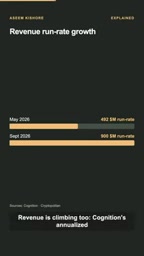
In other words, the valuation increase has been almost entirely "offset" by the simultaneous growth in revenue — the P/S multiple hasn't inflated further. From this perspective, the pricing is rational. But the conditions are extremely demanding: growth must continue compounding at its current pace.
That is precisely where the risk lies. A 53x price-to-sales ratio is not cheap. It is fundamentally paying for the future. If the growth curve slows, that multiple will quickly start to look expensive.
The price-to-sales ratio (P/S) is a commonly used valuation metric for high-growth tech companies, calculated by dividing total valuation by annualized revenue. Traditional software companies typically trade at 5x to 15x P/S, while high-growth SaaS companies can reach 20x to 40x in bull markets. A 53x multiple means investors are willing to pay $53 for every $1 of current revenue, implying that compound growth over the coming years will make today's revenue look trivial. It's also worth noting that "annualized run rate" is not realized full-year revenue — it's an estimate derived by scaling up a recent period (such as a single month or quarter) to an annual figure. This metric reflects the latest momentum during rapid expansion but can mask seasonal fluctuations or early signs of deceleration, introducing an optimistic bias into P/S calculations based on it.
The Moat Is Called "Autonomy" — But Can It Hold?
Cognition's premium is built on Devin's autonomous capabilities. The market's willingness to pay a high multiple rests on the core belief that Devin is ahead of competitors in "autonomously completing programming tasks."

But this moat is not solid. Competition among AI coding tools is fierce — from Microsoft's GitHub Copilot to various open-source agent frameworks, every player is racing toward greater autonomy. If rivals close the gap with Devin, the core narrative supporting a $48 billion valuation starts to unravel, and the price becomes very difficult to justify.
Premiums built on technical leadership are often the most fragile. Unlike network effects or data moats, which are self-reinforcing, a technology lead faces a constant risk of being caught up.
The Cost of Autonomy: Burning $800M a Year
High autonomy doesn't come free. Cognition is estimated to burn through roughly $800 million this year, most of it on leasing NVIDIA servers to run and train its models.

Nearly $900 million in annualized revenue against roughly $800 million in cash burn means the company is essentially earning and spending in the same breath, with profitability still a distant prospect. For AI companies, compute costs are an unavoidable hard constraint — the bills for training and inference rise in lockstep with the scale of the business.
This also explains why Cognition must keep raising capital: maintaining technological leadership while paying enormous compute bills keeps cash flow pressure perpetually present.
AI companies' compute cost structures are fundamentally different from those of traditional software companies. Once a traditional SaaS product is built, marginal serving costs are minimal, and scaling brings significant margin improvement. But AI agents like Devin require multiple rounds of large-model inference for every task execution, plus continuous fine-tuning and training to maintain a competitive edge — making GPU compute a variable cost that scales nearly linearly with revenue. Cloud rental prices for NVIDIA H100/H200 servers are steep, with large-scale usage potentially reaching tens of millions of dollars per month. This means Cognition cannot naturally march toward profitability as revenue grows the way traditional software companies do — unless industry-wide inference cost reductions bring prices down dramatically, or the company achieves significant economies of scale through investment in its own hardware. The $800M burn against $900M in revenue reflects the "high revenue, low margin" predicament facing AI-native companies broadly.
Betting on 2027: A 4x–5x Revenue Gamble
Cognition's own projections are even more ambitious. The company expects its annualized run rate to exceed $1.5 billion by year-end and reach $4 billion to $5 billion by 2027.
These targets assume that today's "scorching" pace of growth can be sustained. If they're realized, the current 53x P/S will look remarkably cheap in hindsight — because the revenue explosion will rapidly dilute that multiple.
But if growth falls short, investors will have paid a steep premium for a future that never arrived. That is the harsh reality of growth investing: the justification for a valuation hinges entirely on whether a set of projections comes true.
Conclusion: A Bet on Compounding Growth
Cognition's $48 billion valuation is, at its core, a bet on whether growth can continue to compound. Both sides of the ledger are clearly visible: on one side, a near-doubling annualized run rate and aggressive future projections; on the other, a fragile technological moat and $800 million in annual cash burn.
The math itself isn't wrong — 53x P/S holds up under a high-growth narrative. The real question is whether the narrative can sustain itself. Hit the projections, and this investment will prove to be exceptional value. Miss them, and it's a premium that was never earned. For anyone watching the AI coding space, Cognition's high-stakes gamble is well worth keeping an eye on.
Related articles

JobRunner MCP Server: AI Agents Can Now Fix Failed Java Jobs
JobRunner launches an open-source MCP server enabling AI agents to view cluster status, diagnose failures, and recover Java jobs—incident response from any cloud coding environment or existing agent.

MLAI Digital Launches 9 Security Agents: MCP Server Safeguards the Full Lifecycle of Agentic AI
MLAI Digital launches Security MCP Server with nine built-in specialized security agents covering vulnerability discovery, attack simulation, prompt injection detection, API and infrastructure assessment, and accelerated remediation—embedding security validation across the full Agentic AI lifecycle from development to production.

Running Isaac Lab on H100 GPUs: Exploring Better Approaches
Exploring optimization methods for running Isaac Lab on NVIDIA H100 GPUs, including MIG configuration, mixed precision, TensorRT acceleration, and community experience to improve robotics simulation and reinforcement learning efficiency.