Can Collins Escape the Shadow of Trump's Low Approval in Maine?

Collins needs her bipartisan voting record to escape Trump's low approval drag in Maine and win reelection in 2026.
The article analyzes Maine Senator Susan Collins's dilemma in her 2026 reelection bid: Maine voters view Trump negatively, so Collins must distance herself from the president to win moderates. She stresses voting with Biden 91% of the time and against Trump 137 times to project independence. But criticism that she is 'not anti-Trump enough' remains her main weakness. Her strategy is 'political gravity suspension,' with the risk that over-distancing from Trump could alienate the Republican base.
In Maine, Senator Susan Collins is facing a difficult political balancing act. With President Trump's approval ratings persistently low, the Republican must try to transcend the president's political gravity in a state that does not approve of Trump's performance. According to YouTube political commentary, Collins is a typical Republican candidate in this election—she must "suspend political gravity" to win reelection in a state that views Trump negatively.
Maine's Electoral Landscape Under Trump's Shadow
Maine is a politically diverse state, but in recent years its evaluation of Trump has been clearly negative. The commentary notes that in a state that "really does not approve of his presidential job performance," Collins needs to project an independent image distinct from the president. Such divisions are not uncommon in electoral politics, but they are particularly tricky for Collins because she needs both the support of the Republican base and the backing of moderate voters and Democrats who are dissatisfied with Trump.

Maine uses a unique "congressional district" method for counting votes in U.S. presidential elections: the statewide popular vote winner takes 2 electoral votes, and the winner in each of the two congressional districts gets 1 each. This makes the state one of the few that can split its electoral votes; Trump won the Second Congressional District in both 2016 and 2020. In addition, Maine senators serve six-year terms, and Collins's seat is up for election in 2026. The state's electorate overall leans "fiscally moderate, socially open," with a high proportion of independent voters, so statewide elections tend to be more volatile than presidential results, and candidates' personal images and bipartisan records often carry more weight than party labels.
Collins's "Anti-Trump" Voting Record
To distance herself from Trump, Collins has emphasized her voting record. In the video, she stated bluntly: "I voted with President Biden 91% of the time." She added, "This year alone, this Congress alone, I have voted against President Trump 137 times." This strategy aims to prove her independence to voters, especially to build trust among those dissatisfied with Trump.
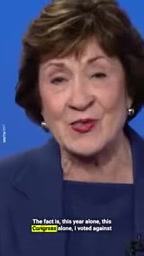
The phrase "voted with Biden" in congressional context does not equate to supporting Biden personally; it refers to voting for legislation or nominations proposed by the Biden administration. As a Republican, Collins is often seen as one of the few senators willing to vote across party lines—for example, she supported some of the Biden administration's infrastructure bills and judicial nominations. But the two figures—"91% with Biden" and "137 against Trump"—require careful interpretation: the former may cover many procedural votes and bipartisan consensus bills, while the latter may include opposition to Trump administration executive nominations or policy reversals. In campaign messaging, such percentages and counts are often used to shape an independent image, but their specific statistical basis often depends on the selected vote sample and time frame.
Historical Attacks and the 2026 Challenge
Collins has long faced criticism for "not opposing Trump enough." The commentary notes that this was a major attack line in her 2020 campaign, which she won during Trump's first term with Trump himself on the ballot. Now, the impeachment cases and Trump's first year and a half in office are described by the commentary as Democratic "pain points," making Collins's 2026 reelection bid destined to be a focal battle.

The commentary argues that Maine's race is "most compelling" because Collins has consistently been attacked for "not standing up to Trump enough." This persistent attack line, combined with the controversies of Trump's early tenure, makes Collins's path to reelection challenging.

The impeachment cases became focal points in U.S. politics in 2019-2020 and 2021. The first concerned Trump pressuring Ukraine to investigate Biden; the second concerned the January 6, 2021, Capitol riot. Collins voted to acquit Trump in the first impeachment trial but voted to convict him in the second—a bipartisan move that drew widespread attention at the time. The impeachment cases remain important material for Democrats attacking Republicans, especially among independent voters, where views on Trump's role in the Capitol events are clearly divided. For Collins, she needs to re-explain these votes during the 2026 campaign cycle—neither fully denying the party base's stance on impeachment nor failing to show moderate voters that she has crossed party lines.
Strategy and Prospects
Collins's strategy is essentially "political gravity suspension"—attracting independent voters in a state that disapproves of the president by emphasizing her bipartisan voting record. However, the risk is that overemphasizing differences with Trump could alienate the Republican base, and Trump supporters may be displeased with her "betrayal" record. The commentary does not offer a clear conclusion but notes that the race's appeal lies in how Collins can win amid this dilemma.
Overall, Collins's reelection prospects depend on whether she can successfully convince Maine voters that she is an independent representative, not Trump's proxy. With Trump's approval ratings low, this task is both full of opportunity and fraught with risk.
"Political gravity" is a common metaphor in election analysis, referring to how a president's approval rating can pull down or drag down candidates of the same party down-ballot. When a president is unpopular in a state, candidates from the same party often need to distance themselves from the president, or even publicly express disagreement, to mitigate the "gravity" drag. Collins's special situation is that she is neither a staunch Trump ally nor has she been an explicit critic, so her "suspension" strategy requires precise distance control: too close and she loses independent voters; too far and she angers the Republican base. In the 2026 election cycle, whether Trump personally intervenes in Maine's race and what kind of opponent emerges from the Democratic primary will affect the practical effectiveness of this balance.
One-line Summary
Collins must use her bipartisan voting record to escape the drag of Trump's low approval in Maine and win reelection in 2026.
Paragraph Summary
The article analyzes Maine Senator Susan Collins's dilemma in her 2026 reelection campaign: Maine voters view Trump's performance negatively, and Collins must distance herself from the president to win over moderate voters. She emphasizes voting with Biden 91% of the time and against Trump 137 times, trying to shape an independent image. But long-standing criticism that she is "not anti-Trump enough" remains her main weakness, already evident in her 2020 campaign. The commentary argues that Collins's strategy is essentially "political gravity suspension," with the risk that over-distancing from Trump could destabilize the Republican base. The race is seen as one of the most compelling campaigns, and its outcome depends on whether she can convince voters she is an independent representative rather than Trump's proxy.
Related articles

Build an AI Super Employee System at Zero Cost: A Full Breakdown of Automated Agent Workflows
A deep breakdown of the AI super employee system demoed on Bilibili: agent orchestration, digital human voiceovers, map and enterprise lead generation, 24/7 customer service, and legal modules. We analyze the business logic and compliance risks behind zero-cost signup to help entrepreneurs judge the real ROI of this AI digital employee system.

The Essential Difference Between Chatbots and AI Agents: Crossing from Conversation to Execution
What's the difference between a chatbot and an AI agent? Based on the MCP series on the Learn Tech channel, this article uses examples like booking flights and summarizing notes to explain: a chatbot only gives answers, while an agent actually completes tasks through a think-act-observe loop. It breaks down the four core components—model, tools, memory, and goal—as well as MCP's role as a bridge, and discusses agents' applicable boundaries and permission risks.

Free GitHub Repo: 342 Hours of AI Courses, from Math to MCP Servers
A free GitHub repo offers 342 hours of AI courses: 523 lessons across 20 phases, from math fundamentals to agent building and MCP servers. Nearly 100,000 learners have started.