Can Formal Methods Tame AI Agents? Lessons from OpenShell's Practice
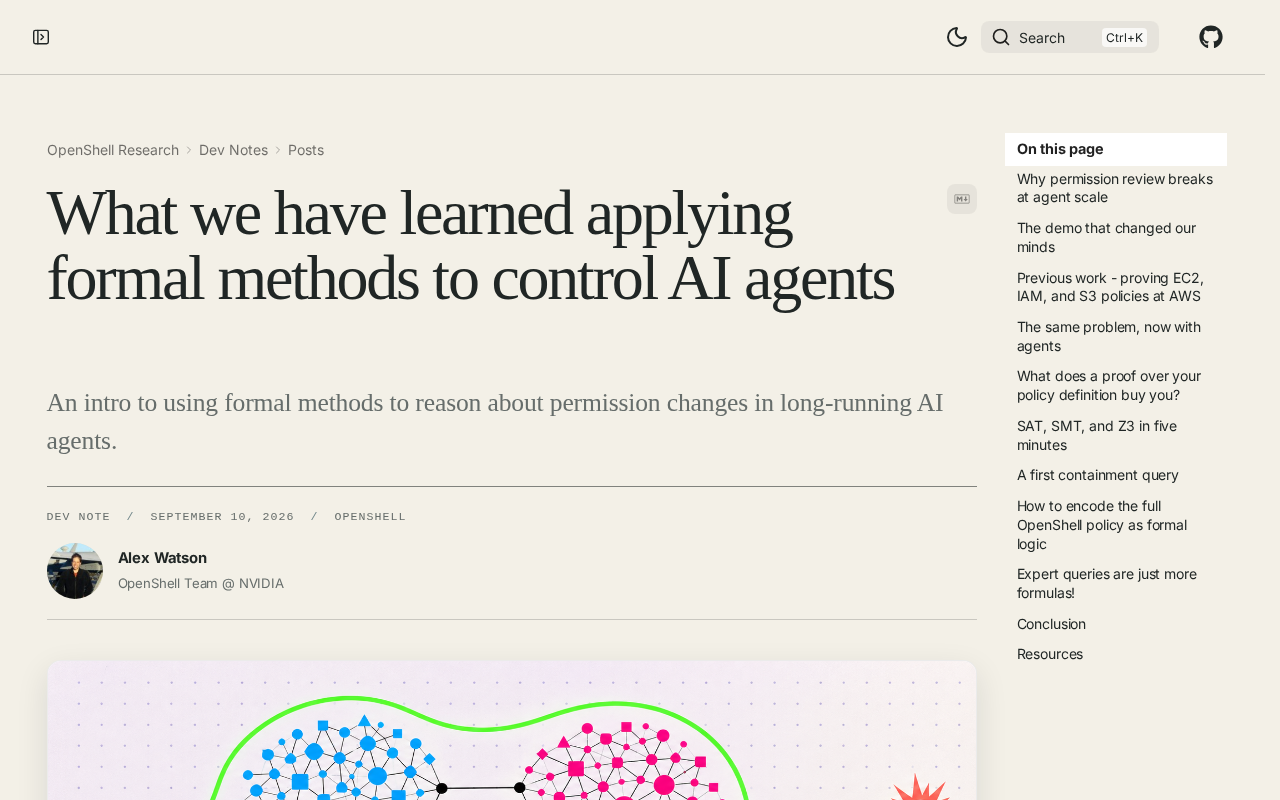
OpenShell applies formal methods to AI agents, replacing soft constraints with hard, provable safety boundaries.
As AI agents enter production, prompt engineering alone can no longer guarantee reliable behavior. OpenShell explores applying formal methods — the mathematical verification techniques from aerospace and chip design — to agent control, using hard constraints to intercept violations before execution and closing the door on threats like prompt injection. Key challenges include translating ambiguous business requirements into precise formal specifications, balancing safety with flexibility, and managing runtime verification overhead. Long term, a hybrid architecture where large models handle intelligence while formal systems enforce boundaries may become the standard paradigm for enterprise agents in high-risk domains.
When AI Agents Edge Toward Losing Control
As AI agents move from research labs into production environments, an increasingly urgent question has emerged: how do we ensure these autonomous decision-making systems always operate within controllable boundaries? OpenShell's team shared their practical experience on Hacker News, bringing formal methods from traditional software engineering into the AI agent control space — offering a compelling approach to this challenge.
While the discussion hasn't generated a huge volume of community responses, the post touches on a core pain point in real-world AI engineering. When agents can invoke tools, execute code, and access external systems, relying solely on prompt engineering and after-the-fact monitoring is no longer sufficient to guarantee reliable, safe behavior.
What Are Formal Methods, and Why Apply Them to AI Agents?
Formal methods are a set of mathematically rigorous techniques for software specification and verification, long used in fields with extreme reliability requirements such as aerospace, chip design, and financial protocols. The core idea is to describe system properties using strict mathematical language, then use formal verification techniques — such as model checking or theorem proving — to prove that system behavior conforms to those specifications.
The logic for applying this methodology to AI agent control is clear and compelling. Large language model–driven agents are inherently probabilistic and nondeterministic systems whose outputs are difficult to fully predict. Formal methods provide a layer of deterministic constraint boundaries — regardless of how the model "thinks" internally, the actions it can execute must fall within a pre-defined, verified safety envelope.
From Probabilistic Control to Hard Constraints
Traditional agent safety strategies typically rely on "soft constraints": using system prompts to tell the model "don't perform dangerous operations," or using another model to review outputs. These approaches are useful, but they carry the risk of being bypassed (e.g., via prompt injection attacks). Formal methods attempt to establish "hard constraints" — encoding safety rules as inviolable logical specifications that are verified before any action is executed, fundamentally eliminating the possibility of violations.
The main technical approaches in formal methods fall into two broad categories: model checking and theorem proving. Model checking verifies properties by exhaustively exploring the system's state space; representative tools include SPIN and NuSMV. Theorem proving constructs mathematical proofs that properties hold; representative tools include Coq and Isabelle. For agent control scenarios, there is also a lighter-weight form of application: runtime verification, which rather than pre-enumerating all states, dynamically checks at runtime whether each action satisfies predefined safety specifications — with relatively manageable computational overhead, making it more suitable for production deployment. Design by Contract is another common entry point, defining preconditions and postconditions for each tool call and automatically intercepting operations that violate constraints when the agent invokes external capabilities.
Prompt injection is one of the most prominent threats in current agent security, and understanding it helps clarify why hard constraints are necessary. Attackers embed text disguised as instructions within external data (such as web content, documents, or emails), tricking the agent into misidentifying malicious content as legitimate user instructions — leading to unauthorized actions such as leaking private data, sending requests to third parties, or even manipulating other systems. Because large language models struggle to reliably distinguish "data" from "instructions" at the semantic level, relying purely on the model's own judgment is inherently fragile. This is precisely where the value of formal methods' hard constraints lies: regardless of what content has been injected into the agent or what reasoning it produces, the set of actions it can actually execute is constrained by a logical layer independent of the model itself — attackers cannot bypass this verification layer by manipulating model inputs.
Key Takeaways from OpenShell's Practice
According to OpenShell's writeup, applying formal methods to AI agent control is far from straightforward. This type of work typically reveals challenges and insights across several dimensions:
The difficulty of defining specifications. Formal verification requires being able to describe "what constitutes safe behavior" precisely in mathematical language. But AI agent use cases are often open-ended and ambiguous; translating business requirements into formal specifications is itself complex work that demands specialized expertise. This has long been one of the primary barriers to broader adoption of formal methods.
The trade-off between verification and flexibility. The stricter the constraints, the safer the system — but also the more likely they are to limit the agent's creativity and adaptability in solving problems. Finding the right balance between "controllable" and "usable" is a core engineering challenge that requires constant tuning in practice.
Performance overhead of runtime verification. Performing a formal check before each step of the agent's decision-making introduces additional computation and latency costs. Designing an efficient runtime monitoring mechanism so that verification doesn't become a system bottleneck is a critical engineering challenge for production deployment.
Industry Significance of This Direction
The combination of formal methods and AI represents a pragmatic and important technical direction within the broader field of AI safety. Compared to relying purely on model alignment or manual review, it provides an auditable, provable assurance mechanism — which is critical for deploying AI agents in high-stakes domains such as finance, healthcare, and industrial control.
It's foreseeable that as agent autonomy increases, this kind of hybrid architecture — "open capabilities, constrained behavior" — will attract growing attention: letting large models handle intelligence and creativity, while letting formal systems handle boundaries and safety. This division of responsibility may become one of the standard paradigms for enterprise-grade AI agents.
Implications for Developers
For teams currently building agent applications, OpenShell's exploration offers at least three key takeaways: first, safety constraints should be designed early rather than retrofitted after the fact; second, start with critical high-risk actions and apply formal constraints there first, rather than pursuing comprehensive coverage from the outset; third, toolchain maturity will directly determine the feasibility of this approach — lowering the barrier to writing formal specifications is key to broader adoption.
Model alignment and formal methods play different roles in AI safety and are not alternatives to each other — they are complementary. Alignment research focuses on establishing correct values and behavioral preferences during training, so the model "wants to do the right thing." Formal methods impose external constraints during inference and execution, ensuring that even if the model experiences alignment drift or is attacked, its behavior remains within acceptable boundaries. The analogy to human society: alignment is like moral education, while formal constraints are like laws and institutions. The problem with relying solely on alignment is that it is difficult to audit and prove externally — we cannot directly observe whether a model "is truly aligned." Formal specifications, by contrast, are explicit and checkable, providing verifiable safety guarantees for regulators and users alike — a value that is irreplaceable in compliance scenarios within regulated industries such as finance and healthcare.
Conclusion
OpenShell's writeup is concise, but it points toward a tremendously valuable technical intersection. While the entire industry races to build more powerful agent capabilities, figuring out how to put reliable "reins" on those capabilities is equally critical to determining whether AI can truly succeed in production. Formal methods may not be the only answer, but they offer a rigorous engineering path toward controllability for AI agents — one that deserves continued attention.
Related articles
DeepSeek Harness in Practice: Building a Low-Cost AI Coding Powerhouse
Learn how to transform DeepSeek's open-source harness using Claude Code, Bright Data scraping, and vision models to build an AI coding workflow costing just half a cent per task.
Overseas Developer Tests: DeepSeek Already Rivals Opus — Stop Waiting for the Next Model
An overseas developer finds DeepSeek V4 Pro rivals Opus 4.8 at a fraction of the cost. Learn how DeepSeek + BrightData compares to Claude Code for building SaaS.
DeepSeek V4.1 Flash Hands-On: Can a Small-Activation New Architecture Top the Open-Source Charts?
DeepSeek V4.1 Flash deep dive: new MoE encoder-decoder architecture, 552B total params, tiny active params, reduced KV cache. Open-source on Hugging Face. Full hands-on test from BrowserOS to 3D printing.