Can Gemini 4 Neon Replace Opus 5.5? A Day of Hands-On Testing Reveals Mixed Feedback
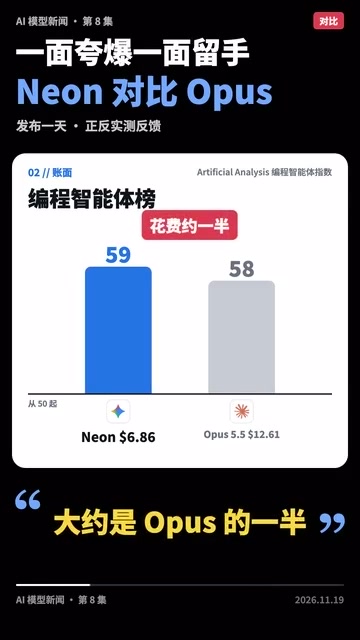
Gemini 4 Neon matches Opus's score at half the price—bright spots on isolated tasks, but complex engineering still falls short.
Gemini 4 Neon nearly matches Opus 5.5's Coding Agent Benchmark score (58 vs 59) at roughly half the per-task cost ($6.86). Community feedback is polarized. Positively, Neon solved in one round algorithmic challenges that stumped Opus plus two other models across multiple rounds, and its frontend UI component and everyday writing experience was praised as more comfortable than Opus. Negatively, at the highest reasoning tier Neon took 20 minutes and $3.50 yet produced far worse results than Opus; cross-file changes spanning five files required Opus to finish; and in a hardware circuit board test, Neon's design looked best but had incomplete routing and poor footprint choices, exposing multi-step planning weaknesses. Conclusion: Neon works as a budget substitute for isolated hard problems and frontend interfaces, but large projects still need Opus as a safety net.
Introduction: The Allure and Controversy of a Budget Alternative
When Opus 5.5 scored 59 on the Coding Agent Benchmark, its cost of roughly $13.72 per task gave many developers pause—after all, not everyone can afford a Claude subscription. Gemini 4 Neon nearly matched it with a score of 58, while costing only $6.86 per task—about half of Opus. Just one day after this so-called "budget replacement" model launched, community feedback has split sharply into two camps: some exclaim "solved in one round what Opus got stuck on," while others bluntly state "Opus is still much better." This article compiles hands-on reports from multiple sources to break down Gemini 4 Neon's real capability boundaries from both positive and negative angles.
The Coding Agent Benchmark is a standardized test suite for evaluating large language models' ability to act as autonomous coding agents. It typically covers multi-step task planning, tool calling, code generation, and debugging, while tracking task success rate, time consumed, and API cost. Unlike traditional code completion benchmarks (such as HumanEval), this type of leaderboard focuses more on a model's overall performance at "independently completing a task" in real engineering scenarios—so a 1-point gap often corresponds to significant differences in task type coverage.
Per-task cost refers to the API call fees consumed by an agent to complete a full task, determined jointly by input/output token pricing and the number of inference rounds. It is not the same as the model's own rate—higher reasoning tiers and more frequent tool calls drive up per-task cost. Therefore, when comparing "per-task cost" across different models, one must check whether the test task set and inference configuration are consistent.
Positive Feedback: Surprises on Isolated Hard Problems and Frontend Experience
Algorithmic Challenge Solved in One Round
According to a Bilibili creator's share, a user tested two algorithmic problems that had stumped Opus and two other models working together across six and nine rounds respectively—Neon solved them in just one round. This "surgical strike" capability is highly appealing in specific scenarios—when the problem boundary is clear and the reasoning path well-defined, Neon shows potential on par with or even better than Opus.
Smoother with UI Components and Everyday Communication
Multiple respondents mentioned that Neon feels "more comfortable than Opus" for building UI components, everyday writing, and communication tasks. Some users praised its output style as more intuitive and its interaction flow as satisfying. For frontend development and lightweight content creation, Neon seems to have found its comfort zone.

Negative Testing: Complex Engineering and the Cost Paradox
Head-to-Head: Opus Still Leads
Negative voices are equally direct. Someone ran the same prompt at the highest reasoning tier: Neon took 20 minutes and $3.50 (still half the cost of Opus's $7.20), but "Opus still did much better." This suggests that on tasks requiring deep reasoning and high-quality output, Neon's cost-effectiveness advantage may be offset by the quality gap.

Hardware Design Exposes Weaknesses
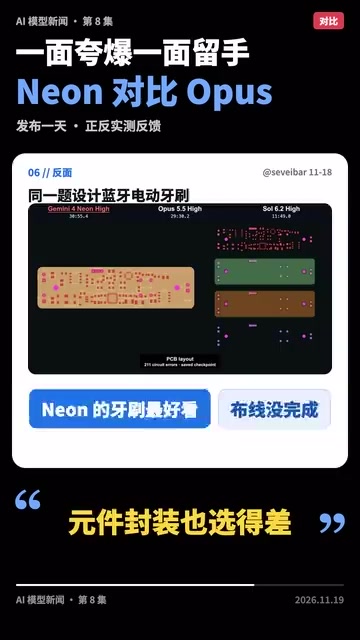
A test involving drawing a Bluetooth electric toothbrush circuit board is quite telling: Neon's toothbrush "looked the best," but the routing was incomplete and component footprints were poorly chosen. This reveals that in tasks requiring multi-step precise planning, Neon may prioritize visual presentation at the expense of engineering completeness—a critical shortcoming for scenarios with low tolerance for error, such as hardware design.
Component footprint is the physical dimensions and pad layout definition of a component on a PCB, which must strictly match the actual pin pitch and pad shapes—otherwise soldering may fail or electrical connections may break. Routing is the process of planning copper traces on board layers to connect pins according to the circuit schematic, while satisfying both electrical rules (trace width, spacing, impedance) and signal integrity requirements. Both tasks rely on multi-step precise planning and global constraint checking, making them key scenarios for evaluating whether a model has "engineering manufacturability" awareness—a good-looking render does not mean the design is usable.
Cross-File Code Changes Still Need Opus to Finish
Some users reported that code changes spanning five files ultimately still needed Opus to wrap up. Multi-file coordination and global consistency maintenance are precisely the deep waters of agentic coding, and Neon still appears inexperienced in such tasks.
Subscription Quotas and Feel: Polarized
Regarding the durability of subscription quotas, user perceptions are similarly split. Some believe Neon's quota goes further, while others feel the difference is minimal. The Bilibili creator themselves said "I also found it handy in my own use," implying that for light everyday use, Neon's experience is satisfactory enough. This divide may stem from differences in use cases: isolated tasks consume little, while complex tasks can quickly burn through quotas.
Conclusion: Who Should Use Neon, Who Should Stick with Opus
Based on a day's worth of positive and negative feedback, Gemini 4 Neon's positioning is becoming clear:
- Scenarios suited for Neon: Isolated algorithmic challenges, frontend UI components, everyday writing and communication. In these tasks, Neon shows capability on par with Opus at half the cost.
- Scenarios still requiring Opus: Large cross-file codebases, hardware circuit design, and other tasks demanding precise multi-step planning and global consistency. Neon may deliver results that are "good-looking but unusable."
If Claude isn't an option for you, Neon is absolutely worth considering as a budget replacement for isolated hard problems and frontend interfaces; but for large projects, it's advisable to keep Opus as a safety net. As the Bilibili creator put it: "For isolated hard problems and frontend interfaces, you can totally rely on it—just keep a backup in mind for big projects."
Follow new model feedback to get hands-on updates as they happen.
One-line Summary
Gemini 4 Neon matches Opus's score at half the price—shines on isolated tasks but lags on complex engineering.
Paragraph Summary
Gemini 4 Neon nearly matches Opus 5.5's Coding Agent Benchmark score of 59 with a score of 58, at a per-task cost of $6.86—about half. Community feedback is polarized. On the positive side, Neon solved in one round algorithmic challenges that stumped Opus and two other models across multiple rounds, and its frontend UI component and everyday writing experience was praised as more comfortable than Opus. On the negative side, hands-on tests at the highest reasoning tier show Neon taking 20 minutes and $3.50 while still producing far worse results than Opus; cross-file code changes spanning five files required Opus to finish; and in a hardware circuit board test, Neon's design looked best but had incomplete routing and poor footprint choices, exposing weaknesses in multi-step planning. The conclusion: Neon can substitute for isolated hard problems and frontend interfaces, but large projects still need Opus as a safety net.
Related articles

AI and Mathematicians Collaborate to Prove the Riemann Hypothesis? The Controversy Behind 1.7 Billion Lines of Lean Code
AI and mathematician Levent Alpoge used 17 million lines of Lean code to prove the Riemann Hypothesis? An AnyGeometry definition sparked controversy, yet an independent audit says the logic holds. This article explains the Riemann Hypothesis, the Yes machine controversy, and the real impact on RSA encryption.

PeppermintOS Launches Void Edition: A Lightweight Experience Without SystemD or XLibre
PeppermintOS launches PepVoid based on Void Linux, featuring XFCE and XLibre with a non-SystemD architecture. This article covers installation, software center experience, preinstalled software, and technical verification for users interested in a lightweight non-SystemD distribution.

Clojure Native Apps: Letting AI Reshape Software at Runtime
Explore how Clojure enables native apps to be reprogrammed at runtime by developers or AI, drawing on Emacs' extensibility, and analyzing REPL-driven development, AI collaboration, and challenges.