Can Hierarchical Latent Representations Replace Next-Token Prediction? An In-Depth Analysis of NCM

Reddit community discusses NCM's potential to replace next-token prediction with hierarchical VQ-VAE plus parallel Transformers, and its information-preservation limits.
This article centers on a Reddit community discussion of Next-Concept Modeling (NCM), an alternative to next-token prediction. NCM uses a two-stage architecture: first, a multi-scale VQ-VAE encodes text into coarse-to-fine discrete codebooks; then a Transformer predicts codes at each level in parallel; finally a decoder reconstructs the text. Its core appeal is trading hierarchical parallel generation for efficiency, theoretically reducing generation complexity from O(n) substantially, at the cost of potential token-level information loss from lossy compression. Community debates focus on three points: fine-grained reconstruction accuracy (especially for code and math), instability of joint training of multi-scale VQ-VAE and parallel Transformer, and similarities/differences with diffusion language models. The author notes that separate training of tokenizer and generator is the main bottleneck, and that end-to-end joint optimization, a refinement stage, and domain-specific hierarchical structures are directions worth exploring.
Introduction: The Bottleneck of Next-Token Prediction and Alternative Approaches
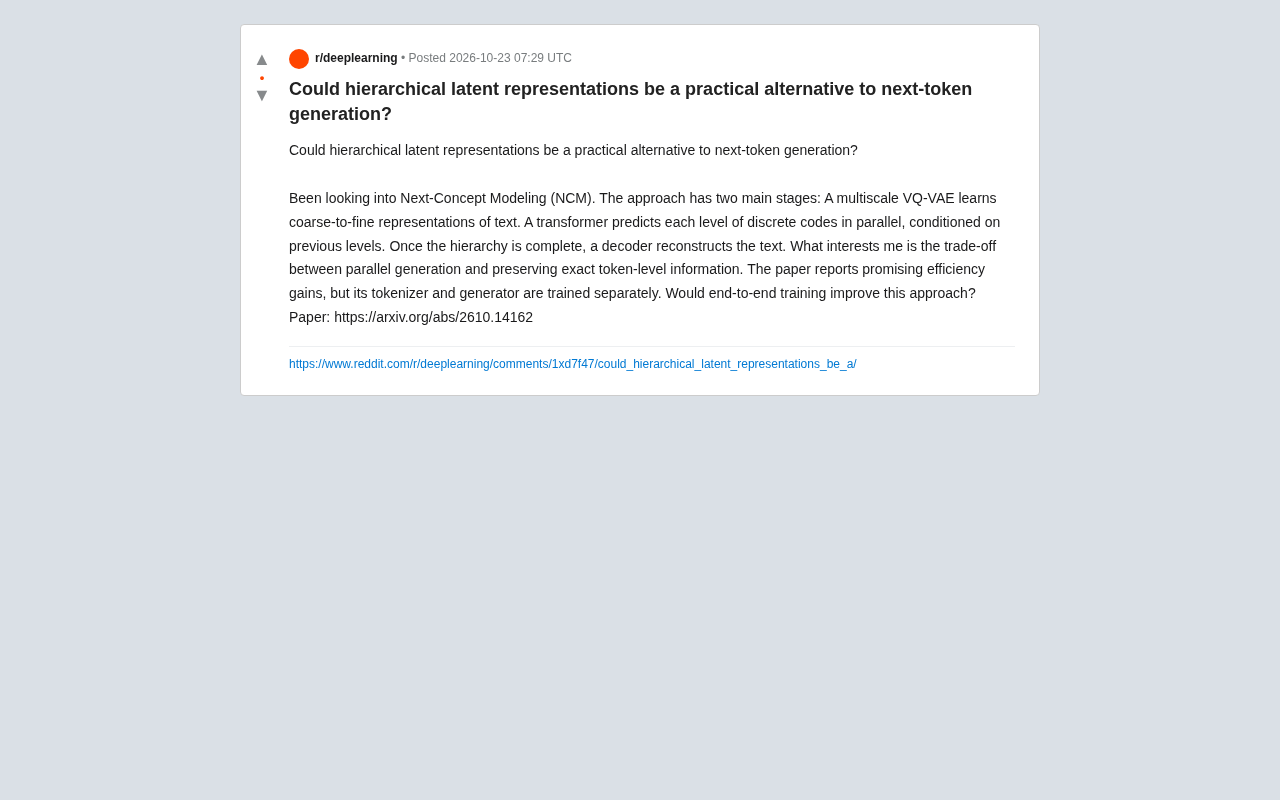
Nearly all mainstream large language models today are built on the next-token generation paradigm. This approach is simple and effective, but as model scale grows, the serial nature of generation introduces efficiency bottlenecks: each token requires a forward pass, resulting in significant latency when generating long texts. Recently, a Reddit community user explored in depth an alternative called Next-Concept Modeling (NCM), which attempts to achieve parallel generation through hierarchical latent representations, seeking a balance between efficiency and information preservation.
According to the paper cited by the user (arXiv:2610.14162), the core idea of NCM is: first use a multi-scale VQ-VAE to learn coarse-to-fine representations of text, then have a Transformer predict the discrete codes at each level in parallel, and finally reconstruct the text through a decoder. This design has sparked discussion about "whether parallel generation can preserve precise token information." This article combines community perspectives to analyze the potential and limitations of NCM.
NCM's Two-Stage Architecture: From Multi-Scale VQ-VAE to Parallel Prediction
Multi-Scale VQ-VAE: Coarse-to-Fine Text Representation
The first stage of NCM is training a multi-scale VQ-VAE that encodes text into discrete codebooks at different granularities. Coarse-grained levels may correspond to sentence- or phrase-level semantics, while fine-grained levels approach word-level information. This hierarchical design mimics the layered nature of human language understanding: first grasping the overall intent, then refining to specific expressions.
VQ-VAE (Vector Quantized Variational Autoencoder) is a class of generative models that discretizes continuous representations. Its core mechanism maintains a learnable codebook; the encoder maps input to a continuous vector, which is then replaced through nearest-neighbor lookup with the closest discrete vector in the codebook, and a decoder reconstructs the input from these discrete codes. Since the nearest-neighbor operation is non-differentiable, VQ-VAE employs a straight-through estimator to backpropagate gradients from the decoder to the encoder. The training objective typically includes three terms: reconstruction loss, codebook alignment loss, and commitment loss. A key characteristic of VQ-VAE is its ability to learn discrete and compact representations, but its training is sensitive to codebook size and initialization and is prone to codebook collapse—where only a few codewords are activated while most remain idle. Multi-scale VQ-VAE builds on this by introducing multiple codebook levels, each capturing information at different granularities, echoing the hierarchical vector quantization approach in image generation.
Parallel Transformer Prediction
The second stage uses a Transformer to predict the discrete codes at each level in parallel, with each level's prediction conditioned on the previous level. This means the model can simultaneously generate code sequences at multiple levels, rather than serially generating token by token as autoregressive models do. Theoretically, this parallelism can substantially improve generation speed, especially in long-text scenarios.
Non-Autoregressive Generation is a paradigm opposed to autoregressive token-by-token generation. Autoregressive models decompose sequence probability into a product of per-token conditional probabilities, so generating the t-th token requires waiting for the first t-1 tokens to complete, making parallelism impossible. Non-autoregressive models assume that positions (or levels) are conditionally independent to some degree, allowing multiple outputs to be produced at once or in hierarchical parallel fashion. Early non-autoregressive machine translation work achieved parallel decoding through a "bag-of-words" assumption but often lost fluency by ignoring inter-token dependencies. NCM's parallel prediction belongs to "hierarchical conditional non-autoregression": parallel within the same level, with conditional dependencies between levels, thus striking a compromise between efficiency and structural coherence. Understanding this paradigm helps position NCM relative to classical autoregressive and purely non-autoregressive methods.
Decoder Reconstruction of Text
Once the hierarchical codes are complete, the decoder is responsible for restoring the discrete codes to the original text. The key challenge here is: whether the discrete codes retain sufficient token-level information to ensure reconstruction accuracy. The paper reports promising efficiency gains, but community users point out that its tokenizer and generator are trained separately, which may limit overall performance.
The Trade-off Between Efficiency and Information Preservation
The most appealing aspect of NCM is the trade-off between parallel generation and precise information preservation. Autoregressive models generate token by token, naturally guaranteeing each token's accuracy, but speed is limited by sequence length. NCM, through hierarchical parallel prediction, can theoretically reduce generation complexity from O(n) to O(log n) or lower, at the cost of potentially losing fine-grained information.
The core question raised by the Reddit user is: Can end-to-end training improve this trade-off? Currently NCM's tokenizer (VQ-VAE) and generator (Transformer) are trained independently, meaning the generator may not fully exploit the representational properties learned by the tokenizer, and vice versa. End-to-end training could allow both to be optimized jointly, but would also increase training difficulty and computational cost.
Community Discussion and Points of Contention
In the Reddit discussion, users raised several concerns about NCM's feasibility:
- Information loss: Hierarchical discrete codes are essentially lossy compression of text. Can the original tokens be perfectly reconstructed at the fine-grained level? Especially for scenarios requiring precise characters, such as code and mathematical formulas, latent representations may fall short.
- Training complexity: Multi-scale VQ-VAE is itself unstable to train, and combined with joint optimization of the parallel Transformer, end-to-end training may face challenges such as gradient propagation and codebook collapse.
- Comparison with diffusion models: Some users noted that NCM's approach shares similarities with diffusion language models—both generate text through iterative or parallel refinement—but NCM's hierarchical structure is more structured.
Despite the controversies, the efficiency gains reported in the paper are still worth attention. If end-to-end training can solve the information preservation problem, NCM may offer a practical alternative for specific scenarios (such as long-text summarization and dialogue systems).
Codebook Collapse is a typical failure mode in training VQ-type models: the encoder tends to map all inputs to a very small number of codewords in the codebook, leaving the rest never used, so the effective capacity of the discrete representation falls far below the designed capacity. Causes include poor codebook initialization, overly concentrated encoder output distributions, and desynchronization between codebook updates and encoder optimization. Common mitigation methods include exponential moving average codebook updates, restarting inactive codewords, and introducing entropy regularization or commitment loss for codebook usage. In multi-scale VQ-VAE, coarse-grained levels have smaller capacity and fine-grained levels have larger capacity; if codebook collapse occurs at the fine-grained level, it will directly weaken the retention of token-level information, thereby exacerbating NCM's risk in precise reconstruction. Thus, the community's concerns about training complexity are not unfounded.
Future Directions: End-to-End Training and Hybrid Architectures
The end-to-end training idea proposed by the user is a natural extension of NCM's development. Specifically, one could try:
- Jointly optimizing tokenizer and generator: Train VQ-VAE and Transformer under a unified loss function so that discrete codes better adapt to the generation task.
- Introducing residual connections or a refinement stage: After coarse-grained generation, use a lightweight autoregressive model to correct fine-grained information, balancing efficiency and precision.
- Customizing hierarchical structures for specific domains: For example, in code generation, use syntactic structure as the coarse-grained level and tokens as the fine-grained level.
These directions still require experimental validation, but NCM opens up new ideas beyond next-token prediction. For AI researchers and engineers, following progress in hierarchical latent representations may reveal new breakthroughs in efficiency-sensitive applications.
Conclusion
Hierarchical latent representations as an alternative to next-token prediction are still at an exploratory stage. NCM demonstrates the potential of parallel generation, but the separate training of tokenizer and generator leaves room for improvement. Whether end-to-end training can unlock its full potential will be key to future research. This Reddit discussion reminds us: while pursuing efficiency, we must not neglect the baseline of linguistic precision. For this direction, staying informed and evaluating rationally may be more important than blindly jumping on the bandwagon.
Background Supplement
Diffusion Language Models draw on the idea of image diffusion, treating text generation as a process of gradually denoising from noise. Continuous diffusion on text requires embedding discrete tokens into a continuous space and then restoring them through multi-step denoising; discrete diffusion (such as absorbing-state diffusion) directly defines forward noising and reverse denoising processes in token space. Unlike autoregressive models, diffusion models can update all positions in parallel at each step, thus possessing parallel generation potential, but they typically require tens to hundreds of iterations, and inference cost may not be lower than autoregressive. NCM and diffusion models share the similarity of abandoning strict left-to-right token-by-token generation in favor of iterative or hierarchical refinement to gradually determine text content; the difference is that NCM organizes the generation process with explicit multi-granularity discrete codebooks, making the hierarchical structure more explicit, while diffusion models implicitly control generation granularity through noise levels.
Related articles

Altman Declares: The Cybersecurity Crisis Is Unsolvable and There Are Too Many Vulnerabilities to Patch
OpenAI CEO Sam Altman publicly admits he can't fix all security vulnerabilities and that the cybersecurity crisis will keep worsening. This article analyzes the industry reality behind this statement: exploding software complexity, the double-edged sword of AI, and the need to shift security paradigms from "zero vulnerabilities" to resilient defense.

Product Hunt Launches Visual Launch Editor, Saying Goodbye to Tedious Form Filling
Product Hunt launches a Visual Launch Editor with in-place editing for name, tagline, gallery, and maker info, auto-saved drafts, and a checklist to guide creators.

Zelensky Speaks: How We Held Kyiv Against 200,000 Russian Troops
Zelensky recalls the early Russia-Ukraine war: 200,000 Russian troops drove on Kyiv while Ukraine's main forces were in the east. He explains how mobilization grew the army from 200,000 to 800,000 and how Kyiv and Chernihiv oblasts were recaptured.