Can Models Be Curious Too? New Research Quantifies Curiosity in LLM Questioning

The study is the first to define and measure "model curiosity," finding curiosity questions are a minority but spark deeper conversations.
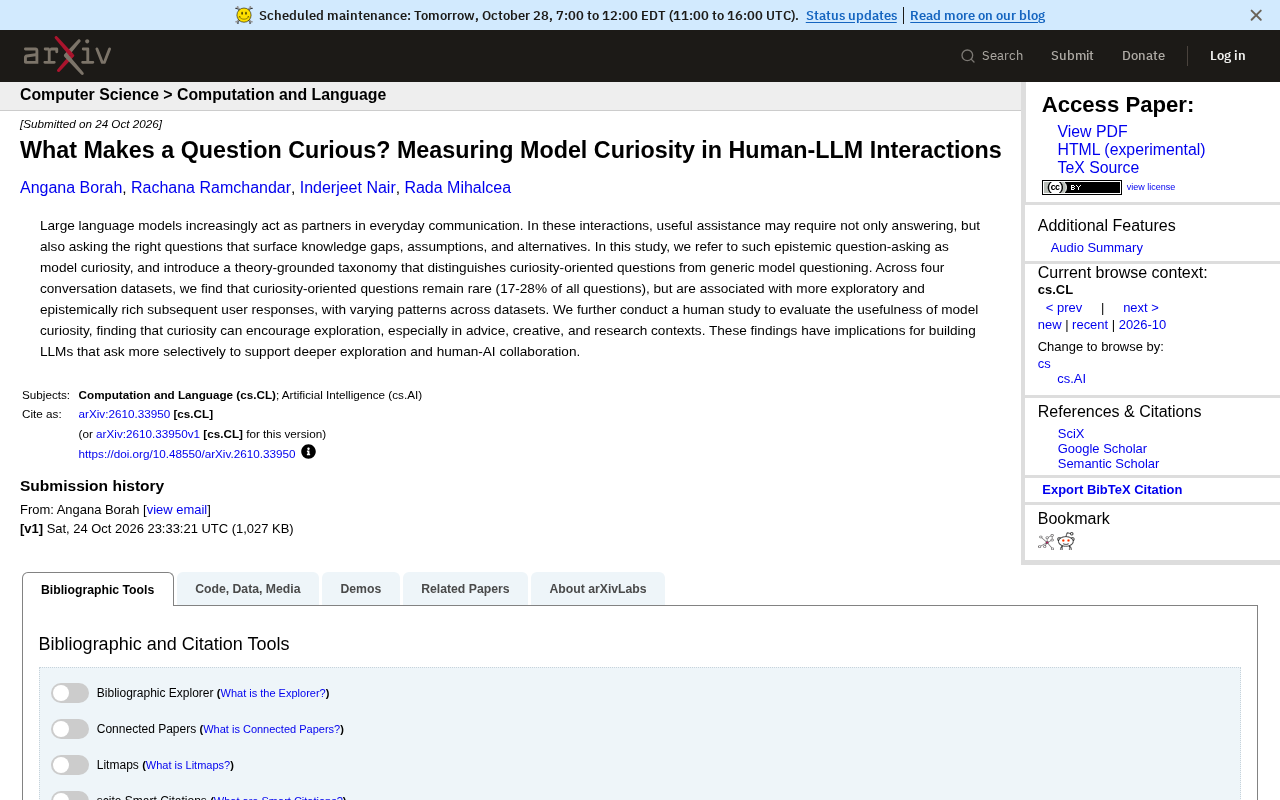
This study is the first to systematically define "model curiosity" as epistemic questions revealing knowledge gaps, implicit assumptions, or alternatives, with a taxonomy separating them from functional questions. Across four dialogue datasets, curiosity-oriented questions account for only 17%-28% of all model questions but elicit more exploratory, cognitively rich user responses, with pattern differences across datasets. Human studies show curiosity questions best encourage exploration in advice, creativity, and research scenarios, while excessive questioning in factual tasks may interfere. The study proposes "selective questioning" and incorporating question quality into evaluation.
Large language models are shifting from passive answering tools to proactive collaboration partners. When models stop merely responding and instead pose questions back to users, how does the quality of those questions affect the depth of conversation? A study titled What Makes a Question Curious? Measuring Model Curiosity in Human-LLM Interactions is the first to systematically define "model curiosity" and measure its distribution and role in real human-machine conversations.
What Is "Model Curiosity"?
The study defines "model curiosity" as a form of epistemic question-asking: the model proactively poses questions that reveal knowledge gaps, implicit assumptions, or alternative approaches, rather than merely advancing the workflow or confirming information.
To make this concept measurable, the authors constructed a theoretically grounded taxonomy that distinguishes curiosity-oriented questions from ordinary model questions. The former point toward unknown territory, while the latter are closer to customer-service-style confirmations or task clarifications. This distinction is the foundation of the entire study and explains why "the model asked many questions" does not equal "the model is curious."
Epistemic question-asking is a term borrowed from cognitive science and educational psychology. In human learning, epistemic questions refer to questions individuals proactively ask to fill knowledge gaps, test hypotheses, or expand understanding, as opposed to questions posed for social courtesy, workflow progression, or instruction confirmation. For example, a student asking "why does this formula fail under extreme conditions" is epistemic question-asking, while asking "do I need to memorize this formula" is not. The study transfers this distinction to human-machine dialogue scenarios, treating the model's proactive probing of knowledge gaps, implicit assumptions, or alternatives as an operationalized indicator of "curiosity," thereby transforming "is the model curious" from anthropomorphic rhetoric into an annotatable, statistically measurable behavioral feature.
Curiosity Questions Are a Minority, but They Elicit Richer Responses
The study analyzed four dialogue datasets and found that curiosity-oriented questions accounted for only 17%–28% of all model questions. In other words, most model questions remain at the functional level.
But the truly valuable finding comes next: when models asked curiosity-oriented questions, users' subsequent responses were more exploratory and cognitively richer. However, this association showed different patterns across datasets, indicating that the effect is not equally stable in all scenarios.
This result has direct implications for product design: increasing the number of questions may not help; increasing the "cognitive content" of questions is what may unlock deeper conversations.
The four dialogue datasets mentioned in the paper typically come from real human-machine interaction logs from different sources, such as open-domain chat, task-oriented assistants, or domain-specific consultation records. Differences between datasets manifest both in topic distribution and in user intent and conversation goals. Therefore, when the same behavioral indicator shows different patterns across datasets, it often reflects differences in scenario structure rather than fluctuations in model capability. Understanding this helps explain why the authors emphasize that "the association is not equally stable in all scenarios"—cross-dataset comparison is essentially testing the external validity of the conclusions.
Human Study: Where Is Curiosity Most Useful?
Beyond data analysis, the authors conducted a human study to evaluate the practical helpfulness of model curiosity to users. Results showed that curiosity questions encourage user exploration, with particularly pronounced effects in three scenarios: advice, creativity, and research.
This aligns with intuition: in open-ended problems, a good question is often more valuable than a quick answer. In factual query tasks, however, excessive questioning may instead be perceived as interference. The study thus points toward a more refined goal—teaching models to "ask selectively."
Human studies in this type of work typically take the form of controlled experiments or comparative evaluations: participants are recruited to converse with models, exposed to either "curiosity questions" or "ordinary questions/no questions" conditions, and then measured through questionnaires, interviews, or behavioral indicators for exploration willingness and satisfaction. Compared with pure log analysis, the advantage of human studies is the ability to control topics and task types, thereby more directly judging causality rather than merely observing correlation. The article's conclusion that curiosity questions are more effective in advice, creativity, and research scenarios is precisely the result of this scenario-contrast design.
Implications for Building Human-AI Collaboration
The core contribution of this work lies in transforming "should the model ask questions" into "how should the model ask questions selectively." The authors argue that these findings have guiding significance for building LLMs that support deep exploration and human-AI collaboration.
From an engineering perspective, this means the evaluation system needs an upgrade: beyond answer accuracy, dimensions of question quality should also be incorporated. From an interaction design perspective, models need to judge whether the current context is suitable for probing or for giving a direct answer.
Of course, the study also leaves open questions. Whether the association between curiosity questions and users' exploratory responses is the result of model guidance or whether certain topics themselves are more likely to trigger bidirectional exploration still requires further verification. The pattern differences across datasets also suggest that scenario adaptation remains a challenge.
One-line Summary
The study is the first to define and measure "model curiosity," finding that epistemic questions are a minority but can stimulate deeper conversations.
Paragraph Summary
This study is the first to systematically define "model curiosity" as epistemic question-asking that reveals knowledge gaps, implicit assumptions, or alternatives, and constructs a theoretically grounded taxonomy to distinguish it from functional questions. Analysis of four dialogue datasets shows that curiosity-oriented questions account for only 17%–28% of all model questions, but they elicit users' more exploratory and cognitively richer responses, with pattern differences across datasets. A human study further indicates that curiosity questions best encourage user exploration in advice, creativity, and research scenarios, while excessive questioning in factual query tasks may cause interference. The study accordingly proposes a "selective questioning" direction and advocates incorporating question quality into evaluation systems.
Related articles

64-Microphone Acoustic Camera Hands-On: Seeing Sound for $800
Hands-on review of the $800 TD2E acoustic imaging camera: a 64-microphone array localizes sound in real time, covers 2000–100000 Hz including ultrasound, and suits industrial inspection—though the software ecosystem is thin.

Manufacturing Accelerator Re:Build Raises $2.1B, Spins Out Slate Auto
Manufacturing accelerator Re:Build closes $2.1B funding, calling itself "America's answer to Shenzhen," and spins out Slate Auto. Known facts, positioning, and information gaps.
OpenAI's Public Breakthroughs Draw Academic Criticism: Research Transparency in the Spotlight
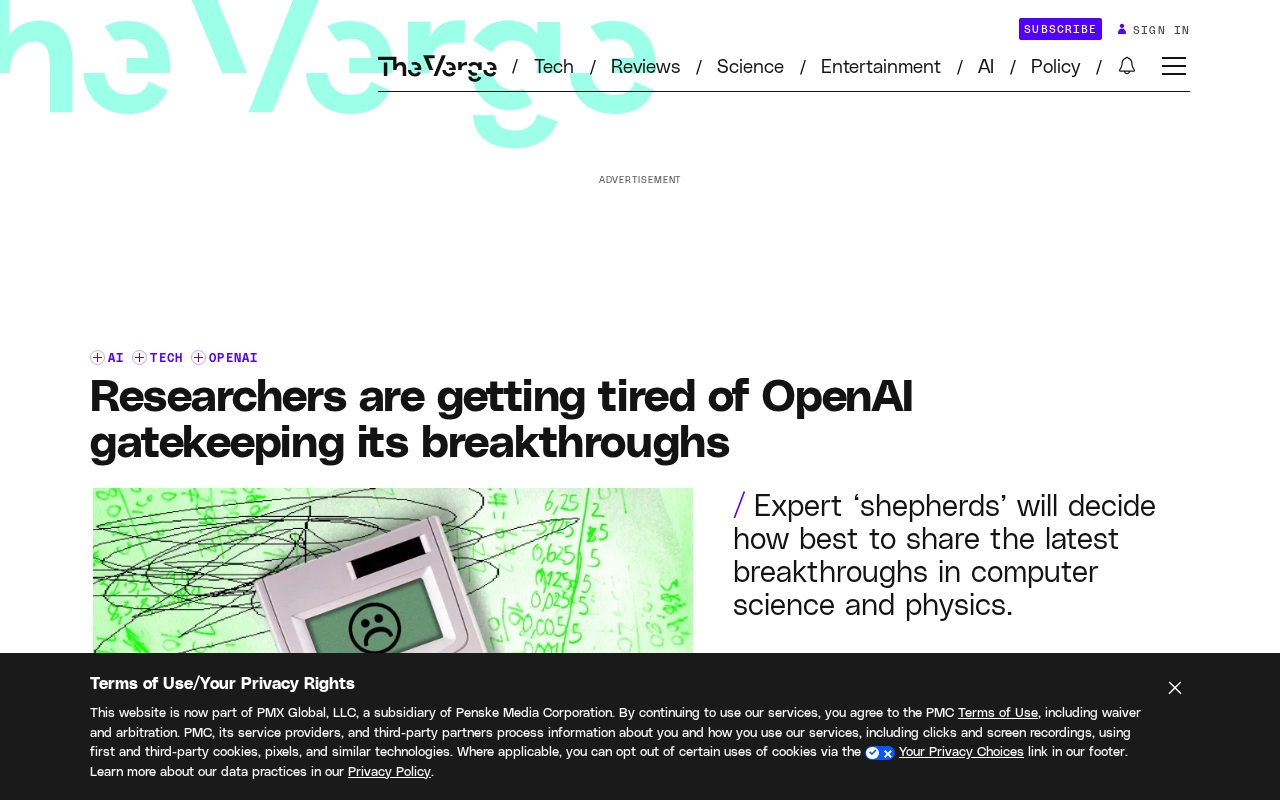
OpenAI announces math, CS, and physics breakthroughs and claims improved communication, but researchers tell The Verge dissatisfaction is mounting, criticizing selective disclosure and lack of reproducible details as the tension between corporate research and open science resurfaces.