Can Open-Source Prompt Injection Detectors Stop Real-World AI Agent Attacks?

Open-source prompt injection detectors lower the barrier to AI security, but real-world reliability remains unproven — defense-in-depth is essential.
As AI Agents gain tool-calling and autonomous execution capabilities, prompt injection attacks become far more destructive — attackers can hide malicious instructions in webpages or documents for Agents to silently execute. Open-source detectors using rule matching, classification models, and LLM judges have emerged, but lab accuracy doesn't guarantee real-world reliability: obfuscation, semantic rewriting, and second-order injection can systematically bypass detection logic. Developers are advised to treat detectors as one layer in a defense-in-depth strategy, combining least privilege, sandboxing, human confirmation, and continuous red team testing.
Prompt Injection: The Top Security Threat in the AI Agent Era
As large language models (LLMs) evolve from simple Q&A tools into AI Agents capable of executing tasks autonomously, a class of attacks known as "prompt injection" has drawn intense scrutiny from security researchers. The core idea behind these attacks is straightforward: an attacker crafts malicious text to trick a model into deviating from developer-defined instructions and instead carrying out harmful actions — such as leaking sensitive data, invoking unauthorized tools, or planting dangerous commands inside automated workflows.
When an AI Agent is granted the ability to read emails, access files, call APIs, or manipulate external systems, the destructive potential of prompt injection is multiplied many times over. A malicious instruction hidden inside a webpage, document, or email body can be "silently executed" as the Agent processes that content — with the user completely unaware. This is precisely why detection and defense against prompt injection has become one of the most active research areas in AI security.
Prompt injection can be divided into two categories based on attack vector: Direct Prompt Injection, where an attacker embeds malicious instructions directly in user input to override the constraints of the System Prompt; and Indirect Prompt Injection, which is far more covert — the attacker pre-plants malicious instructions in external content the Agent may read, such as webpages, PDF documents, email attachments, or database records. When the Agent fetches and processes this content during task execution, those instructions get "proxy-executed." What makes indirect injection so dangerous is that the attack surface extends entirely beyond the direct interaction between user and system, making it nearly impossible for defenders to anticipate the trustworthiness of every external data source. Classic examples include: embedding instructions in a competitor's webpage to manipulate an AI assistant into outputting false price comparisons; hiding instructions inside a resume PDF to trick a recruiting AI into prioritizing that candidate; and hijacking an AI assistant's subsequent actions through hidden text in a calendar invite.
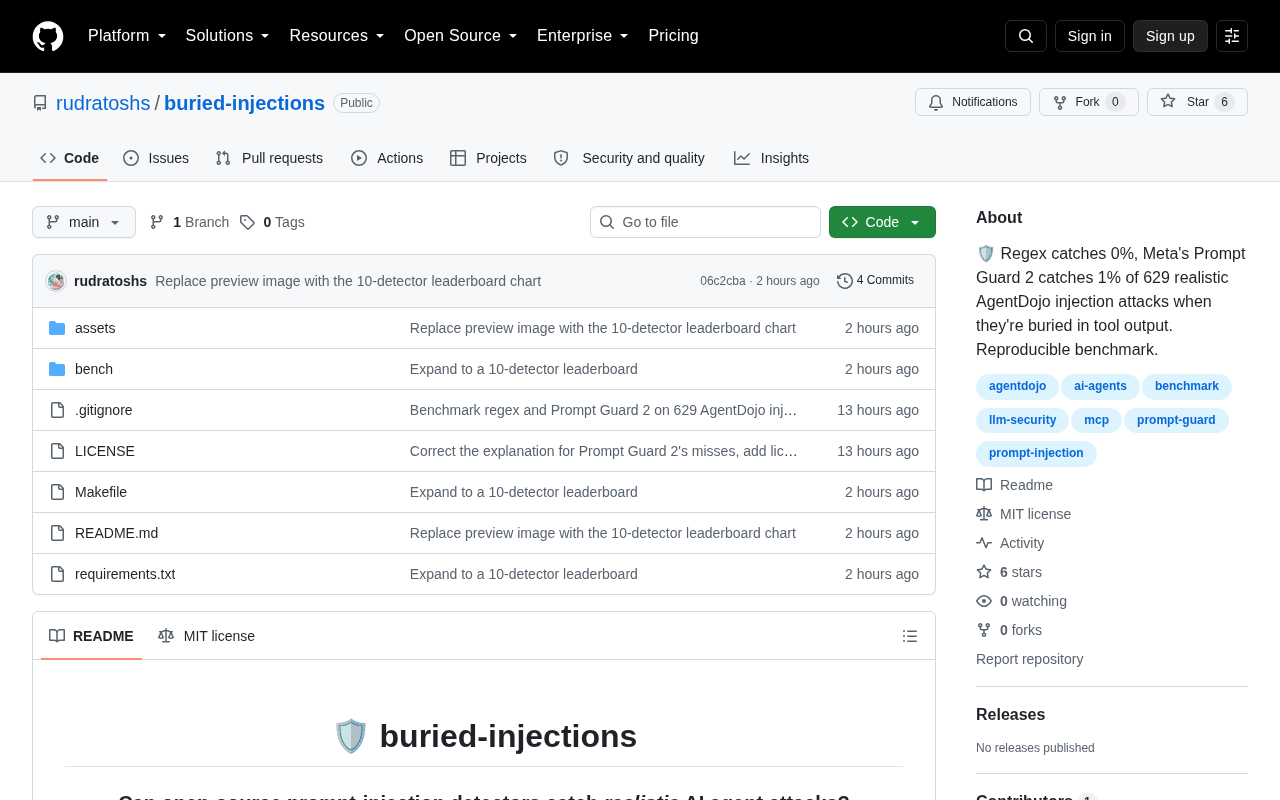
The Rise of Open-Source Detectors — and the Central Question
To combat this threat, the community has produced a wave of open-source prompt injection detection tools. Their approaches generally fall into a few categories: keyword- and rule-based pattern matching, semantic classification using trained models, and using an LLM itself as a "judge" to determine whether an input contains injection intent. The value of these tools lies in their low barrier to entry and free integration — enabling smaller teams to add a layer of defense to their AI applications.
But one critical question remains unresolved: can these open-source detectors actually intercept attacks that reflect real-world AI Agent scenarios? Benchmark tests in controlled lab settings typically use relatively straightforward attack samples, while real-world attackers continuously vary their tactics — employing encoding obfuscation, multilingual bypasses, semantic rewriting, fragmented injection, and more. High accuracy on controlled datasets does not necessarily transfer to complex real-world conditions.
Some of the more widely used open-source detection tools include: Rebuff (a self-hardening framework combining heuristic rules with LLM-based dual verification), Prompt Guard (a lightweight classification model released by Meta, trained specifically on jailbreak and injection scenarios), and input validation components integrated into Agent frameworks like LangChain. Additionally, some teams adopt an "LLM-as-judge" approach, routing suspicious inputs to a separate LLM instance to determine whether injection intent is present before passing them to the main model. This approach offers stronger semantic understanding, but introduces additional latency and cost — and the judge model itself faces the risk of being injected, a problem known as Second-order Injection. Choosing among these approaches often requires balancing accuracy, inference speed, maintenance cost, and adversarial robustness.
Why "Effective in the Lab" Doesn't Mean "Reliable in the Field"
The greatest challenge facing detectors is the fundamental asymmetry between offense and defense. Defenders must cover every possible attack variant; attackers need only find a single gap. Rule-based detection is easily bypassed through synonym substitution and character obfuscation. Classification model-based detection is limited by the coverage of its training data and often struggles against novel attack patterns. Even LLM-based judges can be fooled by secondary injection attacks targeting the judge itself.
Detectors must also strike a difficult balance between false negatives and false positives. Overly aggressive detection will flag legitimate user inputs as attacks, severely degrading the user experience; being too lenient renders the detector effectively useless. In real-world Agent workflows, inputs are often long-form text, multi-turn context, or data streams spanning multiple tools — all of which make accurate detection considerably harder.
Implications for Developers and Security Teams
For teams building AI Agent applications, this topic raises several practical considerations. Detectors should be treated as one layer in a defense-in-depth strategy — not as the sole line of defense. Truly robust solutions typically combine the principle of least privilege, human confirmation of tool invocations, sandboxed isolation of output content, and continuous monitoring of Agent behavior.
When evaluating open-source detectors, teams should not rely solely on officially reported benchmark scores. Independent testing with attack samples that closely reflect their own business context is essential. Attack techniques evolve rapidly, and any static detection ruleset can become outdated quickly — which means detection capabilities need continuous updates and red team testing to validate their effectiveness.
Least Privilege in the AI Agent context has specific practical implementations: when assigning tools to an Agent, follow the "just enough" principle — for example, do not grant write permissions in read-only scenarios, and do not open network request interfaces for tasks that don't require data exfiltration. Sandboxing means isolating the Agent's code execution environment from the host system, preventing malicious instructions from reaching the file system or process space through tool calls. Red Teaming involves organizing a dedicated team to systematically attempt to bypass existing defenses by simulating real attackers — and the findings should feed directly back into updates of detection rules and models. For high-risk operations (such as financial transfers, external API calls, or bulk data exports), introducing a Human-in-the-loop confirmation mechanism provides an effective buffer between automation efficiency and safety guarantees.
Conclusion
Open-source prompt injection detectors lower the barrier to AI security, but whether they can truly stop production-grade attacks still requires more rigorous, real-world-oriented evaluation to answer. As AI Agent capabilities continue to expand, security cannot be entrusted to any single tool — it must be built on a foundation of layered defense and continuous adversarial testing. This remains an open question that the entire industry needs to address together.
Related articles

AI-Powered SRC Vulnerability Hunting: A Hands-On Guide to Building the Hermes Agent Workbench
Based on a hands-on Bilibili video: how to build an AI-powered SRC vulnerability hunting workbench—three-step method, four report elements, Agent mode vs web chat, and tool selection.

CLI-Anything Complete Beginner's Guide: How AI Operates Software — Principles and Practice
A complete beginner's guide to CLI-Anything: how AI Agents operate professional software via the command line, covering the three-layer architecture, CLI Hub installation, DrawIO practice, generator principles, and limits.

Carbon-X: A 14.8B Open-Source Model That Handles DNA and Text Simultaneously
Carbon-X is a 14.8B open-source multimodal model on Hugging Face where DNA and text share a token stream. 6-mer tokenization, 302B token mid-training, deployable on a single 80GB GPU, 66.7% average on five DNA benchmarks, Apache 2.0 license.