Can Programming Make You Smarter? What Cognitive Transfer Research Tells Us About the Limits of AI

1980s psychology shows domain training doesn't produce general intelligence — a key lens for evaluating AI's generality claims.
The article revisits a largely overlooked 1980s psychological finding: learning programming or mathematics does not enhance general reasoning ability, and skill gains in one domain don't transfer to unrelated ones. General intelligence appears to be a foundational brain property, not a stackable set of trainable skills. The author then applies this to AI, asking a pointed question: when a model scores high on specific tasks, does that signal the emergence of general intelligence, or merely the accumulation of vertical specializations? Two interpretations are presented — either true generality requires an architectural breakthrough, or human cognitive transfer and machine learning generalization are simply not comparable — warning against the common mistake of equating benchmark performance with genuine general intelligence.
A Forgotten Finding in Psychology
In the 1980s, a wave of research swept through the field of psychology on a topic called the "cognitive consequences of programming." The prevailing hypothesis was compelling: learning formal logic and algorithmic structure was like going to the gym for your brain — it would broadly enhance reasoning, planning, and general problem-solving ability. In other words, learning to code would make you smarter across the board.
The idea is intuitively appealing. Programming demands rigorous logic, abstract modeling, and structured thinking — all hallmarks of what we'd call "higher cognition." Yet foundational studies and subsequent meta-analyses arrived at a surprising conclusion: this kind of transfer simply did not happen.
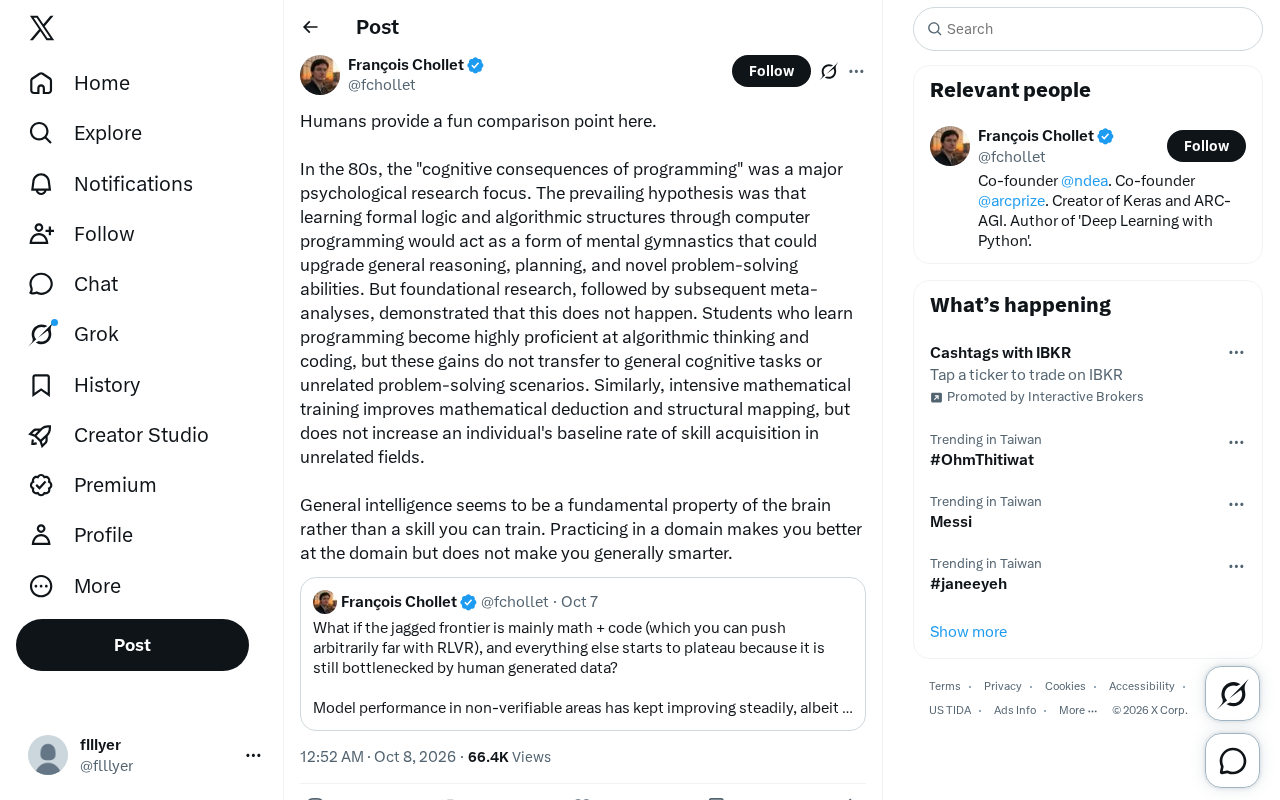
Students who learned programming did become highly skilled at algorithmic thinking and coding itself — but those gains did not carry over to general cognitive tasks or problem-solving in unrelated domains. Similarly, intensive math training improved mathematical reasoning and structural mapping, but did not raise a person's baseline rate of acquiring new skills in unrelated fields.
The foundational work in this research tradition came from cognitive psychologist Richard Nisbett and others, building on an earlier body of literature on transfer learning. In psychology, "transfer" refers to the degree to which skills or knowledge acquired in one context can be applied in a different one. Researchers typically distinguish between "near transfer" (highly similar tasks) and "far transfer" (tasks that differ significantly). Experiments consistently show that near transfer is relatively easy to achieve, while far transfer — the extension of ability across domain boundaries — is exceedingly rare and difficult to replicate reliably. The 1980s programming cognition research was attempting to demonstrate that programming training could produce far transfer effects; the meta-analyses' negative findings struck directly at that grander claim. The field remains somewhat contested — some later studies observed limited transfer under specific conditions — but the strong version of the hypothesis, that "programming makes you generally smarter," has been largely abandoned.
Domain Skill ≠ General Intelligence
The core insight from this body of research is this: general intelligence looks more like a foundational property of the brain than a skill that can be acquired through training. Repeated practice in a domain makes you stronger in that domain — it does not make you "smarter overall."
This distinction is crucial. It separates two things that are often conflated:
- Domain expertise: continuously accumulated through deliberate practice — programming, mathematics, chess.
- General reasoning ability: relatively stable, and difficult to significantly shift through training in any single domain.
A programmer who has mastered algorithms won't necessarily pick up an unfamiliar field faster. A mathematical genius won't necessarily excel at social judgment or creative writing. Practice generates vertical depth, not horizontal breadth.
This connects to a classic theoretical framework in psychology: the Cattell-Horn-Carroll (CHC) model of intelligence, which distinguishes between "fluid intelligence" (the ability to reason and adapt to novel problems, more closely tied to genetic and neural foundations, relatively stable or declining in adulthood) and "crystallized intelligence" (accumulated knowledge and skills built through learning and experience, which can keep growing). Domain expertise is essentially an expansion of crystallized intelligence, while "general reasoning ability" more closely resembles fluid intelligence. Training a specific skill primarily develops crystallized intelligence, but struggles to significantly boost fluid intelligence — providing a neurological explanation for why deliberate practice can sharpen a person within a domain, yet cannot produce universal intelligence gains across domains.
What This Means for Understanding AI
The reason this human psychology research is worth referencing here is that it offers a compelling "point of contrast" for understanding contemporary AI systems.
When we train a model to achieve superhuman performance on a specific task, a natural question arises: will that specialized capability "spill over" into something more general? The historical record of cognitive transfer research in humans urges caution — in humans, domain-specific training does not automatically translate into gains in general ability.
This raises a longstanding central debate in AI: when models acquire powerful domain capabilities from training on massive datasets, are they approaching some form of general intelligence — or merely stacking "specialized skills" across a growing number of vertical domains? If even the highly flexible human brain struggles to achieve cross-domain transfer, shouldn't claims about AI "emerging general capabilities" be subjected to more rigorous scrutiny?
Two Possible Interpretations
This analogy can be read in two directions, and it's worth presenting both honestly:
One view holds that this is precisely why general intelligence is a "foundational architecture" independent of specific skills — not something you can accumulate by scoring well on individual tasks. For AI, this implies that true generality may require a breakthrough at the architectural level, rather than simply piling on more capabilities.
The other view challenges the validity of the analogy itself: the mechanisms of cognitive transfer in humans and the mechanisms of generalization in machine learning are not the same thing. Applying conclusions from 1980s programming psychology directly to modern large language models may risk oversimplification.
The corresponding core concepts in AI are "generalization" and "out-of-distribution reasoning." A model that performs well within its training distribution offers no guarantee it can handle novel problems it never encountered during training — a structural predicament strikingly similar to humanity's "far transfer" problem. The "emergent capabilities" exhibited by current large language models are seen by some researchers as signals of general intelligence, while others argue these capabilities may still represent efficient compression and retrieval of patterns implicit in training data, rather than genuine cross-domain reasoning. Benchmark tests designed to evaluate whether AI possesses general ability — such as the ARC-AGI benchmark — exist precisely to distinguish between "performing well on seen tasks" and "flexibly handling novel structural problems." Their design philosophy follows the same logic psychologists use to differentiate near transfer from far transfer.
The Real Value of Practice
Whether applied to humans or AI, this body of research does not negate the value of practice. What it negates is an overly optimistic fantasy — that one type of training can act as a master key, unlocking every cognitive door.
For personal development, this means that if you want to get better at something, you need to work directly in that domain. Hoping that learning to code will "incidentally" boost everything else is unrealistic. For AI research, it's a reminder that "performing well" and "becoming smarter" are two different things: a system that achieves high scores on benchmark tests has not necessarily acquired general intelligence that can transfer freely.
The nature of intelligence may be far more complex than the simple intuition that more practice leads to greater smarts.
Related articles

REA: Reverse Engineer Any App with AI, No Coding Required
REA is a viral open-source AI reverse-engineering tool that lets Claude, Codex, and other AI agents analyze any app and generate functional clones—no coding required. This article covers how it works, installation, a hands-on test, and legal risks.

2026 AI Coding Tools Comparison: Claude, ChatGPT, Gemini — Which Is the Best?
A 2026 comparison of five mainstream AI coding tools — Claude Code, ChatGPT Codex, Gemini, DeepSeek, and GitHub Copilot — on real projects, pricing, and code quality, to help you decide where that $20/month should go.

ChatGPT Codex Can Clone Any Software? Testing the Risks and the Truth
YouTube shorts claim ChatGPT Codex or Claude Code can clone Adobe, Excel, and Figma for lifelong free use. We break down the feasibility, legal risks, and DM-funnel tactics—and explain what AI coding tools are truly good for.