Can Robots Self-Evolve? The Physical RSI Framework Offers an L0-L5 Taxonomy

The paper proposes Physical RSI and an L0-L5 taxonomy, arguing true recursive self-improvement in robots remains unachieved.
This research introduces "Physical Recursive Self-Improvement" (Physical RSI), requiring robots to update both their capabilities and the process that improves them through physical experience, so improvement efficiency can recursively rise across tasks. It notes that physical-world RSI faces four obstacles: observation noise, continuous dynamics, costly trial and error, and irreversible outcomes, leaving far less fault tolerance than software. The paper designs an L0-L5 taxonomy along capability/meta-level and within-task/across-task dimensions, with L5 reserved for independently verified recursive gains. After reviewing two technical routes, it concludes no surveyed work proves Physical RSI as defined, and proposes four priorities—reliable feedback, causal attribution, safety preservation, and benchmarking.
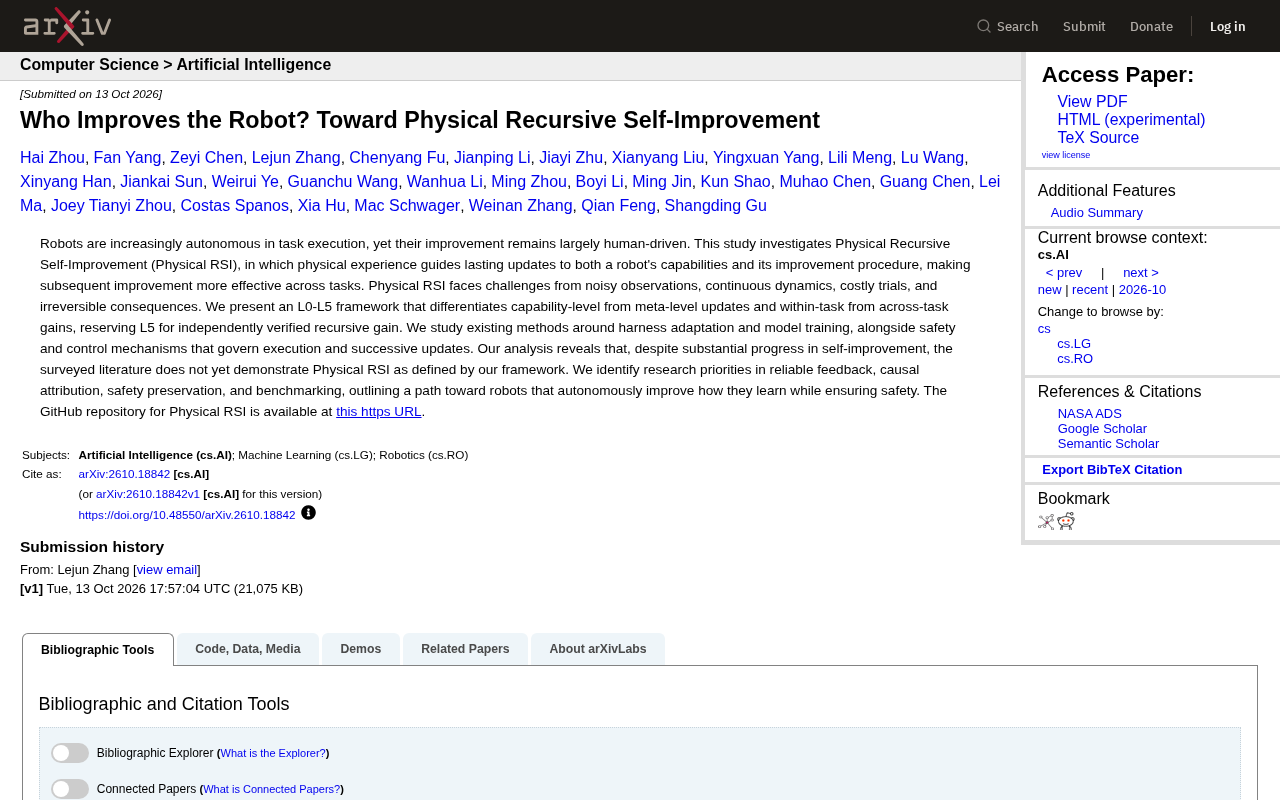
Robots are increasingly capable of completing tasks autonomously, but their "progress"—whether learning new skills or optimizing how they learn—still depends largely on human effort. A paper titled Who Improves the Robot? Toward Physical Recursive Self-Improvement introduces the concept of Physical Recursive Self-Improvement (Physical RSI) and uses an L0-to-L5 taxonomy to systematically assess how far existing methods are from true self-evolution.
What Is Physical RSI?
Recursive self-improvement (RSI) is not new in AI safety discussions, but previous discussions have mostly focused on the software and algorithmic levels. This research turns its gaze to the physical world: robots continuously update two things through their own physical experience—the capabilities themselves, and the process that improves those capabilities. The latter is the key. When the improvement procedure itself is also updated, subsequent improvement efficiency can rise across tasks, forming a genuine recursive loop.
The authors point out that this definition is far more demanding than "a robot learning to walk on its own." Learning to walk is a capability-level improvement; Physical RSI requires that the robot not only walks better, but also learns "how to learn to walk faster," and that this meta-learning strategy transfers to other tasks.
Recursive self-improvement (RSI) originated in AI safety discussions, first proposed by mathematician I.J. Good in 1965 as the "intelligence explosion" idea: a machine capable of improving its own intelligence, whose improvement capacity can itself be further improved, entering a self-accelerating positive feedback loop. In software and algorithmic contexts, the typical form of RSI is a system modifying its own code or learning algorithm. Meta-learning refers to "learning how to learn"—after training on many tasks, a model acquires a general learning strategy that can quickly adapt to new tasks, rather than mastering only one specific task. The key to distinguishing the two lies in what is being updated: ordinary learning updates task capabilities, while meta-learning updates the process that produces task capabilities. Physical RSI brings this distinction into the physical world, and its difficulty lies in the fact that the meta-strategy a robot learns must emerge from real interaction, rather than being cheaply and repeatedly sampled as in digital environments.
Why RSI Is Especially Difficult in the Physical World
The research explicitly lists four obstacles facing Physical RSI: high observation noise, continuous and complex dynamics, costly trial and error, and irreversible consequences.
In software environments, a failed training run can be rolled back and restarted; when a physical robot breaks a joint, the cost is real time and money, and some damage cannot even be repaired. These four constraints compound, making the fault-tolerance margin for Physical RSI far smaller than in purely digital environments. The authors argue that any system claiming to achieve Physical RSI must confront these problems head-on rather than sidestep them.
The L0-L5 Framework: Distinguishing Capability Improvement from Meta-Improvement
One of the paper's core contributions is the L0-L5 taxonomy. This framework divides along two dimensions: updates at the capability level vs. the meta level, and gains within-task vs. across-task.
L0 to L3 roughly correspond to gradual progress at the capability level: from fixed policies to within-task adaptation, and then to cross-task transfer. L4 enters the meta level—the improvement procedure itself is modified. And L5 is specifically reserved for "independently verified recursive gains": not only does the system claim to have improved how it learns, but this improvement must also be independently reproduced and confirmed by external parties. The authors use this high standard to filter out self-proclaimed forms of "self-improvement."
The significance of this taxonomy is that it provides an operational criterion, allowing researchers and reviewers to clearly determine at which stage of self-evolution a given piece of work actually sits.
In the graded assessment, the distinction between the "capability level" and the "meta level" corresponds to the two layers of base learning and meta-learning in machine learning: the former is the system getting better at a task, while the latter is the system's learning mechanism itself getting better. The other dimension, "within-task vs. across-task," corresponds to the problem of generalization—within-task improvement may simply be overfitting to a specific setting, whereas cross-task improvement shows that the improvement is universal. Crossing these two dimensions yields a two-dimensional coordinate space, and L0-L5 is precisely the arrangement along that space from lower to higher order. In particular, the "independently verified" requirement of L5 draws on the principle of reproducibility: for a system claiming self-improvement, its gains must be reproduced by an external third party under the same conditions in order to hold. This aligns with the scientific community's requirements for validating new discoveries, and is the key threshold distinguishing "true recursion" from "self-proclamation."
Where Existing Methods Stand
The research analyzes two technical routes: harness adaptation and model training, while also examining safety and control mechanisms for constrained execution and continuous updates.
The conclusion is notably restrained: although there has been substantial progress in the direction of self-improvement, among the surveyed literature, no work can yet demonstrate Physical RSI as defined by this framework. In other words, existing systems are indeed becoming stronger at the capability level, but few systems have truly changed their own procedure for "how to improve," and even fewer have produced independently verifiable evidence of recursion.
This is not a denial of existing achievements, but rather the drawing of a clear boundary—there is a substantive gap between "automated improvement" and "recursive self-improvement."
Four Priority Research Directions
The paper does not stop at criticism, but offers four research priorities:
- Reliable feedback: obtaining trustworthy improvement signals under noisy observations is the prerequisite for any recursive loop.
- Causal attribution: it must be possible to distinguish which specific change produced a performance gain; otherwise, meta-level updates lose their basis.
- Safety preservation: safety constraints must not be gradually eroded during recursive improvement.
- Benchmarking: standardized evaluations are needed to verify L5-level recursive gains.
These four points are interrelated—without reliable feedback and causal attribution, it is impossible to confirm whether improvements are real; without safety preservation and benchmarking, recursive improvement cannot be trusted or reproduced.
A Pragmatic Path Forward
The value of this research lies less in providing answers than in asking the right questions. While the industry is enthusiastic about discussing robot autonomy, the question of "who improves the robot" is often implicitly answered as "humans." The Physical RSI framework brings this default option to the table and, with L5's independent verification standard, sets an honest and rigorous target for "robots autonomously improving how they learn."
The research team has opened a code repository for Physical RSI on GitHub (SAIL-Research-Lab/Physical-RSI), for follow-up work to advance research on feedback reliability, causal attribution, and safety benchmarks on this basis.
For readers concerned with robot autonomy and AI safety, this paper provides a rare and clear coordinate system: it neither over-optimistically claims that recursive self-improvement has arrived, nor underestimates the progress already made in automated improvement, but instead accurately marks the distance between the two.
One-line Summary
The paper introduces the Physical RSI concept and an L0-L5 taxonomy, arguing that true recursive self-improvement in robots has not yet been achieved.
Paragraph Summary
This research proposes the concept of "Physical Recursive Self-Improvement" (Physical RSI), requiring robots to simultaneously update their own capabilities and the procedure that improves those capabilities through physical experience, so that improvement efficiency can rise recursively across tasks. The article points out that RSI in the physical world is constrained by four obstacles: observation noise, continuous dynamics, high trial-and-error costs, and irreversible consequences, leaving a fault-tolerance margin far smaller than in software environments. To this end, the paper designs an L0-L5 taxonomy, dividing along the dimensions of capability/meta-level and within-task/across-task, with L5 reserved specifically for independently verified recursive gains. After analyzing two existing technical routes, it concludes that no surveyed work can yet demonstrate Physical RSI as defined by this framework. The research then proposes four priority directions—reliable feedback, causal attribution, safety preservation, and benchmarking—providing a clear coordinate system for measuring the gap between automated improvement and recursive self-improvement.
Related articles

Free Unlimited Claude Code Solution: Agnes AI + CC Switch Setup Guide
No paid subscription needed — pair the free AI platform Agnes AI with the open-source tool CC Switch to provide a backend for Claude Code, enabling unlimited free calls to text, image, and video models. This guide covers the full setup, test results, and usage boundaries.

A Complete Zero-Cost Guide to Getting Started with Claude Code for Beginners in China
A beginner's guide to Claude Code for users in China: two installation methods (command line and IDE plugin), full configuration steps for replacing the official API with the free domestic LongCat model, and a hands-on demo of building a small tool with natural language, plus tips.

When the NSA Gets Involved: The AI Supply Chain Crisis Behind Open-Source CVEs and API Key Hijacking
Multiple open-source projects disclosed severe CVEs in one day, PHP flaws alarmed the FBI, and Railway and OpenCode were breached with API keys stolen. This article breaks down the vulnerability window, AI-accelerated exploitation, and the AI supply chain crisis behind the API key black market, with a developer defense checklist.