Can the Optimization Gains from Qwen3.8 Flash Next Carry Over to Qwen4?
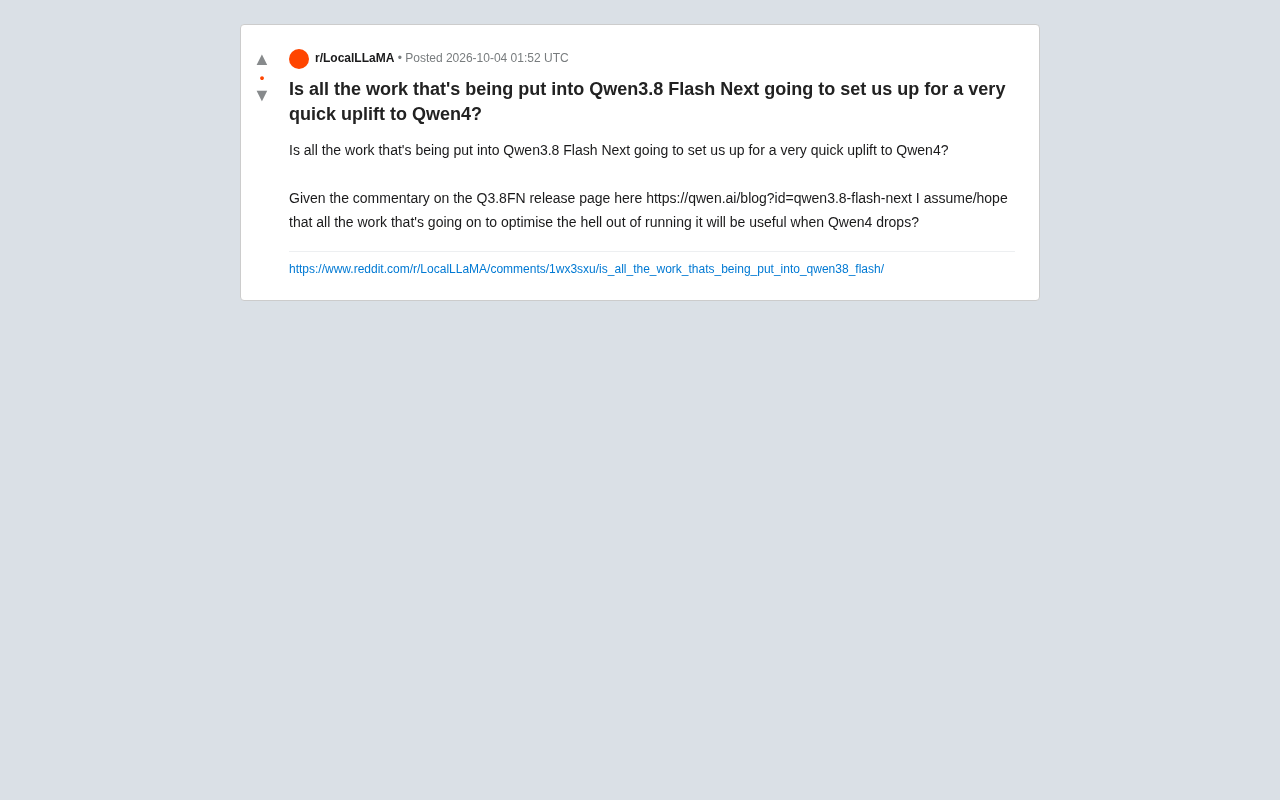
Whether Q3.8FN optimization assets carry over to Qwen4 hinges on how much the architecture changes.
A Reddit thread in the local LLM community raises a key engineering question: can quantization work, inference framework tuning, and deployment optimizations done for Qwen3.8 Flash Next serve as a fast-track runway for Qwen4? General-purpose assets like quantization pipelines, vLLM/llama.cpp adapter code, and KV Cache tuning are highly transferable — but if Qwen4 adopts MoE, a new attention mechanism, or tokenizer changes, low-level optimizations may need significant rewrites. The practical advice: invest in version-agnostic skills and wait for official architectural disclosures before drawing firm conclusions.
A Community Question Worth Paying Attention To
Over in Reddit's local LLM community, a developer raised a forward-looking question: will the extensive optimization work currently being done on Qwen3.8 Flash Next (Q3.8FN) translate into a rapid performance leap when Qwen4 arrives?
This question touches on a long-overlooked but critically important topic in the LLM ecosystem — the generational continuity of model architectures, and how much of the engineering investment built around inference optimization can actually be reused. The poster's intuition was based on technical notes from the Q3.8FN release page, leading them to speculate that community efforts to squeeze out every bit of efficiency from this model would likely pay off when the next generation lands.
Note: This article is based on discussion from a single community post. Specific technical details of Q3.8FN should be taken from official release information, and some conclusions here represent reasonable community-level assumptions.
Why Optimization Work May Carry Over
The key to determining whether Q3.8FN optimizations can benefit Qwen4 lies in how similar the two generations are in terms of underlying architecture and inference pathways.
If Qwen4 largely continues the Transformer variant structure, attention mechanism implementation, and tokenizer specification from the Qwen3 series, then a large portion of optimization work transfers naturally. This includes:
- Quantization schemes: Quantization pipelines like GGUF, AWQ, and GPTQ, which are designed around specific weight distributions, can often be applied directly to new models within the same family.
- Inference framework support: Once inference engines like vLLM, llama.cpp, and SGLang have mature support code tuned for the Qwen3 series, the cost of onboarding a new version drops significantly.
- Deployment know-how: Operational tuning experience around KV Cache management, batch scheduling, and VRAM allocation is largely decoupled from specific model versions.
In short, the pitfalls the community has navigated, the kernels written, and the parameters tuned for Q3.8FN could very well serve as a "warm-start asset" when Qwen4 arrives.
The Flywheel Effect of the Engineering Ecosystem
The true competitive advantage of open-source models often isn't just benchmark scores — it's how mature the surrounding toolchain has become. When a model has well-developed quantization formats, stable inference backend support, and rich deployment documentation, the barrier to adoption drops dramatically.
Qwen's continuous iteration strategy has, in effect, had each generation "paving the road" for the next. This compounding effect of ecosystem accumulation is the underlying logic behind the poster's intuition of a "rapid performance leap."
A quick guide to quantization formats: GGUF is the weight storage format used in the llama.cpp ecosystem, supporting compression of model weights from FP16 down to INT8, INT4, or even lower precision, enabling large models to run on consumer-grade GPUs or CPUs. AWQ (Activation-aware Weight Quantization) and GPTQ are two mainstream low-bit quantization schemes for GPU inference — the former protects critical weights by analyzing activation distributions, while the latter uses second-order gradient information to reconstruct weights layer by layer. All three rely on assumptions about the shape of model weight tensors, data types, and inter-layer connectivity. As long as a new model maintains a similar Transformer layer structure, the same quantization scripts and calibration datasets can be reused almost directly — which is the technical foundation for the community's optimism about cross-version migration.
Continuity Is Not Guaranteed
That said, there are clear variables that could limit how fully optimization gains carry over, and the community's optimism comes with some important caveats.
Architectural changes are the biggest uncertainty. If Qwen4 introduces a new attention mechanism, switches to a Mixture-of-Experts (MoE) architecture, or adjusts model dimensions and layer counts, then low-level optimization code written for the old structure may require significant rewrites. Historically, major version upgrades for many models have been followed by an adaptation period for inference frameworks, where the community often needs to reinvest weeks or more to get a new model running at peak efficiency.
Changes to the tokenizer and training paradigm also affect reusability. If the vocabulary size, special token definitions, or context handling logic changes, parts of the preprocessing and postprocessing code will need to be updated accordingly.
So a more accurate take is: general-purpose engineering experience is highly transferable, but the reusability of model-specific performance optimizations depends entirely on how different Qwen4's architecture is from Qwen3's.
The impact of MoE architecture: In a traditional dense Transformer, every token passes through all parameters of every feed-forward network (FFN) layer. An MoE architecture replaces a single FFN with multiple "expert" sub-networks, activating only a few of them per inference pass (typically 2–8), while the rest of the expert weights sit idle. This change has fundamental implications for inference systems: memory must hold all expert weights, but compute scales down with the activation ratio. KV Cache management, batch scheduling, and operator fusion logic all need to be redesigned for sparse activation patterns. Frameworks like vLLM and llama.cpp often lag months behind in MoE support compared to dense models. If Qwen4 adopts MoE, existing low-level kernel optimizations built for dense structures will be difficult to reuse directly.
Practical Takeaways for Developers
For developers and teams currently investing in Q3.8FN optimization, this discussion offers a few grounded recommendations:
- Prioritize transferable capabilities. Focus energy on standardizing deployment workflows, building familiarity with inference frameworks, and mastering quantization toolchains — these investments don't depreciate when models change generations.
- Be realistic about what version number jumps signal. The naming leap from Qwen3.8 to Qwen4 may imply more significant architectural changes than a minor version bump — don't assume everything will migrate seamlessly.
- Watch official technical documentation for architectural signals. The question of whether optimizations carry over can only truly be answered by the architectural details Qwen4's release reveals, not by current speculation.
Conclusion
Short as it is, this Reddit thread highlights a consistently underappreciated dimension of the open-source model ecosystem: engineering optimizations built around a model are themselves assets that can compound across generations. The community's optimism has a solid foundation — as long as Qwen4 continues the core architecture, a substantial amount of optimization work can genuinely accelerate its adoption. But the size of that dividend can only be determined once the official architecture is revealed. Until then, the safest bet is to focus on general-purpose capabilities that aren't tightly coupled to any specific model version.
Related articles

Cursor AI Programming in Practice: Build a Student Management System from Scratch in 30 Minutes
A Bilibili creator demonstrates Cursor AI programming: generating a student management system in 30 minutes with natural language. Details on Agent mode, Claude selection, prompt techniques, and thresholds.

Top 20 AI Coding Tools Ranking: From Rock-Solid to Lackluster, a Scored Matrix
Bilibili creator releases top 20 AI coding tools ranking, tiered T0–T4 from rock-solid to lackluster, with Claude Code and Codex tied at T0. This article details the scoring dimensions (capability, reliability, robustness, durability, cost, domestic availability) and tool performances to help developers choose the right AI coding assistant.

Vibe Coding Systematic Tutorial: Master AI-Assisted Programming from Zero
A three-month Vibe Coding tutorial from a Bilibili creator covering Codex, ClaudeCode, and Cursor, from core logic to commercial project practice for beginners.