Can Trypophobia Help You Spot AI Images? An Overlooked Detection Instinct

A trypophobic Reddit user finds AI images trigger his condition, hinting at a deeper perceptual link to detecting AI artifacts.
A Reddit user with trypophobia noticed that AI-generated food images trigger intense physical discomfort while real photos do not — even when no obvious hole patterns are present, just an invisible, indescribable sense of background repetition. The article explores how diffusion models leave statistical traces in texture and repeating structures that the conscious mind can't easily pinpoint, but that pattern-sensitive neural systems may detect first. This suggests trypophobic individuals, with lower thresholds for unnatural repetition, may amplify the vague "something's off" feeling into a concrete physical reaction — and that human perceptual instincts could be a harder-to-bypass AI detection mechanism than traditional technical cues.
An Unexpected Question: Can Physical Discomfort Detect AI?
A Reddit user recently posed a surprisingly thought-provoking question: could there be a link between trypophobia and the ability to detect AI-generated images?
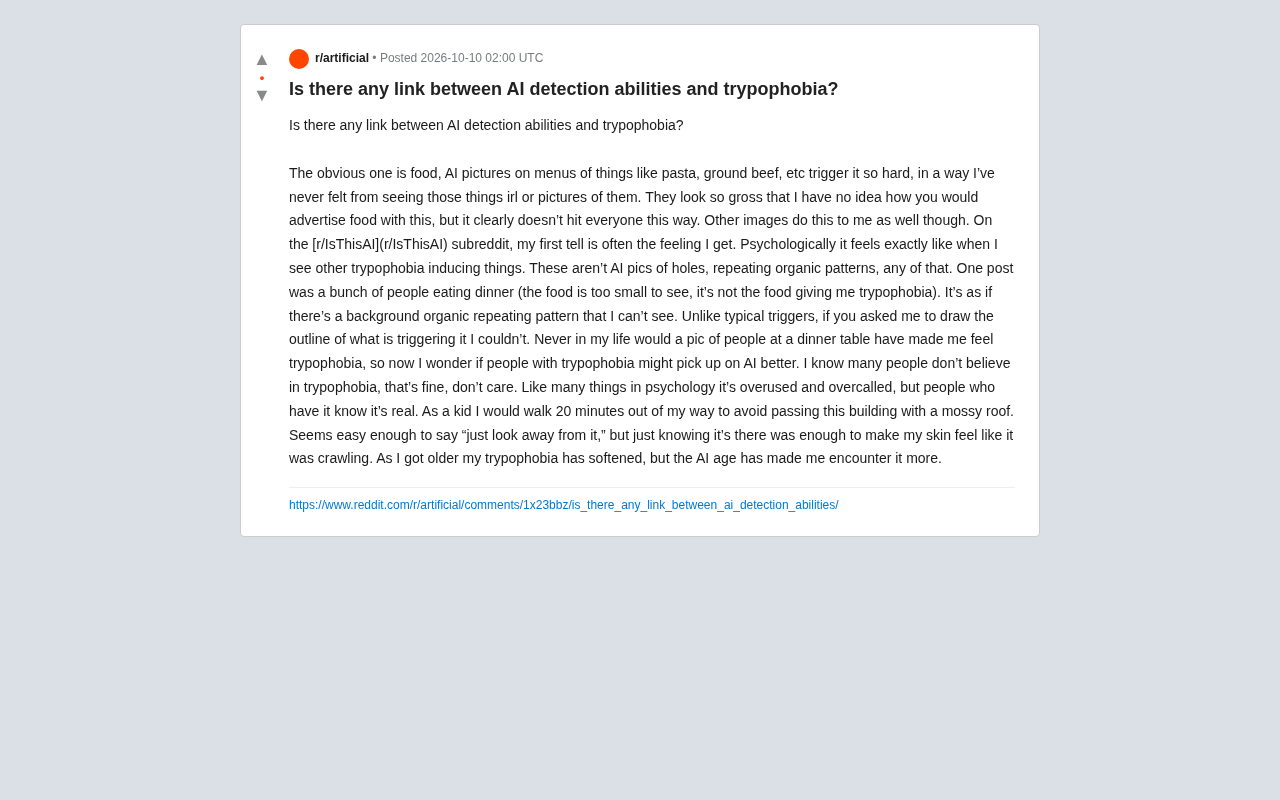
At first glance, this sounds odd — but it touches on a rarely discussed dimension of AI image detection: the role of human physiological and intuitive responses, rather than rational analysis. The user's description was remarkably specific: when he saw AI-generated food photos on menus — pasta, ground beef, and similar dishes — they triggered an intense trypophobic reaction. He found it "nauseating beyond belief that anyone would use these images to advertise food," yet the same foods in real life or in genuine photographs never produced this effect.
The Invisible "Repeating Organic Pattern"
The most intriguing part of this user's observation is that the triggering images don't match the typical profile of trypophobia stimuli.
Classic trypophobia triggers are usually obvious — honeycomb-like holes, repetitively arranged organic structures, lotus-pod-style dense clusters. But the AI images he described were entirely different: "These aren't AI images of holes, not repeating organic patterns. One image was a group of people having dinner (the food was too small to see, so it wasn't the food triggering it). It felt like there was an invisible, repeating organic pattern somewhere in the background."
He went further, noting that unlike typical triggers, he couldn't identify exactly what was setting it off: "If you asked me to draw an outline of what's triggering it, I couldn't." In the r/IsThisAI community — dedicated to identifying AI-generated images — this physical sense of discomfort often serves as his gut-level "first instinct" when judging whether an image is AI-generated.
Trypophobia is not an officially recognized psychiatric diagnosis and is not listed in the DSM-5, but it has attracted genuine research attention as a real perceptual phenomenon. A 2013 study by Arnold and Cole proposed that trypophobia triggers (such as lotus pods and honeycombs) share similar spatial frequency characteristics with the skin textures of certain venomous animals, suggesting the response may have evolved as an early-warning mechanism against dangerous creatures. Crucially, trypophobia is not fundamentally about "holes" themselves, but about the spatial frequency composition of a pattern — high-contrast, mid-range spatial frequency, repetitively clustered structures. This explains why certain images without obvious holes (including some AI-generated images) can still trigger a reaction: the threshold targets underlying visual statistical features, not surface-level semantic content.
Why This Hypothesis Deserves Serious Consideration
Setting aside debates over whether trypophobia is "scientifically legitimate," this phenomenon points to a real technical problem: subtle anomalies lurking in AI-generated images that are difficult for the human eye to consciously pinpoint, yet are nonetheless perceived.
Current diffusion models leave subtle statistical traces in texture, lighting, and the distribution of repeating elements when generating images. These traces may manifest as pixel-level patterns that are either unnaturally regular or unnaturally random — not necessarily detectable at a conscious level, but potentially triggering an early alarm in neural systems that are particularly sensitive to anomalous repetition.
In other words, people with trypophobia may have a lower perceptual threshold for detecting subtle, unnatural repetitive structures in images. This is fundamentally the same phenomenon as the vague sense of "something's off" that many people report about AI images — it's just that in trypophobic individuals, the discomfort is amplified and made concrete as a distinct physical reaction.
The diffusion model is the core architecture behind today's mainstream AI image generation technology, powering products like Stable Diffusion, Midjourney, and DALL-E 3. The process works by gradually adding noise to real images until they become fully randomized, then training a neural network to learn to "reverse" this process — starting from noise and progressively denoising to reconstruct an image. A key limitation of this generative mechanism is that the model is essentially sampling from the statistical distribution of its training data, rather than understanding the physical laws of the real world. As a result, generated images tend to exhibit a statistical "averaging" quality in local regions: textures are overly smooth and uniform, the spacing of repeating elements is too regular, and organic materials (like hair or food fibers) lack sufficient "chaotic" randomness. These artifacts are especially apparent in frequency-domain analysis — researchers have identified systematic biases in AI-generated images at specific spatial frequencies, which may well be the physical source of that vague, hard-to-articulate visual unease.
Intuitive Detection vs. Technical Detection
The value of this discussion lies in its reminder that human recognition of AI images relies heavily on hard-to-articulate "intuition" rather than pixel-by-pixel rational analysis.
As the quality of AI-generated images continues to improve, traditional detection cues — extra fingers, distorted text, physically impossible lighting — are rapidly disappearing. Yet the sensitivity to "natural" versus "unnatural" patterns that the human brain has developed over millennia of evolution may prove to be a line of defense that machines cannot easily replicate. The extreme case of trypophobia effectively "visualizes" this kind of subconscious sensitivity.
Of course, the user also acknowledged the limitations of his personal experience — as a child, he would take 20-minute detours to avoid a moss-covered rooftop building, "just knowing it was there was enough to make my skin crawl." His symptoms have eased with age, but the AI era has brought this feeling back with renewed frequency. This is a personal observation, not a verified research finding.
An Unexplored Intersection
There is currently no formal research confirming a link between trypophobia and AI image detection ability. This Reddit post reads more like a hypothesis worth exploring at the intersection of psychology and computer vision.
If such a connection does exist, it could offer new directions for AI image detection: rather than training algorithms solely to identify technical artifacts, researchers might study what exactly the human perceptual system picks up on as "machine traces" — and translate those "discomfort signals" into quantifiable detection features. Whatever the conclusions, this user's observation points to a fascinating direction: when it comes to distinguishing real images from fake ones, the body is sometimes more honest than the mind.
Related articles

Build an AI Super Employee System at Zero Cost: A Full Breakdown of Automated Agent Workflows
A deep breakdown of the AI super employee system demoed on Bilibili: agent orchestration, digital human voiceovers, map and enterprise lead generation, 24/7 customer service, and legal modules. We analyze the business logic and compliance risks behind zero-cost signup to help entrepreneurs judge the real ROI of this AI digital employee system.

The Essential Difference Between Chatbots and AI Agents: Crossing from Conversation to Execution
What's the difference between a chatbot and an AI agent? Based on the MCP series on the Learn Tech channel, this article uses examples like booking flights and summarizing notes to explain: a chatbot only gives answers, while an agent actually completes tasks through a think-act-observe loop. It breaks down the four core components—model, tools, memory, and goal—as well as MCP's role as a bridge, and discusses agents' applicable boundaries and permission risks.

Free GitHub Repo: 342 Hours of AI Courses, from Math to MCP Servers
A free GitHub repo offers 342 hours of AI courses: 523 lessons across 20 phases, from math fundamentals to agent building and MCP servers. Nearly 100,000 learners have started.