Canada's Brain Drain Debate: Should Silicon Valley Engineers Go Home to Build Their Country?

A viral tweet reignites debate over whether Canadian engineers in Silicon Valley should return home.
A tweet urging Canadian tech talent abroad to "come home and build" sparked fierce debate about brain drain. With Silicon Valley offering 2x salaries, world-class projects, and unmatched ecosystems, Canadian engineers face steep trade-offs in returning. Despite Canada's strong AI research roots and emerging success stories like Cohere and Waabi, the piece argues that moral appeals won't work — only systemic ecosystem building and diaspora networks can turn talent flow into a two-way street.
A Single Tweet Ignites a Tech Industry Talent Debate
Recently, a short tweet went viral in tech circles: "Canada needs its Canadians. You should come home and help build this country." This call for Canadian talent abroad to return home struck a nerve in the global tech talent mobility conversation.
The number of Canadian engineers and researchers working in tech hubs like Silicon Valley and Seattle is enormous — many hold key positions at top companies like Meta, Google, and OpenAI. Behind this tweet lies a deeper anxiety about Canada's place in the AI era: how can the country build its own tech ecosystem while talent continues to drain away?
How Severe Is Canada's Tech Brain Drain?
Canada has long grappled with tech talent loss. Despite being home to world-class AI research institutions like the University of Toronto and the University of Waterloo, and having nurtured deep learning pioneers like Geoffrey Hinton, a large proportion of graduates and researchers ultimately head south to the United States.
It's worth noting that Canada occupies an exceptionally unique position on the global AI research map. Geoffrey Hinton, known as the "Godfather of Deep Learning," laid the theoretical foundations for modern neural networks through his research at the University of Toronto. In 2012, Hinton and his students Alex Krizhevsky and Ilya Sutskever developed the AlexNet model, which achieved breakthrough results in the ImageNet competition and directly ignited the deep learning revolution. Yet in a deeply ironic twist, all three researchers were subsequently absorbed by American companies like Google and OpenAI — Ilya Sutskever went on to become a co-founder and Chief Scientist at OpenAI. This case is almost a microcosm of Canada's brain drain problem: foundational research happens in Canada, but the commercial fruits are harvested by the United States.
The salary gap is the core driver. AI engineers in Silicon Valley easily earn $300,000–$500,000 per year, while comparable positions in Canada often pay half that or less. This wage chasm has deep structural roots: American tech giants command trillion-dollar market caps, and their revenue scale allows them to offer globally competitive compensation packages. Take AI researchers as an example — senior research scientists at Google DeepMind and OpenAI can earn total annual compensation (base salary, stock grants, and bonuses) exceeding $1 million, a figure almost unimaginable in the Canadian market. Additionally, the resource scale, project magnitude, and industry influence of American tech giants are difficult for Canadian companies to match.
This talent siphon effect is particularly pronounced in AI. The Canadian government has invested heavily in AI research, only to watch both the results and the researchers get poached by Silicon Valley. In 2017, Canada became the first country in the world to release a national AI strategy, launching the Pan-Canadian AI Strategy with an initial investment of CAD 125 million, later increased to over CAD 443 million. The strategy primarily funded three AI research centers: the Vector Institute in Toronto (co-founded with Hinton's involvement, focused on deep learning and machine learning research), MILA in Montreal (led by Turing Award winner Yoshua Bengio, one of the world's largest academic deep learning research centers), and Amii in Edmonton (focused on reinforcement learning, closely associated with pioneers like Richard Sutton). While all three institutions enjoy global renown and produce exceptionally high-quality research, retaining top talent remains a persistent challenge — academic prestige alone cannot fully offset the pull of industry-level compensation and project scale.
What Real-World Barriers Do Silicon Valley Canadians Face in Returning Home?
The tweet's call to action sounds simple, but reality is far more complex than sentiment. For Canadian engineers who have already established themselves in Silicon Valley, returning home means accepting multiple trade-offs.
The Financial Math Doesn't Add Up
Even accounting for cost-of-living differences, total compensation in the U.S. tech industry remains significantly higher. Long-term incentive mechanisms like stock options and bonuses are far less common at Canadian tech companies. In Silicon Valley, Restricted Stock Units (RSUs) typically make up 40%–60% of total compensation and carry enormous upside potential as company stock prices rise. Consider a senior engineer who has worked at Google for five years — their accumulated unvested RSUs could be worth hundreds of thousands or even millions of dollars, and returning home means walking away from these "golden handcuffs." Furthermore, institutional benefits like 401(k) retirement matching and tax-optimized stock option exercise strategies further widen the real income gap between the two countries. For professionals who have already accumulated wealth and assets, the opportunity cost of returning is substantial.
Limited Career Development Opportunities
Participating in GPT-series development at OpenAI versus building application-layer products at a Toronto startup carry entirely different weight on a résumé. This isn't just about brand prestige — it's about the depth of technological frontiers an engineer can access. At OpenAI, engineers may be involved in training trillion-parameter models, using supercomputing clusters composed of tens of thousands of GPUs, and processing massive corpora of human knowledge. The experience accumulated through engineering at this scale — optimizing distributed training, exploring model alignment techniques, deploying large-scale inference systems — is a scarce resource globally. The rarity of cutting-edge projects and the depth of industry networks are things that smaller markets simply cannot provide. Silicon Valley's "weak ties network" effect means that during a lunch break, an engineer might exchange ideas with a future unicorn founder, a top VC partner, or a Nobel Prize-caliber researcher. This density of information and concentration of opportunity is nearly impossible to replicate elsewhere.
A Clear Gap in Innovation Ecosystems
Silicon Valley isn't merely a collection of tech companies — it's a complete innovation ecosystem: the density of venture capital, the completeness of industry supply chains, and the fluidity of the talent market all far exceed what Canada offers.
To understand the essence of this ecosystem gap, you need to grasp the underlying logic of how Silicon Valley operates. Silicon Valley concentrates roughly one-third of global venture capital, and in 2023 alone, U.S. venture investment in AI exceeded $67 billion. Venture capital isn't just money — top VCs like Sequoia and Andreessen Horowitz bring an entire resource network, including talent recruitment support, customer introductions, and follow-on funding connections. More importantly, Silicon Valley has cultivated a unique "failure tolerance" culture: startup failure isn't a stigma but experience, which significantly lowers the psychological barrier to innovation. While Canada has developed nascent tech clusters in Toronto and Vancouver in recent years, its VC market is roughly one-tenth the size of America's and tends toward more conservative investment preferences, favoring later-stage, lower-risk deals. This ecosystem advantage can't be bridged by any single company or policy — it's the result of decades of continuous accumulation of talent, capital, and culture.
Moral Guilt-Tripping Won't Solve Brain Drain
The tweet carries an implicit value judgment: Canadians living abroad have a responsibility to come home and "build their country." But this kind of moral guilt-tripping may actually backfire.
The movement of modern tech talent is an inevitable consequence of globalization. Top engineers choosing Silicon Valley is much like elite athletes joining premier clubs — it's a rational decision to maximize career value. Framing this as "unpatriotic" or "fleeing" is neither fair nor helpful. The economic theory of "Brain Drain" has long established that cross-border talent movement is primarily driven by "push-pull factors": the destination country's high salaries, quality projects, and mature ecosystems create "pull," while the home country's market limitations create "push." Emotional appeals alone cannot change these structural factors.
The real question worth asking is: How can Canada create conditions that make talent want to stay or return? This requires not emotional appeals, but systematic ecosystem building — more competitive compensation structures, larger-scale R&D investment, a more vibrant entrepreneurial environment, and more open immigration policies to attract global talent. Israel's "Startup Nation" model offers a valuable reference: through government-guided funds (like the Yozma program) that leveraged private capital, military technology units (like Unit 8200) that cultivated technical talent, and tax incentives that attracted multinational R&D centers, Israel successfully built a globally leading tech innovation ecosystem in a country of just over 8 million people.
Some positive signals are emerging. Cohere is a large language model company founded in Toronto by former Google Brain researcher Aidan Gomez (a co-author of the Transformer paper "Attention Is All You Need"), focused on providing secure, deployable AI solutions for enterprises, with a valuation exceeding $5.5 billion in 2024. Waabi, founded by University of Toronto professor Raquel Urtasun, uses generative AI technology to develop autonomous driving systems, representing a path of directly converting academic breakthroughs into commercial products. Shopify, one of Canada's most successful tech companies, has evolved from an e-commerce platform into a commercial infrastructure giant with a market cap exceeding $100 billion, and its CEO Tobias Lütke has recently been aggressively pushing an AI integration strategy, requiring all employees to incorporate AI into their daily workflows. The demonstration effect of these success stories is reshaping young developers' career imagination — proving that staying in Canada can also mean participating in world-class technological innovation. But to truly reverse the talent flow, Canada still has a long road ahead.
Talent Mobility Doesn't Have to Be a Zero-Sum Game
This topic extends far beyond Canada. For China, India, Europe, and every other region that sends talent to Silicon Valley, this is a shared challenge. How do you maintain attractiveness in the global competition for talent? How do you balance open collaboration with homegrown cultivation?
In recent years, academics have proposed the concept of "Brain Circulation" as a correction to the traditional "Brain Drain" narrative. This theory argues that cross-border talent movement isn't necessarily a one-way loss but can create a circular flow of knowledge, capital, and networks. The experiences of China and India have validated this view to some extent: large numbers of Chinese and Indian engineers returning from Silicon Valley have brought back Silicon Valley's technological philosophies, management expertise, and investment networks, catalyzing new waves of entrepreneurship. China's "haigui" (sea turtles, a homophone for "returnees") community has founded numerous high-tech enterprises in AI, semiconductors, biotech, and other fields; the connections and reputations that Indian-origin executives built in Silicon Valley have helped cities like Bangalore attract substantial multinational R&D center investments.
Perhaps the answer doesn't have to be either/or. The very existence of overseas talent is itself a resource — they are transmitters of technology, bridges for cross-border collaboration, and conduits for capital. Rather than demanding they "come home," it's better to think about how to build more flexible connection mechanisms that turn talent mobility into bidirectional empowerment rather than one-way loss. Specifically, the rise of remote work has created unprecedented possibilities for this kind of "distributed contribution": a Canadian AI researcher working in Silicon Valley can simultaneously serve as an adjunct professor at a Canadian university, provide technical advisory services to Canadian startups, or support early-stage domestic projects through angel investing. The Canadian government and tech community should actively build such "Diaspora Networks," transforming globally dispersed Canadian tech talent into a strategic asset rather than merely viewing them as a loss.
The discussion sparked by this tweet ultimately points to a deeper question: how to build national technological competitiveness in an era of globalization. The answer lies not in emotional appeals, but in creating real value and opportunity. When a country can offer a stage that matches the ambitions of its talent — whether that's breakthrough research projects, industry-changing entrepreneurial opportunities, or a fair and reasonable reward system — talent will naturally vote with their feet. That is a far more powerful call than any single tweet.
Related articles
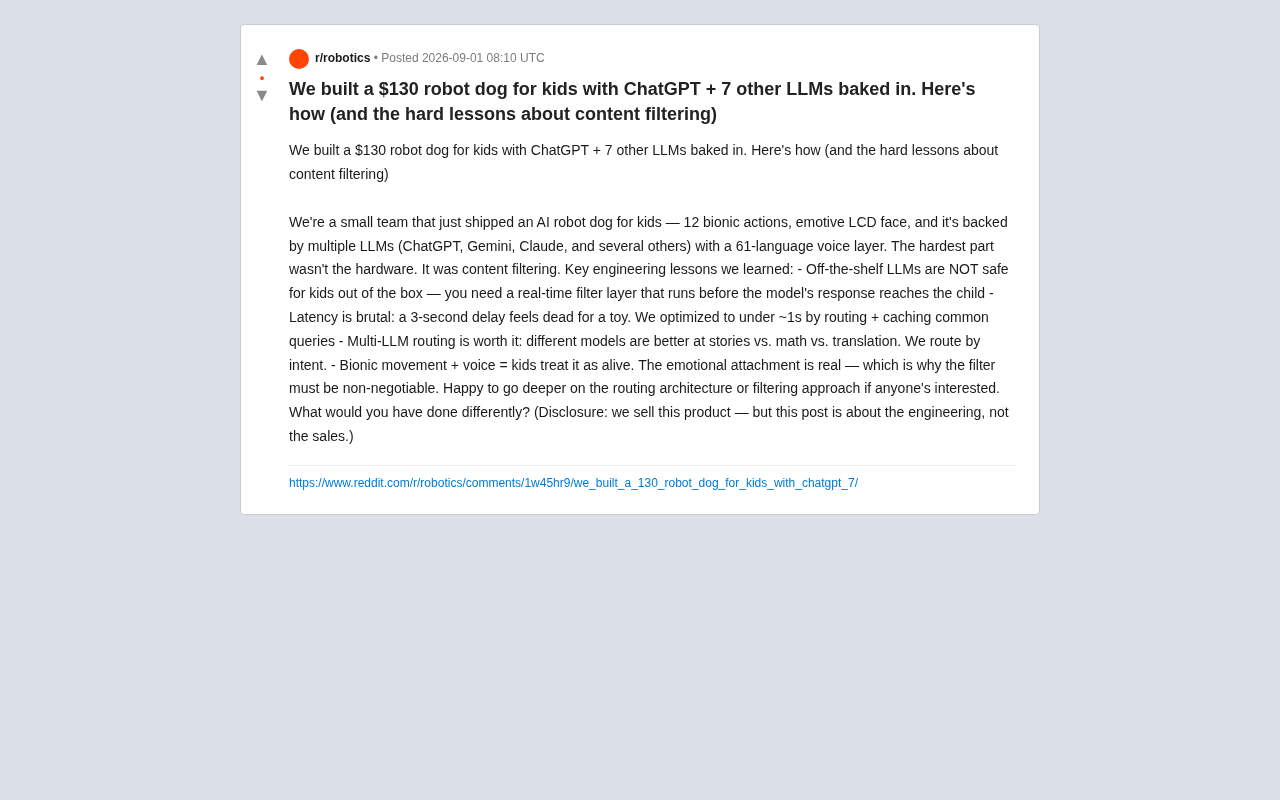
Building an AI Robot Dog for Kids: Multi-Model Routing, Content Filtering, and Latency Optimization
A $130 AI robot dog for kids integrates 8 LLMs with 61-language voice interaction. The team shares key engineering lessons on content safety filtering, multi-LLM intent routing, and sub-1-second latency optimization.

Can Omarchy Dominate the Sub-$1000 Laptop Market? An In-Depth Analysis
Omarchy, based on Arch Linux, shows unique advantages in the sub-$1000 laptop market. This analysis compares Windows and MacBook performance bottlenecks on low-spec hardware and examines why Omarchy enables cheap laptops to run smoothly, plus the ecosystem challenges and market prospects it faces.

AI Agent Beginner's Guide: Building a Creative Strategy Intelligent Assistant from Scratch
A complete guide to building a creative strategy AI Agent from scratch. No coding required — use tools like Dify and Coze to quickly build an intelligent assistant.