Carbon Model Shines in Benchmarks: High Performance Meets Low Cost

Carbon model excels in benchmarks with a standout cost line, drawing attention for its cost-effectiveness.
Based on a tweet, this article interprets the Carbon model's benchmark performance and cost advantages. The tweet cites "high-quality benchmark results with headroom" and highlights its cost line. Carbon demonstrates notable cost competitiveness while maintaining strong benchmark performance, potentially lowering the barrier to AI adoption and affecting enterprise TCO. Industry competition is shifting from pure performance to balancing performance and cost. However, public information is limited to a tweet and screenshot, lacking specific testing conditions, baselines, and cost calculations; the community awaits more transparent reports and reproducible results.
Introduction
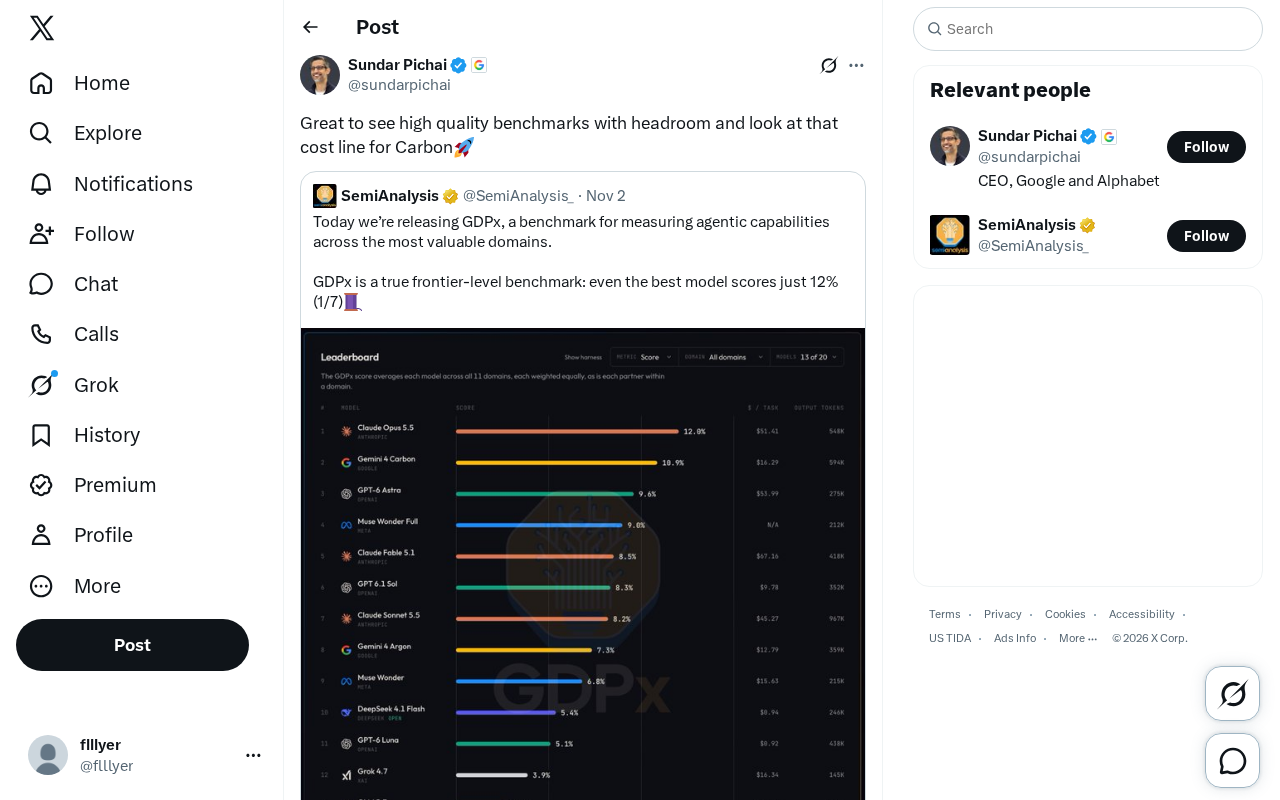
Recently, a tweet from Twitter caught the AI community's attention: "Great to see high quality benchmarks with headroom and look at that cost line for Carbon🚀". The accompanying image showcased the Carbon model's performance in benchmarks, with impressive high-quality results and a highly competitive cost line. This article will interpret it from three dimensions: benchmark performance, cost advantages, and industry impact.
Benchmarks: High Quality with Room for Improvement
The "high quality benchmarks with headroom" mentioned in the tweet conveys two key messages: on one hand, Carbon achieved high-quality results in benchmarks; on the other hand, these results still have headroom, meaning the model has not yet reached its performance ceiling, and future iterations are worth anticipating.
Although the tweet did not disclose the specific benchmark names and values, the term "headroom" suggests the model still has room for optimization on top of its current performance. For AI models, maintaining the potential for performance improvement is an important factor in continuously attracting developers and enterprise users.
Benchmark refers to standardized test sets for evaluating AI model capabilities, typically covering dimensions such as language understanding, reasoning, code generation, and mathematical problem-solving. Common benchmarks include MMLU (Massive Multitask Language Understanding), GSM8K (grade-school math reasoning), HumanEval (code generation), and others. Benchmark scores facilitate horizontal comparison across different models, but it should be noted that test set contamination, prompt sensitivity, and differences in evaluation protocols can all affect the comparability of results.
Headroom refers to the gap between a model's current performance and its theoretical upper limit. In the context of benchmarking, large headroom means the model is not yet saturated, and there is still significant potential for improvement through scaling parameters, adding data, or improving training methods; conversely, it indicates proximity to the performance ceiling. For developers and enterprises, headroom is an important signal for judging a model's iteration roadmap and investment value.
Cost Line: Carbon's Standout Advantage
The tweet specifically emphasized "look at that cost line for Carbon" and juxtaposed it with a rocket emoji, clearly highlighting its cost advantage. In today's increasingly fierce AI model competition, inference cost has become one of the key indicators for enterprise selection. Carbon's ability to deliver high-quality benchmark performance at a lower cost gives it differentiated competitiveness on the cost-effectiveness dimension.
The direct significance of the cost advantage is that more small and medium-sized teams can afford high-performance AI capabilities, thereby lowering the barrier to AI adoption. For large-scale deployment scenarios, a lower cost line will also significantly affect total cost of ownership (TCO).
Inference cost is typically measured in dollars per million tokens, covering GPU compute, memory bandwidth, and operational overhead. The cost line in comparison charts generally refers to the unit cost curve of different models at the same benchmark score; a lower curve indicates higher cost-effectiveness. The main approaches to reducing inference cost include model distillation, quantization (such as INT8/FP4), sparsification, KV cache optimization, and dedicated inference chips.
Total Cost of Ownership (TCO) includes not only API call fees but also model integration, data pipelines, monitoring and operations, latency optimization, and human resource investment. For large-scale deployments, inference cost often accounts for the majority of TCO, so small differences in the cost line will be significantly amplified at scale. Enterprises should weigh benchmark scores, latency, throughput, and TCO together when selecting models.
Industry Impact and Outlook
The emergence of the Carbon model reflects a trend in the AI industry: the balance between performance and cost is becoming a new competitive focus. In the past, top benchmark results were often accompanied by high compute costs; Carbon attempts to prove that high quality and low cost can be achieved together.
Of course, the currently public information is limited to a single tweet and a screenshot, lacking detailed testing conditions, comparison baselines, and cost calculation methods. The community looks forward to the Carbon team publishing a more complete benchmark report and cost analysis for objective evaluation.
Conclusion
The Carbon model's high-quality benchmark performance and standout cost line have earned it initial attention. If more transparent technical details and reproducible test results can be provided subsequently, Carbon is expected to secure a place in the AI model market. We will continue to follow its progress.
One-line Summary
Carbon model delivers excellent benchmark performance with a standout cost line, drawing attention for its cost-effectiveness.
Paragraph Summary
Based on a tweet, this article interprets the Carbon model's benchmark performance and cost advantages. The tweet states it has "high-quality benchmark results and headroom" and specifically highlights its cost line. The article analyzes that while maintaining high-quality benchmark performance, Carbon demonstrates significant cost competitiveness, which is expected to lower the barrier to AI adoption and affect enterprises' total cost of ownership. The industry's competitive focus is shifting from purely pursuing performance to balancing performance and cost. However, since the public information is limited to a single tweet and screenshot, lacking specific testing conditions, comparison baselines, and cost calculation methods, the community looks forward to more transparent technical reports and reproducible results.
Related articles

9 AI Subscription Plans Compared: The Real Cost Per 100M Tokens Revealed
Bilibili creator tests 9 AI subscription plans from Volcano, Alibaba, Tencent, Baidu, Zhipu, Xiaomi, MiniMax and more, converting them all to real cost per 100M tokens, breaking down fixed-quota vs. three-tier coefficient billing and how caching, time-of-day discounts, and window limits affect actual quota.

Vibe Coding for Beginners: Expressing Intent Instead of Handwriting Code
What is Vibe Coding? A 137-episode Bilibili course defines it: the core is expressing intent, not writing code. This article analyzes Vibe Coding's productivity logic, target audience, and entry expectations to help beginners decide if it's worth learning.

LangChain Beginner's Guide: An Agent Development Roadmap from LangGraph to Deep Agents
Clarify the encapsulation relationship among LangChain, LangGraph, and Deep Agents, and master the learning path and selection logic for agent development frameworks—suitable for beginners in large model development.