Career Switch to LLM Development from Scratch: A Four-Stage Learning Roadmap

A 342-episode, four-stage roadmap for switching careers into LLM application development from scratch.
This article introduces a 342-episode structured course for LLM application development, refined over six months by a Bilibili creator. Targeting career switchers, traditional backend developers, and demo builders who can't ship production systems, it follows a top-down four-stage path: building conceptual foundations (tokens, context windows, API basics), mastering core skills (Prompt engineering, RAG, Agent architecture) with hands-on projects, tackling production engineering (FastAPI, streaming, cost monitoring, LangChain vs. bare-metal decisions), and finally preparing for job search with resume writing, interview Q&A, and portfolio deployment.
How to Actually Learn LLM Development
For people looking to transition into large language model (LLM) development, the biggest challenge usually isn't a lack of effort — it's not knowing where to start. There's too much noise online. Some courses pile on model theory and math derivations, leaving you unable to build a single application afterward. Others are pure hype — big-picture trends and buzzwords with nothing concrete to show for it.
This Bilibili creator spent half a year refining a structured course that tries to land somewhere in between: enough model understanding to hold your own in interviews, and enough engineering skill to actually get things done. The full curriculum spans 342 episodes, with the goal of taking learners from zero experience to independently building LLM applications.
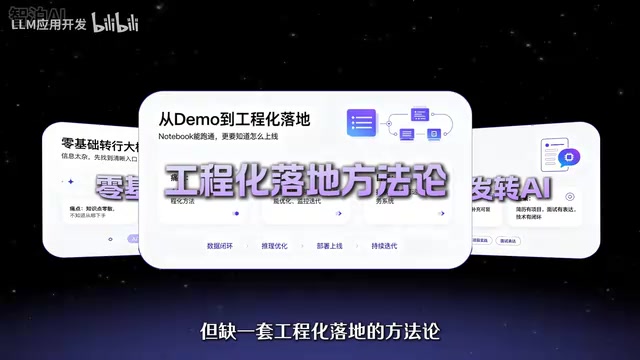
Who This Course Is For
The author clearly defines three target audiences — also the three most common types of learners in the LLM development space right now:
Career switchers with no background — want to break into AI, but the internet is overwhelming and there's no clear starting point.
Experienced traditional developers — two or three years of backend work under their belt, want to add an AI credential to their resume, but freeze up the moment someone asks about RAG or Agents.
Half-baked demo builders — can call a model API and run sample code, but lack a systematic methodology for engineering production-ready systems.
If you fall into any of these categories, the value of this course is turning a vague sense that "LLMs are hot" into a concrete roadmap you can actually follow. The author emphasizes that this curriculum wasn't pulled from thin air — it was built from hard-won lessons through their own job search, interviews, and onboarding new team members.
Breaking Down the Four-Stage Learning Path
The course is structured into four progressive stages, built on the logic of establishing a framework first and filling in skills second — so learners always know what they're studying, why, and what they'll be able to do with it.
Stage 1: Building Conceptual Foundations
This stage answers the question: "What does this job actually involve?" The core focus is understanding the fundamental difference between LLM application development and traditional backend development, and getting a clear grasp of capability boundaries — what these models can do, and what they can't.
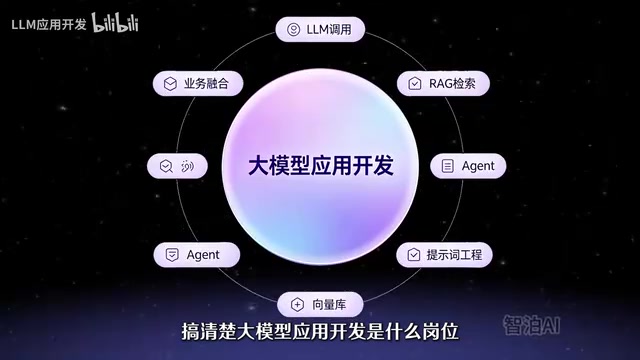
Specific topics include: what tokens and context windows actually do, how the temperature parameter affects output, API call mechanics and billing logic, which scenarios different mainstream models are best suited for, and how to systematically parse a job description. The author is direct about it: without a solid grasp of these fundamentals, whatever system you build is a house of cards — one question from an interviewer and the whole thing collapses.
Stage 2: Core Technical Skills
This is the heart of the curriculum, focused on three areas of hard technical competency:
Prompt engineering — going from "can get it to work" to "can get it to work consistently," covering role prompting, few-shot examples, and structured output.
RAG (Retrieval-Augmented Generation) — from theory to implementation, including Embeddings, vector databases, chunking strategies, and one unavoidable real-world problem: why retrieval accuracy stalls out and how to fix it.
Agent architecture design — how to orchestrate multi-step tasks, how to integrate tools via Function Calling and MCP, and how to handle failures gracefully.

Each skill area comes with a hands-on project: a document Q&A system for RAG, and an automated workflow for Agents. The author points out that these three areas are both the core interview topics and the fundamental day-to-day skills on the job.
RAG (Retrieval-Augmented Generation) is one of the most widely used engineering patterns in LLM application development today. The core idea: LLMs have a knowledge cutoff at their training date and can't directly answer questions about private or real-time data. RAG solves this by retrieving relevant document chunks from an external knowledge base at inference time and injecting them as context for the model — effectively giving the model temporary access to that information. The full pipeline involves document chunking, vectorization (Embedding), storage in a vector database, similarity-based retrieval at query time, and finally assembling a prompt for the model to generate a response. Retrieval accuracy is the most common bottleneck — poor chunking granularity, a poorly chosen Embedding model, or overly simplistic retrieval strategies can all result in the model receiving the wrong passages, leading to hallucinations.
Agents are an architectural pattern that goes beyond having a model "output text" — instead, the model can call external tools and execute multi-step tasks. The typical implementation uses Function Calling to let the model decide which tool to invoke and with what parameters, then feeds the tool's output back to the model to continue reasoning until the task is complete. MCP (Model Context Protocol) is a recently emerged standardized protocol for tool calling, aimed at unifying how different models interface with different tools.
Stage 3: Production Engineering
Being able to write a demo isn't enough. This stage is about turning that demo into a system you can actually ship. Topics include wrapping your model logic with FastAPI, implementing streaming output, managing conversation state, adding observability through logging, writing test cases that cover model failure modes, and handling cost and monitoring — controlling token spend, tracking live performance, and capturing bad outputs for analysis.
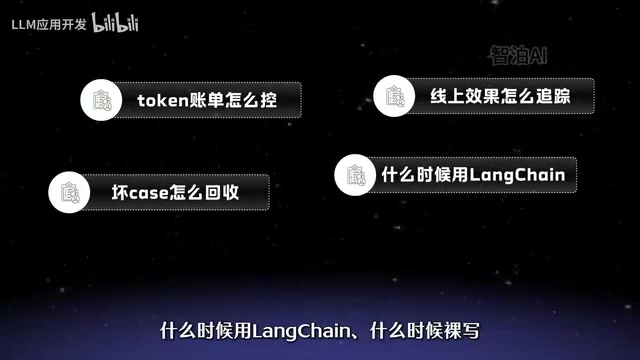
One particularly practical topic: when to use LangChain versus when to write everything from scratch. This kind of engineering judgment call is exactly where beginners tend to trip up, and the author offers a clear framework for making that decision.
LangChain is currently the most popular framework for building LLM applications, offering pre-built components like Chains, Agents, Memory, and Retrievers for quickly prototyping RAG systems or Agents. However, its high level of abstraction makes debugging difficult, its API changes frequently, and in production environments it can actually increase maintenance overhead. "Writing from scratch" means calling model APIs directly, without a framework, and manually managing context, tool-calling logic, and state. The general heuristic: use LangChain for rapid prototyping and early iteration; lean toward bare-metal or lightweight libraries for production systems where performance, observability, and customization matter. This is a real engineering decision in LLM development and a detail that often comes up in interviews.
FastAPI is a high-performance Python web framework with native support for async operations and streaming responses — making it a natural fit for wrapping LLM interfaces. Since model generation is token-by-token, streaming lets users see results in real time rather than waiting for the full response to complete, dramatically improving the experience.
Stage 4: Job Search and Interview Prep
The final stage comes full circle to employment. It covers how to write your resume (what problem did you solve, what approach did you take, what were the measurable results), how to answer common interview questions (how to address RAG hallucinations, how to break Agent infinite loops, how to reduce costs), and how to deploy your portfolio so you can hand over a working link. The goal is end-to-end support from preparation to offer.
The Methodological Value of This Curriculum
A lot of people trying to break into LLM development start by grinding through papers and memorizing architecture diagrams, then quit two weeks in with nothing to show for it. This course takes the opposite approach: build the framework first, so you understand what skills this role actually demands, then fill in each skill one by one.
This top-down learning path is especially well-suited for career switchers and beginners — it reduces early frustration and ensures every skill you learn has a clear, concrete application. That said, 342 episodes is a serious time commitment. The author's quip about "forcing yourself to finish it in a week" is more motivational rhetoric than realistic advice. The real value of this course comes from genuinely working through all four stages — foundations, core skills, production engineering, and job prep — and building something solid along the way.
Related articles

Automate Job Search with AI Agents and Residential Proxies for Precise Matching
Build an AI Agent with MCP and residential proxies to bypass recruitment site anti-scraping and geo-restrictions, scrape thousands of DevOps jobs, then have Claude score and rank each against your resume. Includes proxy comparison experiments, project structure, and cost analysis—filtering only, no auto-submission.

The AI Task Assistant That Knows When to Back Off: A Cure for Activation Struggles
One Small Step is an AI assistant for task initiation struggles, using agentic decisions for guilt-free reminders, timely retreat, and cross-platform task management. The developer shares real test results on 13 tasks and architectural trade-offs.

FastAPI: A High-Performance Python Framework and a Production-Ready API Development Powerhouse
FastAPI is a high-performance web framework based on Python type hints, supporting async and automatic OpenAPI docs. With over 100k GitHub stars, this article analyzes its core strengths, production readiness, and selection advice.