Cartesian: A First Look at the AI-Powered 3D Modeling Design Tool
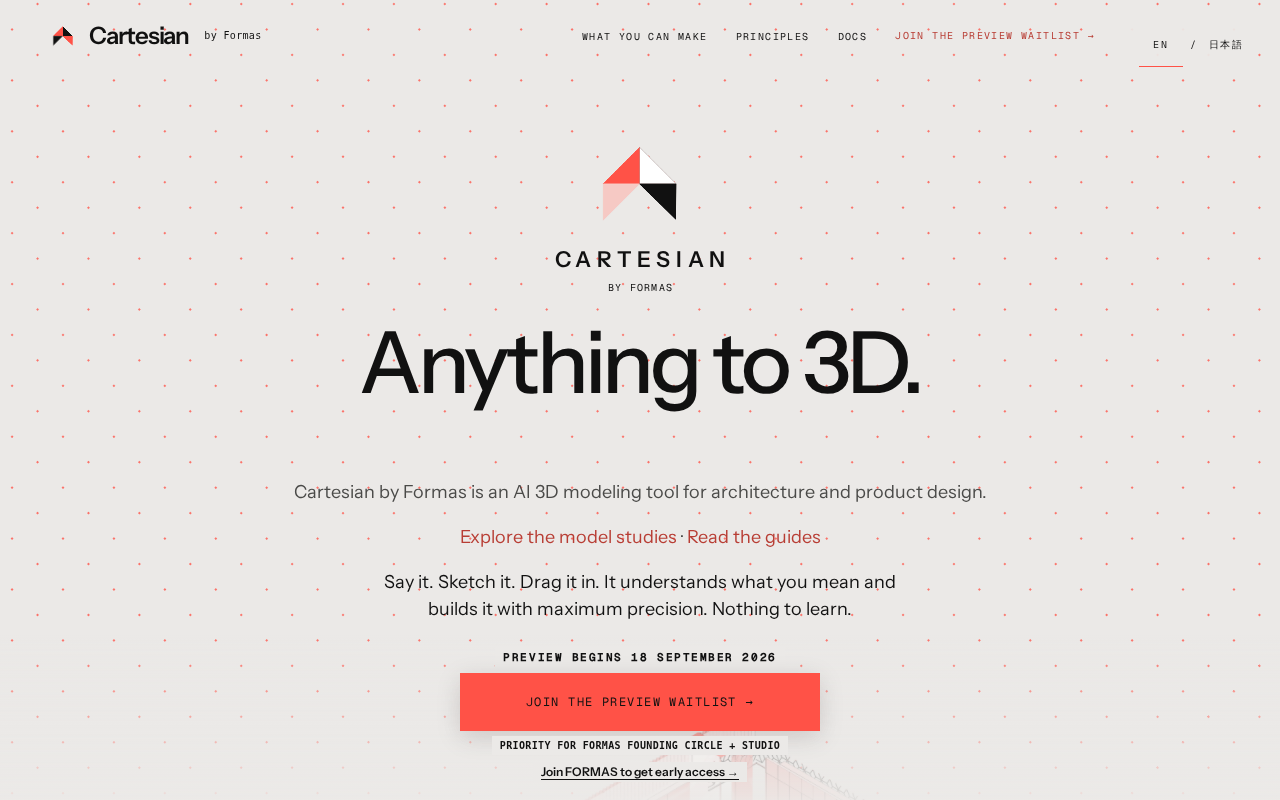
Cartesian is an early-stage AI 3D modeling tool focused on geometric precision and design workflow integration.
Cartesian is an AI-driven 3D modeling design tool that recently gained traction on Hacker News. Unlike generative AI in text and image domains, 3D has lagged due to complex data representations, scarce training data, and demanding geometric precision requirements. Named after the Cartesian coordinate system, it signals a focus on precision and controllability for industrial and product design — not just one-click generation demos. That said, it remains early-stage with limited technical details and faces strong competition from Meshy, Luma, Tripo, and Rodin. Worth tracking as an emerging project rather than a production-ready solution.
What Is Cartesian
Cartesian is a design tool built around "AI-driven 3D modeling" that recently caught the attention of the Hacker News community (19 points, 7 comments). Its core positioning is straightforward: use AI to make the traditionally steep, time-consuming process of 3D modeling faster and more aligned with how designers actually work.
Anyone who has touched 3D software knows just how punishing the learning curve can be — Blender, Maya, SolidWorks. Modeling, topology, UV unwrapping, rendering: each step demands dedicated training. Cartesian aims to close the gap between "having an idea" and "having a usable 3D model."
Why AI-Powered 3D Modeling Deserves Attention
Over the past two years, generative AI has successively exploded in text, image, and video domains — while 3D has consistently lagged behind. The reasons are structural: 3D data representations are complex (meshes, point clouds, voxels, NeRF, implicit functions, and more), high-quality training data is scarce, and the geometric precision required far exceeds the "looks right" bar that image generation can get away with.
That's precisely why any product attempting to bring AI into 3D modeling is worth exploring. Cartesian's emphasis on serving "Design" use cases suggests it may be aiming for more than flashy one-click generation demos — it wants to embed itself into real design workflows. That ambition carries far more commercial potential than a simple "text-to-3D model" proof of concept.
The various 3D data representations each have their strengths: Mesh is the most common format, built from vertices, edges, and faces — easy to edit but hard to generate directly; Point Cloud consists of discrete 3D points, common in LiDAR scanning; Voxel is essentially a 3D pixel grid — structurally regular but memory-intensive; NeRF (Neural Radiance Field) is a recently popularized implicit representation that encodes scenes via neural networks, excelling at photorealistic rendering but making geometry extraction difficult; Implicit functions (e.g., SDF — Signed Distance Field) describe object surfaces mathematically and handle topological changes more robustly. Different downstream tasks — rendering, 3D printing, physics simulation, CAD editing — demand entirely different formats. This is the fundamental reason AI 3D generation is so much harder than image generation: producing an image that "looks like a chair" is infinitely easier than generating a chair mesh you can actually send to production.
What a Design-Focused Positioning Actually Means
Naming the product Cartesian — after the Cartesian coordinate system — is itself a signal: it implies a commitment to geometric precision and structured modeling, rather than generating freeform organic shapes at random. In industrial design, product design, and CAD-adjacent fields, controllability and accuracy consistently matter more than "artistic feel."
If an AI 3D tool can accelerate iteration from concept to finished model while keeping geometry editable and parameterizable, it addresses a real efficiency bottleneck for designers. This is the critical threshold that separates today's 3D AI tools into two camps: toys versus productivity tools.
Limited Information for Now — Stay Measured
It's worth being honest: based on currently available information, Cartesian is still in early stages. Community discussion is modest, and accessible technical details and real-world test results remain limited. Key questions — what generative model it uses, how editable the output geometry actually is, how well it integrates with mainstream design software — are yet to be answered publicly.
For practitioners at the intersection of AI and design, the right posture is to track this as a promising early-stage project rather than treating it as a production-ready solution. The AI 3D space is crowded with competitors (Meshy, Luma, Tripo, Rodin, and others), and whether Cartesian can carve out a differentiated position still needs time to prove out.
The competing tools mentioned above represent the dominant approaches in today's AI 3D landscape: Meshy and Tripo focus on one-click generation of downloadable 3D meshes from text or images, targeting use cases like gaming and e-commerce where precision requirements are relatively forgiving; Luma AI leads with NeRF/3DGS technology, emphasizing high-quality 3D scene reconstruction from video or images; Rodin (Hyper3D) concentrates on high-fidelity character and asset generation, aiming at professional game and film production pipelines. The shared limitation across these tools is that generated results often suffer from messy topology and bloated polygon counts, making them difficult to re-edit directly in Blender or CAD software — which is precisely where Cartesian's most valuable differentiation opportunity lies, if it can genuinely deliver on editability.
Summary
Cartesian represents another attempt to bring AI-powered 3D modeling into real design workflows. Its value isn't in what it has already achieved — it's in the direction it points toward: continuously lowering the barrier to 3D creation so designers can focus their energy on ideas rather than tool operations. As generative AI extends its reach from 2D fully into 3D, tools like this are worth keeping an eye on.
Related articles

DeepSeek Harness in Practice: Building a Low-Cost AI Coding Powerhouse
Learn how to transform DeepSeek's open-source harness using Claude Code, Bright Data scraping, and vision models to build an AI coding workflow costing just half a cent per task.
Overseas Developer Tests: DeepSeek Already Rivals Opus — Stop Waiting for the Next Model
An overseas developer finds DeepSeek V4 Pro rivals Opus 4.8 at a fraction of the cost. Learn how DeepSeek + BrightData compares to Claude Code for building SaaS.

DeepSeek V4.1 Flash Hands-On: Can a Small-Activation New Architecture Top the Open-Source Charts?
DeepSeek V4.1 Flash deep dive: new MoE encoder-decoder architecture, 552B total params, tiny active params, reduced KV cache. Open-source on Hugging Face. Full hands-on test from BrowserOS to 3D printing.