Celebrity AI Deepfakes Are Everywhere: No One Is Safe

Celebrity AI deepfakes are rampant, and the real crisis is the collapse of the 'seeing is believing' trust foundation.
Using the AI-fabricated 'divorce counterstrike' photo of actress Mia Goth as an entry point, the article analyzes why celebrities are ground zero for deepfakes: abundant source material, easily manipulated public emotions, and near-zero generation costs. The core harm isn't making people believe a fake photo, but dismantling the cognitive foundation of 'seeing is believing.' The article offers practical detection methods and analyzes the three-way governance tug of war among platforms, regulators, and technology.
A seemingly ordinary Instagram photo, a T-shirt bearing a provocative slogan, a perfectly timed soundtrack — until people realized the star's face in the photo was AI-generated. This isn't a sci-fi movie plot; it's a reality unfolding across social media at scale. Celebrity AI deepfakes have evolved from a niche plaything of the tech world into a trust crisis affecting public figures, fan communities, and the entire information ecosystem.
How a Fake Photo Fooled Everyone
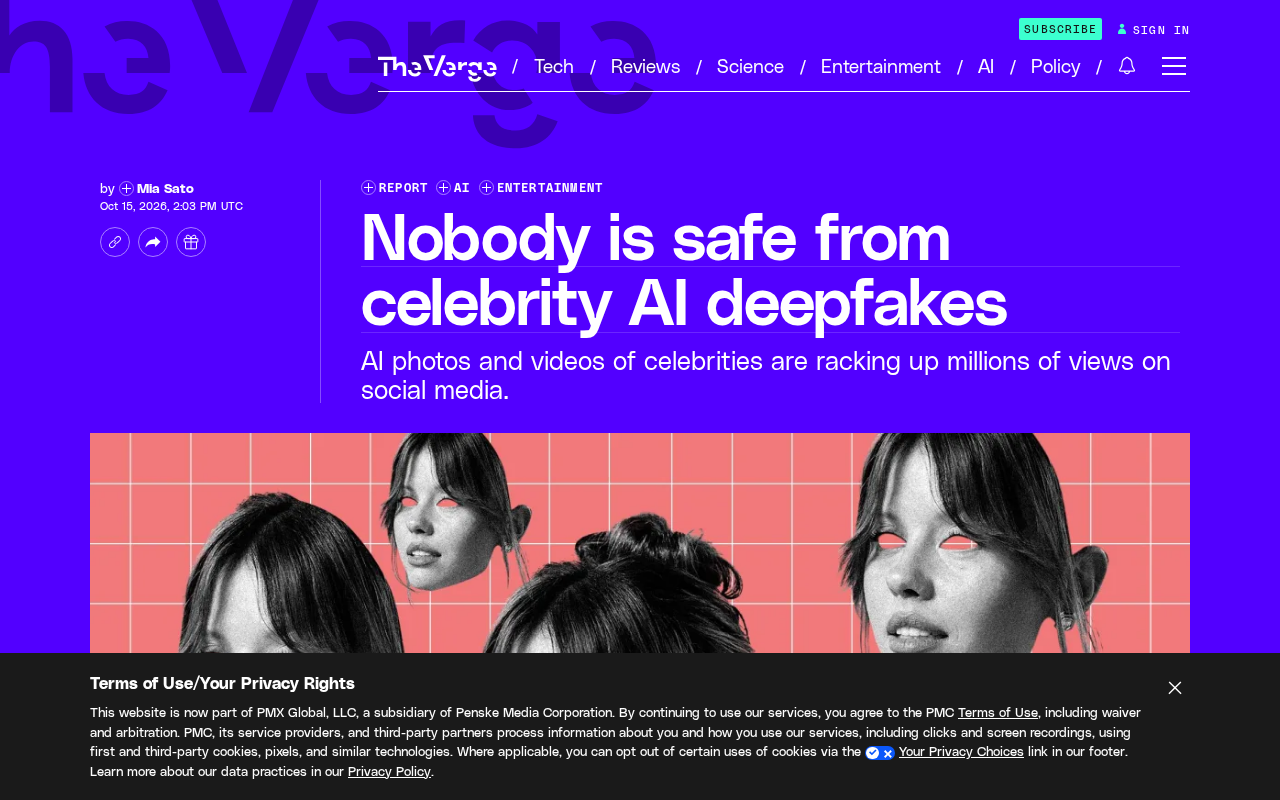
According to RSS sources, the photo that drew attention claimed to show actress Mia Goth — just days after she filed for divorce from actor and director Shia LaBeouf. In the image, she wears a T-shirt printed with "MY EX IS MY BIGGEST FAN," set to the song "Single." The whole package looked like a carefully orchestrated social media counterstrike.
The problem: the photo was almost certainly AI-generated. In hindsight, that Instagram post should have raised far more red flags — but most people only realized it after the fact. This is precisely what makes celebrity AI deepfakes so dangerous: they don't need to be perfect, only convincing enough to complete the leap from "suspicious" to "certain" within the chain of virality.
Why Celebrities Are Ground Zero for Deepfakes
The explosion of celebrity deepfakes is no accident. At least three factors are working in tandem:
Abundant source material. Celebrities have vast archives of public photos, videos, and interview footage, providing an almost limitless training library for AI models. An ordinary person might leave behind only a few dozen high-resolution photos, but an active star's visual footprint is enough for a model to learn how to precisely reproduce their face from every angle and expression.
Easily manipulated public emotions. Celebrities' lives carry immense public emotional investment. When Mia Goth's "divorce counterstrike" image appeared, many people wanted to believe it was real — because it fit the narrative they expected. Deepfake creators understand this well: they don't manufacture random illusions but "customized lies" that precisely target emotional pressure points.
Near-zero cost of propagation. The time and technical barrier to generating a convincing celebrity photo is dropping rapidly. From open-source models to commercial tools, the proliferation of AI image generation means anyone with basic operational skills could become the next deepfake creator.
The technical underpinnings of deepfakes. The term "deepfake" is a portmanteau of "deep learning" and "fake," first appearing on Reddit in 2017, initially used mainly to swap celebrity faces into pornographic videos. Its core technologies are Generative Adversarial Networks (GANs) and the more recently emerged Diffusion Models: the former produces realistic images through a contest between a "generator" and a "discriminator," while the latter reconstructs high-quality images from random noise through progressive denoising. These models need only dozens to hundreds of photos of a target person to learn their facial features and synthesize new scenes. With the proliferation of tools like Stable Diffusion and Midjourney, the cost of generating a fake celebrity photo has dropped from hours of professional work to minutes of simple prompt input — this is the technical foundation fueling the deepfake flood.
Nobody Is Safe
The key word in "Nobody is safe from celebrity AI deepfakes" isn't "celebrity" — it's "nobody." Celebrities bear the brunt because they have the highest exposure, the most material, and the strongest public attention. But the same technological logic is spreading to broader populations: politicians, entrepreneurs, influencers, and even ordinary people's social media avatars can all become deepfake targets.
The deeper crisis lies in the collapse of trust mechanisms. When people realize celebrity photos might be fake, they begin to doubt all photos; when they discover videos can also be forged, they begin to doubt all videos. This state of "blanket skepticism" is precisely the most lasting social harm of deepfakes — it doesn't need to convince you to believe a falsehood, only to stop believing in any truth.
Detection and Defense: What Ordinary People Can Do
In the face of widespread celebrity AI deepfakes, completely eliminating them is nearly impossible, but several practical principles can reduce the probability of being misled:
- Check the source. If a celebrity photo appears only on a social media account with no reliable attribution, assume it's fake first.
- Watch for "too perfect" narratives. Deepfakes often come paired with highly dramatic captions, music, and timing — because they need emotional virality, not factual virality.
- Reverse search. Run a reverse image search on suspicious images to see if they can be found in earlier or more authoritative sources.
- Pay attention to platform labels. Some platforms have begun labeling AI-generated content; watch for these notices.
- Delay sharing. Wait a few extra minutes before reposting, giving fact-checking a window of opportunity.
These methods aren't perfect, but at least they can help you maintain basic judgment amid the deepfake torrent.
The Three-Way Tug of War: Platforms, Regulation, and Technology
Governing celebrity AI deepfakes is becoming a three-way contest among platforms, regulators, and technology developers.
On the platform side, companies like Meta and TikTok have begun attempting to label and restrict AI-generated content, but enforcement varies widely. Labels often lag behind propagation, and deepfakes spread on a timescale measured in minutes.
On the regulatory side, countries are exploring dedicated legislation targeting deepfakes, but the pace of legal updates trails far behind the iteration of AI generation capabilities. More vexing still, the cross-border nature of deepfake propagation limits the effectiveness of any single country's regulation.
On the technology side, detection tools and generation tools are in a race. Every improvement in detection capability spurs generation technology to find new workarounds. This is an arms race with no finish line.
The C2PA standard and content provenance. Beyond detection technology, another governance path is "Content Credentials," whose technical foundation is the C2PA (Coalition for Content Provenance and Authenticity) standard. Jointly promoted by Adobe, Microsoft, the BBC, and others, the standard embeds cryptographically signed metadata into images and videos, recording the content's generation tools, editing history, and source information. Camera manufacturers can write credentials directly at the point of capture, and AI tools can label at the point of generation. Readers can use specialized tools to see "where an image came from and what modifications it underwent." This approach attempts to shift from "post-hoc detection" to "ex-ante provenance," but the challenge is that metadata is easily stripped, and not all platforms and tools support the standard — the ecosystem remains fragmented.
When "Seeing Is Believing" No Longer Holds
The real impact of celebrity AI deepfakes isn't how many people a single fake photo fooled, but that it undermines "seeing is believing" — a basic assumption human society has operated on for thousands of years.
When a photo, a video, or even an audio recording can no longer serve as credible evidence, the cognitive infrastructure we rely on to judge truth from falsehood is being eroded. Repairing it requires not only better detection technology but also a collective effort across platform responsibility, legal frameworks, and public media literacy.
That fake photo of Mia Goth is just the tip of the iceberg. The real question is: in the age of deepfakes, what can we still believe?
One-line Summary
Celebrity AI deepfakes are rampant, and the real crisis is the collapse of the "seeing is believing" trust foundation.
Paragraph Summary
Using the AI-fabricated "divorce counterstrike" photo of actress Mia Goth as an entry point, the article analyzes why celebrities are ground zero for deepfakes: abundant source material facilitates model training, public emotions are easily manipulated by dramatic narratives, and the cost of generation and propagation approaches zero. The author points out that the core harm of deepfakes isn't making people believe a fake photo, but dismantling the cognitive foundation of "seeing is believing," plunging the public into blanket skepticism. The article offers practical detection methods such as checking sources, reverse searching, watching for platform labels, and delaying sharing, and analyzes the three-way tug of war among platform labeling, regulatory legislation, and technological detection — all of which lag behind the iteration speed of generation technology, leaving governance facing severe challenges.
Related articles

Free Unlimited Claude Code Solution: Agnes AI + CC Switch Setup Guide
No paid subscription needed — pair the free AI platform Agnes AI with the open-source tool CC Switch to provide a backend for Claude Code, enabling unlimited free calls to text, image, and video models. This guide covers the full setup, test results, and usage boundaries.

A Complete Zero-Cost Guide to Getting Started with Claude Code for Beginners in China
A beginner's guide to Claude Code for users in China: two installation methods (command line and IDE plugin), full configuration steps for replacing the official API with the free domestic LongCat model, and a hands-on demo of building a small tool with natural language, plus tips.

When the NSA Gets Involved: The AI Supply Chain Crisis Behind Open-Source CVEs and API Key Hijacking
Multiple open-source projects disclosed severe CVEs in one day, PHP flaws alarmed the FBI, and Railway and OpenCode were breached with API keys stolen. This article breaks down the vulnerability window, AI-accelerated exploitation, and the AI supply chain crisis behind the API key black market, with a developer defense checklist.