Character.AI Launches AI-Powered Micro-Dramas Where Viewers Can Chat with Characters in Real Time

Character.AI launches interactive micro-dramas where viewers can hold real-time conversations with AI-driven characters.
Character.AI has officially entered the microdrama market, combining vertically formatted short-form video with its core AI character interaction technology. Unlike traditional short dramas, users can talk directly to AI-powered characters, explore story branches, and engage in roleplay — blending passive viewing with active participation in a format the company is calling a new frontier for AI-native content.
Character.AI's New Venture: AI Micro-Dramas
Character.AI — the company that built its name on AI-driven roleplay chatbots — has officially entered the microdrama space with its own original content. But unlike traditional short-drama platforms, Character.AI brings a pivotal twist: its core AI character interaction capability is deeply woven into the viewing experience itself.
About Character.AI: Founded in 2021 by former Google Brain researchers Noam Shazeer and Daniel De Freitas, the platform is built on large language models (LLMs) and specializes in creating conversational AI that can embody specific personas and maintain character consistency. Users can create or interact with millions of AI characters — from historical figures and fictional personas to celebrity likenesses. By 2023, the platform had surpassed 20 million monthly active users, with average session lengths approaching 30 minutes, far exceeding most social apps — a testament to its remarkably strong user retention. In 2024, Character.AI struck a significant technology licensing deal with Google while continuing to operate as an independent company.
Micro-dramas have exploded in popularity worldwide in recent years, particularly in China and Southeast Asia, where vertically formatted, fast-paced, plot-driven short-form video content has attracted massive audiences. Industry background: Microdrama episodes typically run one to five minutes, presented in portrait format with breakneck pacing, and monetize primarily through per-episode unlocks or subscriptions. The format originated in China, where the market surpassed 30 billion RMB in 2023. Platforms like ReelShort and DramaBox then successfully carried the model to North American and Southeast Asian markets. Competition is fierce, with players ranging from ReelShort to a wave of domestic short-drama apps. Character.AI's entry at this moment clearly isn't about replicating what already exists — it's about leveraging its unique AI character interaction expertise to carve out a differentiated path.
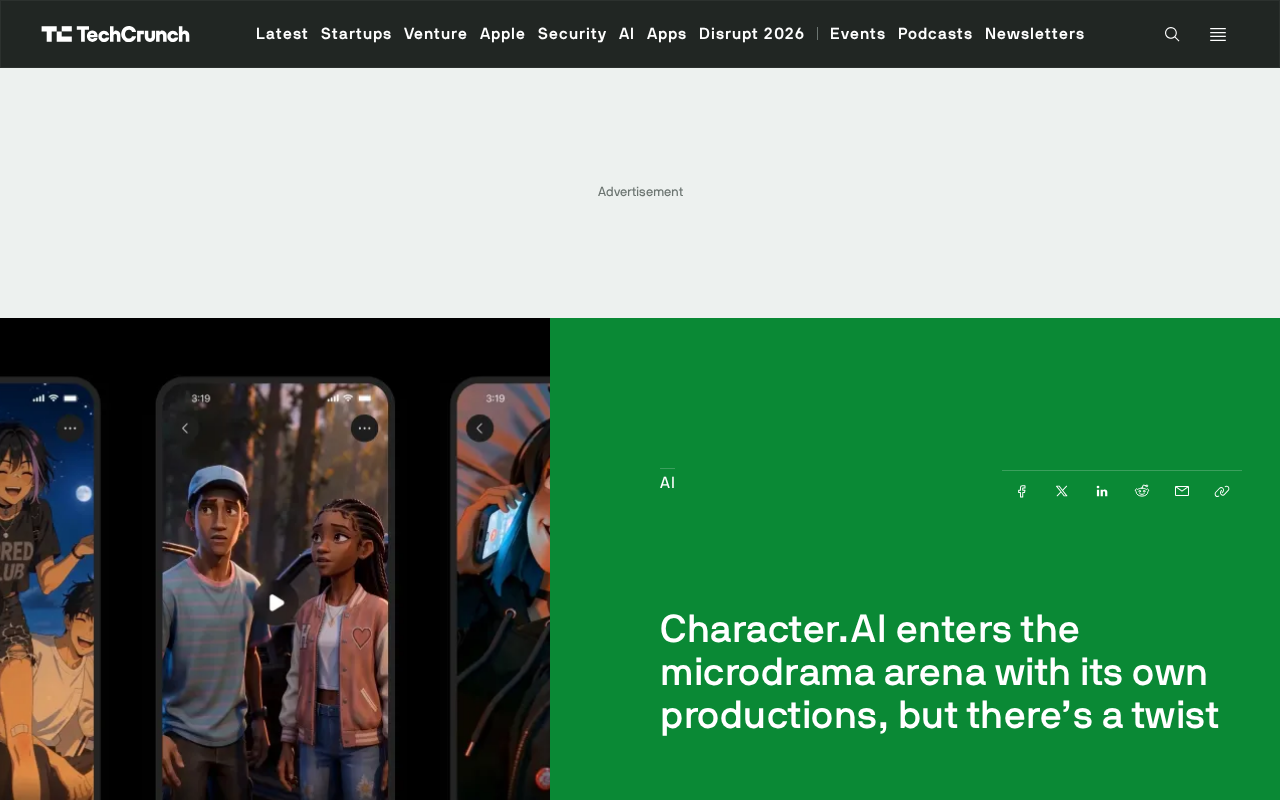
The Core Hook: Real-Time Conversations with Characters Inside the Story
The most striking aspect of this launch is that users aren't just passive viewers — they can actually talk to the AI-powered characters in the drama. According to reports, users can ask characters questions and even engage in roleplay across different story branches.
This is precisely where Character.AI's competitive edge lies. As a platform built on LLMs and purpose-built for AI character interaction, it is uniquely positioned to "bring to life" video content in ways traditional platforms cannot. Conventional short dramas end when playback stops — the relationship between viewer and content is purely one-way. Under Character.AI's model, watching is just the beginning: users can step inside the story and build more personalized emotional connections with the characters.
From Watching to Participating: Redefining the Experience
This design fundamentally blurs the line between "watching" and "playing." When users can interrogate a character's motivations, explore unexplored plot branches, or even influence where the story goes, content consumption shifts from passive reception to active participation.
The evolution of interactive narrative: Interactive storytelling is hardly a new idea — from text adventure games in the 1980s to Netflix's 2018 interactive film Black Mirror: Bandersnatch, the industry has long explored giving audiences narrative agency. But traditional interactive content is constrained by pre-scripted branches; user choices are ultimately limited to a finite decision tree. The arrival of large language models changes everything — AI can generate contextually appropriate, in-character dialogue responses in real time, theoretically offering near-infinite narrative possibilities. This LLM-powered "open interactive narrative" is sometimes called Generative Narrative by researchers, and represents a key frontier in the convergence of AI and the creative industries. With its mature conversational AI technology, Character.AI is well positioned to deliver a more natural and open interactive experience than traditional interactive film formats have managed.
Why This Move Matters
Redefining Content with AI-Native Capabilities
Character.AI's foray into micro-dramas demonstrates how AI-native companies can extend their technical advantages into entirely new application areas. Rather than treating AI as merely a cost-cutting tool in production, the company positions AI interaction as the central selling point of the content experience itself. This "technology as experience" philosophy may be precisely what distinguishes AI content companies from traditional content platforms.
For the microdrama industry — which is highly dependent on user retention and paid conversion — interactive AI characters can meaningfully deepen engagement. When viewers develop an emotional attachment to a character and can then speak with that character directly, that connection deepens, driving longer session times and greater monetization potential.
A Note on Information Availability
Worth flagging: public information remains limited. The company has yet to disclose specifics about the number of original titles, genre categories, monetization structure, or technical implementation details. Parts of this article are based on single-source reporting, and it will be important to track Character.AI's actual execution and user response as more information becomes available.
Industry Implications and the Road Ahead
Character.AI's push into micro-dramas reflects a broader trend of AI companies actively exploring new content formats and revenue streams. Against a backdrop of maturing pure-chatbot markets and growing content safety pressures, blending AI capabilities with video content could open meaningful new growth avenues for the company.
From a macro perspective, this also signals that AI is fundamentally reshaping how content is produced and consumed. Future entertainment content may no longer be a fixed, finished product — it could become "living content" that dynamically evolves through real-time interaction with users. Whether this particular experiment succeeds or not, Character.AI's attempt provides the broader industry with a case study worth examining closely.
That said, the challenges are real. Character consistency and content safety are two core problems: "character consistency" refers to an AI's ability to maintain a persona's personality, backstory, and values stably across long, multi-turn conversations — avoiding breaking character or producing contradictory responses. Character.AI has accumulated considerable proprietary technology and training data in this area. At the same time, content safety has been a persistent source of regulatory pressure for the company, which has faced controversy and litigation on multiple occasions over the content of user-AI conversations. How to preserve the openness and naturalness of character interaction while effectively filtering harmful content — and how to strike the right balance between interactivity and narrative coherence — are practical challenges Character.AI urgently needs to address. This experiment at the intersection of AI technology and content creation is only just beginning.
Key Takeaways
Related articles

LLaMA-Factory in Practice: A Complete No-Code Guide to Fine-Tuning Large Models
An introduction to LLaMA-Factory, the open-source fine-tuning tool: its 60.1K-star background, supported models and algorithms, local vs. cloud deployment, and CUDA setup steps.

Zeng Ming's Deep Retrospective: Why OpenAI May Not Be the Ultimate Winner — and Why the Corporate System Will Disappear
Zeng Ming's deep retrospective on the AI endgame: model companies are just infrastructure, OpenAI and Anthropic won't be the final winners; the next battle is the Agent entry point standard; the corporate system will disappear as AI restructures collaboration, and only mission-driven companies can survive the cycle.

OpenHands v1.28.0: OpenCode and PI Added as Built-in Agents, API Keys Requestable In-Conversation
OpenHands ships 5 releases in 21 days: v1.27.0 adds OpenCode and PI as built-in agents, v1.28.0 enables in-chat key requests. ACP integration, credential reuse, model list changes, and upgrade advice.