Chat.sh: A New AI-Powered Help Center That Ditches the Subscription Model

Chat.sh is an AI-powered help center tool challenging Intercom with generative search and a one-time payment model.
Built by developer Damon Chen after a frustrating experience with Intercom's search, Chat.sh debuted at #9 on Product Hunt. It uses AI to generate cited answers instead of keyword matching, supports deployment under your own domain path, and exposes content in Markdown for ChatGPT, Claude, and the llms.txt standard. Its lifetime deal pricing makes it especially attractive to indie developers and small teams, and future plans include a chat messenger and support inbox to form a full lightweight customer support suite.
Born Out of a Broken Search Experience
Many teams have faced the same frustration: a help center search that's essentially useless — users type in keywords, find nothing relevant, and end up sending a support email anyway. Developer Damon Chen experienced exactly this with Intercom's failing search, which prompted him to build a more modern help center tool from scratch: Chat.sh.
The product launched on Product Hunt and earned 84 upvotes on day one, landing at #9 and earning placement in three categories: Customer Success, SaaS, and Artificial Intelligence. Its positioning is refreshingly straightforward — replace traditional keyword matching with AI-powered search, and swap monthly subscriptions for a one-time payment.
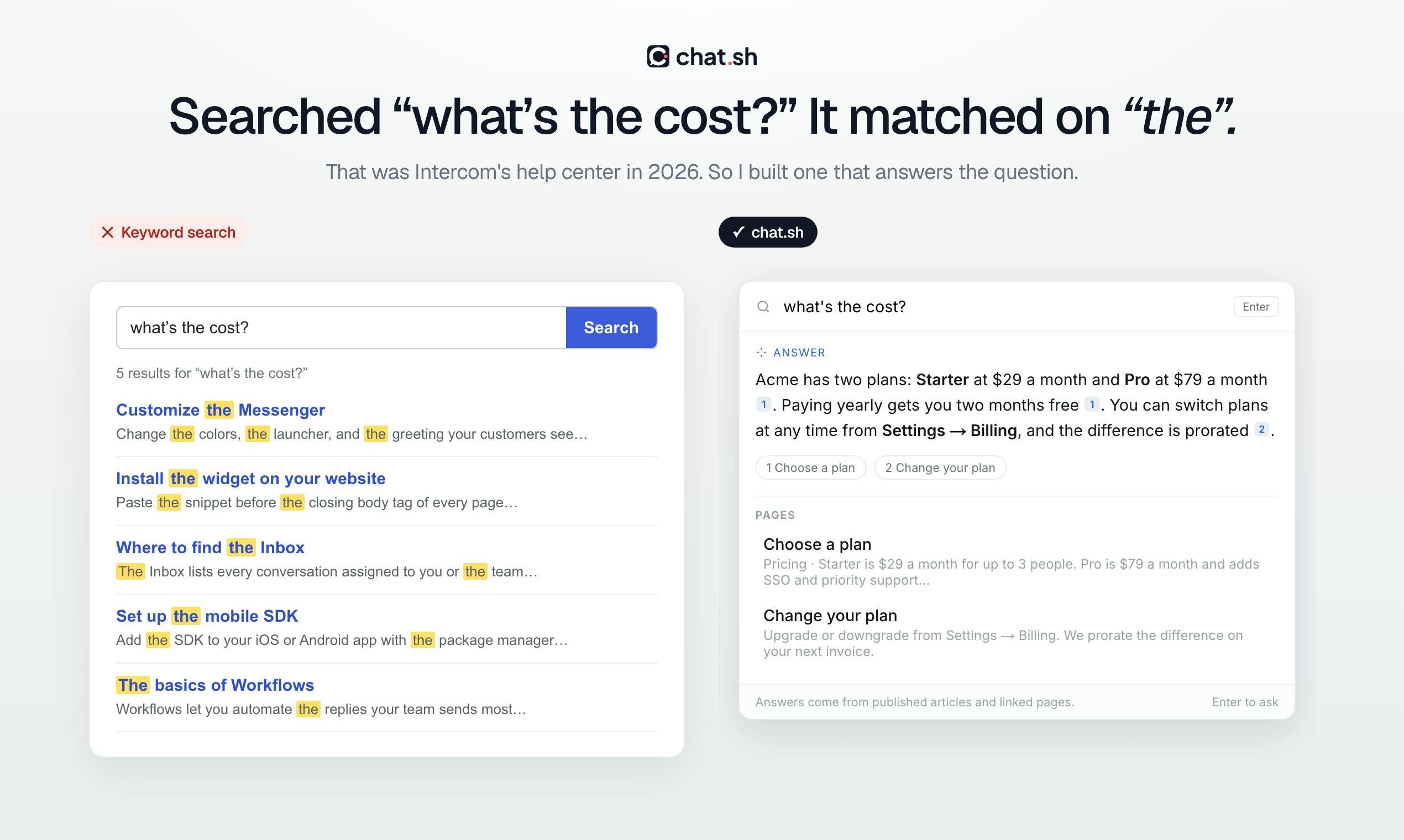
The Core Difference: AI Search vs. Keyword Matching
The traditional help center playbook goes like this: hand you a subdomain, a keyword search box, and a monthly invoice. Chat.sh is designed to break that mold.
Its most important capability is that AI search directly writes answers rather than returning a list of loosely related article links. Crucially, it cites the source pages it draws from, giving both users and operators full traceability. This "generated answer + cited sources" approach aligns with the design philosophy of leading AI Q&A products over the past couple of years — boosting retrieval efficiency while also alleviating trust concerns around AI hallucinations.
For content teams, this means you no longer need to obsessively optimize keyword tags just so users can find things. The AI understands semantics and synthesizes answers across multiple documents.
Two Clever Design Decisions
Chat.sh includes two product design details worth highlighting.
Hosted Directly Under Your Own Domain
Most help centers assign you a standalone subdomain, which isn't ideal for brand consistency or SEO. Chat.sh instead lets your help center live inside a folder on your own website — something like yoursite.com/help. Compared to subdomains, same-domain paths carry more weight in search engine authority transfer and tend to inspire greater user trust.
Markdown Pages Built for the AI Era
Another forward-thinking design choice: every help page is available in Markdown format so that large language models like ChatGPT and Claude — as well as the llms.txt standard — can read them easily. As more users turn to AI assistants rather than search engines to find information, making documentation "readable" by LLMs is becoming the new frontier of content distribution. The fact that Chat.sh has already prepared for this reflects a sharp awareness of where the AI content ecosystem is heading.
llms.txtis an emerging unofficial standard, similar in concept torobots.txt(which tells search crawlers how to handle a site). Its purpose is to help large language models understand and index website content more efficiently. Developers place anllms.txtfile in their site's root directory, listing key pages, documentation structure, and core content entry points in concise Markdown format — enabling AI assistants to quickly and accurately locate authoritative sources when users ask related questions. The concept was proposed by fast.ai founder Jeremy Howard in 2024 and spread rapidly through the indie developer community. Unlike traditional SEO, which targets search engine crawlers,llms.txtis aimed at conversational AI systems like ChatGPT, Claude, and Perplexity. Chat.sh's native support for this standard means its help documentation is structurally ready to be cited and distributed by AI systems.
A One-Time Payment Business Model
In a SaaS landscape dominated by subscriptions, Chat.sh has opted for a lifetime deal model — pay once, use forever. On launch day, a limited-time promo code was available, taking $200 off the lifetime plans (reducing a $399 plan to $199, and a $799 plan to $599).
This pricing strategy is particularly appealing to budget-conscious indie developers and small teams — it transforms a help center from an ongoing operational expense into a one-time tool investment. That said, the one-time payment model also means the vendor needs to find a sustainable balance between ongoing maintenance and feature development — a long-term challenge that products like this will inevitably face.
The lifetime deal model has a long history among indie developers and early-stage SaaS products, popularized by platforms like AppSumo. For sellers, it's a way to generate quick cash flow early on, build a seed user base, and gather real-world feedback. For buyers, it eliminates the cumulative cost of long-term subscriptions. However, the model carries inherent tension: as the user base grows, marginal costs — servers, AI calls (vector search, LLM APIs, etc.) — keep rising while revenue doesn't. Successful lifetime deal products typically need to use early sales revenue to cover infrastructure costs, or develop supplementary income through premium add-ons or higher-tier plans. For Chat.sh, maintaining AI search quality over the long run means balancing LLM API costs against one-time revenue — a defining challenge for its commercial sustainability.
Current State and Roadmap
Chat.sh is currently focused on the help center itself, which you can try directly at chat.sh/help. According to the maker, upcoming features include a chat messenger and a support inbox, gradually evolving the product into a more complete customer support suite.
This roadmap signals that Damon Chen isn't content to build a static documentation tool — he wants Chat.sh to grow into a lightweight alternative capable of going head-to-head with established players like Intercom. For teams that find Intercom bloated or overpriced, lean indie products like this offer a compelling new option.
Wrapping Up
Chat.sh's arrival reflects how the long-stagnant help center category is being redefined by AI and new pricing models. AI generative search, same-domain path deployment, LLM-ready Markdown content, and a one-time payment — these four qualities combine to form its core differentiation from traditional solutions. Whether it can truly challenge industry giants like Intercom remains to be seen, but it at least offers indie developers and small-to-medium teams a clear-headed, modern alternative worth considering.
Related articles

Free Unlimited Claude Code Solution: Agnes AI + CC Switch Setup Guide
No paid subscription needed — pair the free AI platform Agnes AI with the open-source tool CC Switch to provide a backend for Claude Code, enabling unlimited free calls to text, image, and video models. This guide covers the full setup, test results, and usage boundaries.

A Complete Zero-Cost Guide to Getting Started with Claude Code for Beginners in China
A beginner's guide to Claude Code for users in China: two installation methods (command line and IDE plugin), full configuration steps for replacing the official API with the free domestic LongCat model, and a hands-on demo of building a small tool with natural language, plus tips.

When the NSA Gets Involved: The AI Supply Chain Crisis Behind Open-Source CVEs and API Key Hijacking
Multiple open-source projects disclosed severe CVEs in one day, PHP flaws alarmed the FBI, and Railway and OpenCode were breached with API keys stolen. This article breaks down the vulnerability window, AI-accelerated exploitation, and the AI supply chain crisis behind the API key black market, with a developer defense checklist.