ChatGPT Desktop Reportedly Forwards SSH Agent: Is Your AI Session an Infrastructure Backdoor?
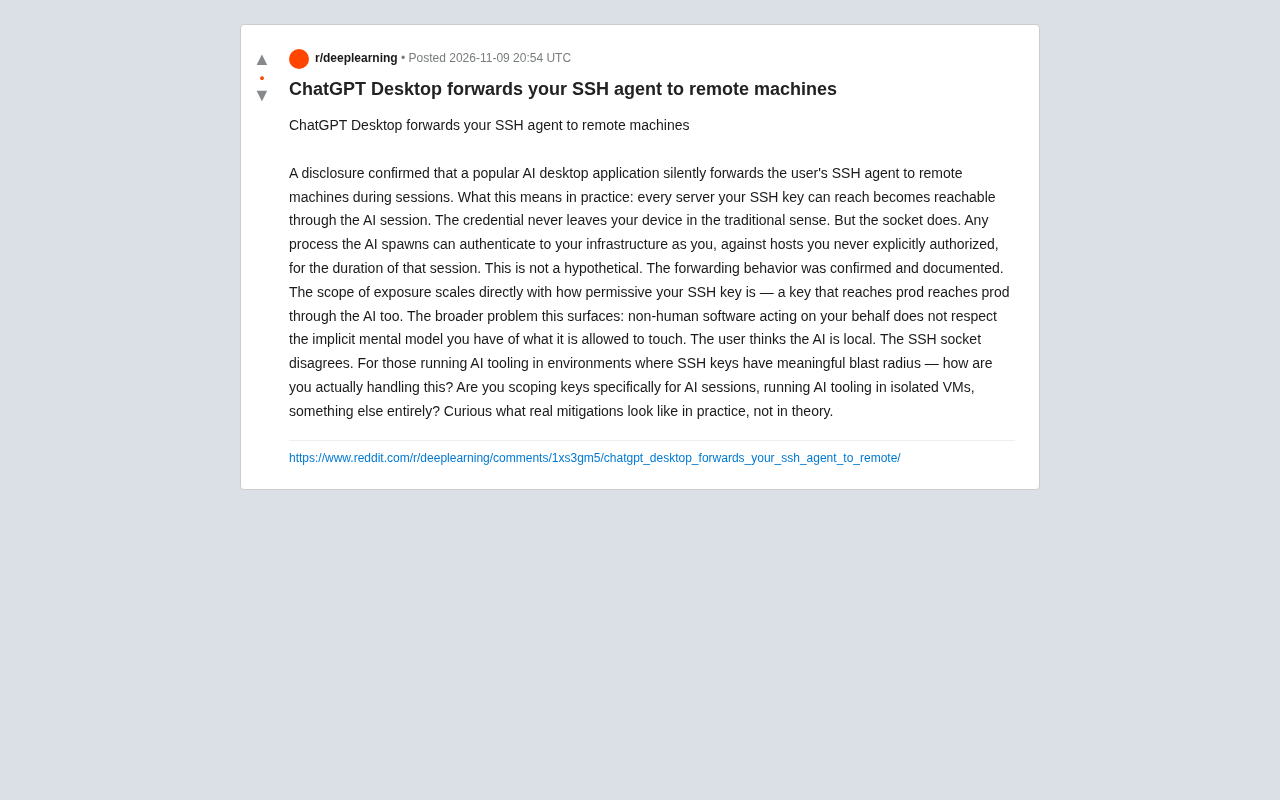
ChatGPT Desktop reportedly silently forwards SSH agents, letting AI sessions reach any reachable host as the user.
The Reddit community disclosed and confirmed that ChatGPT Desktop silently forwards the user's SSH agent to remote machines. The private key never leaves the device, but a forwarded agent socket means any AI-derived process can authenticate as the user and reach hosts never explicitly authorized—for as long as the session lasts. Risk scales with key scope: a key with production access gives AI production access. Community practices include restricted dedicated keys, isolated VMs, and signature confirmation. The article argues this exposes a systemic mismatch between "local AI" expectations and system-level access, and that organizations should treat AI sessions as high-privilege principals.
Event Core: A Confirmed Case of SSH Agent Forwarding
According to disclosures from the Reddit community, ChatGPT Desktop silently forwards the user's SSH agent to remote machines during a session. This behavior has been confirmed and documented. Put simply, every server your SSH keys can reach may be reachable through the AI process while the AI session is active.
The key point: in the traditional sense, credentials never leave your device—but the SSH socket is forwarded. This means any process spawned by the AI can authenticate to your infrastructure as you, accessing hosts you never explicitly authorized—for as long as the session persists.
SSH agent is a key management service provided by OpenSSH. It holds decrypted private keys in memory and provides signing capabilities to clients like ssh and git via a Unix socket (specified by the SSH_AUTH_SOCK environment variable), so that the private keys themselves need not leave disk or be exposed to every process. "Agent forwarding" refers to an SSH client using the -A option or configuring ForwardAgent yes to create a tunnel on the remote host pointing back to the local agent socket, enabling processes in the remote session to request authentication from the local agent. This was originally designed as a convenience feature for jump-host scenarios, at the cost that the remote host (and any process on it with access to that socket) can borrow your keys to authenticate. The key risk, therefore, is not that private keys are copied, but that signing capability is borrowed—as long as the socket is reachable, it is equivalent to holding your identity.
Why This Is Not a Theoretical Risk
The severity of this issue depends directly on the scope of your SSH keys. A key that can access production environments can equally access production environments through AI. This is not hypothetical—the forwarding behavior has been confirmed and documented.
More alarming is that it exposes a deeper problem: when non-human software acts on your behalf, it does not respect your implicit mental model of "what it can touch." Users assume the AI runs locally, but the reality of the SSH socket is otherwise. There is an overlooked gap between credential locality and access remoteness.
Practical Protection: What the Community Is Doing
The original poster's question was direct: how are people running AI tools in environments where SSH keys have a substantial blast radius actually handling this?
Several real practices emerged in the discussion:
- Scoping keys specifically for AI sessions: using dedicated keys with restricted permissions rather than everyday high-privilege keys.
- Running AI tools in isolated VMs: isolating the AI session from the host's SSH agent to cut the forwarding chain.
- Other unstated measures: the original post did not elaborate, but implied more practices exist.
These are not theoretical exercises but mitigation measures adopted by community members in real environments.
Isolated VMs work because they cut off two links at once: the AI process runs inside the guest, its SSH_AUTH_SOCK points to an agent inside the guest (or does not exist at all), and the host agent's socket is not automatically exposed across the virtualization boundary; even if the AI tool attempts to initiate forwarding, it can only forward the guest's agent. In contrast, application-layer permission settings alone are difficult to make effective, because forwarding behavior is typically initiated by the underlying ssh client. Another lower-cost alternative is to use ssh-add -c to enable confirmation mode, or to switch to hardware keys (such as YubiKey resident keys) so that every signature requires physical confirmation, turning silent borrowing into explicit authorization.
Deeper Implication: The Trust Boundary of AI Tools Needs Redefinition
The value of this incident lies not in a flaw in a single application, but in the fact that it reveals a widespread ambiguity in the trust boundaries of AI desktop apps. There is a systematic mismatch between users' mental expectation of "local AI" and the system-level access capabilities the software actually possesses.
When an AI tool can silently forward an SSH agent, it effectively gains an invisible channel into your entire infrastructure. Any AI-derived process during the session can become an attack surface. For organizations using AI tools in sensitive environments, this means treating AI sessions as potential high-privilege principals rather than ordinary local applications.
The original post's question is still awaiting more responses from practitioners, but the question itself is clear enough: is your AI tool reaching machines you never authorized—as you?
One-line Summary
ChatGPT Desktop is reported to silently forward the SSH agent, allowing AI sessions to reach any reachable host under the user's identity.
Paragraph Summary
The Reddit community disclosed and confirmed that ChatGPT Desktop silently forwards the user's SSH agent to remote machines during a session. The private keys themselves do not leave the device, but the forwarded agent socket means any AI-derived process can authenticate as the user and access hosts the user never explicitly authorized—and this channel persists as long as the session continues. The risk scales with the key's permission scope: a key that can access production environments can equally access production through AI. Community responses include using restricted dedicated keys for AI sessions, running AI tools in isolated VMs to cut the forwarding chain, and enabling signature confirmation. The article argues that this incident exposes a systematic mismatch between the "local AI" mental expectation and system-level access capabilities, and that organizations should treat AI sessions as high-privilege principals.
Related articles

Gemini 4 Neon Review: Benchmark Scores Rival Carbon, API Pricing and Quota Breakdown
Google Gemini 4 Neon is now live, benchmark scores closely tracking Carbon, API pricing 3/15 at twice Hydrogen's rate. This article compiles Bilibili creator testing: Neon can replace 90% of Carbon scenarios, AntiGravity quota consumption is only one-third of Carbon, plus subscription channel restrictions and 2API ban risks.

Gemini 4 Helium Coming Soon? Signals of Google Loosening Subscription Restrictions
Google team member hints releases will continue; community speculates Gemini 4 Helium (Flash Lite) may be next. Subscription ban controversy gets a response as product lead says "Soon," suggesting restrictions may be lifted. This article covers Gemini developments, OpenAI Coding Agent and risk management, Doubao real-time audio-video API, and compute business dynamics.

AI-Assisted React Development in Practice: Optimizing a Video App and Handling Errors
A 14-year veteran developer demonstrates AI-assisted React video app optimization: compressing video from 80MB to 5MB (~94%) via ImageKit, plus reliable error handling and retry mechanisms. Includes planning, code understanding, and verification methods for working with AI.