ChatGPT Helps a Paralyzed Brother Regain the Ability to Express Himself: A Real-World Case of AI-Assisted Communication

A brother uses ChatGPT to build a custom AAC system giving his paralyzed sibling independent expression.
A Reddit user shared how he used ChatGPT to build a custom assistive communication system for his brother Ben, who is quadriplegic and nonspeaking due to the rare disease H-ABC. With no existing AAC software fitting Ben's unique needs, AI-assisted programming enabled a non-developer to create a tailored solution that transformed Ben's communication from simple yes/no head movements to true independent expression. The project has been open-sourced to help other overlooked families.
A Corner Overlooked by Mainstream Technology
In an era where AI technology is advancing at breakneck speed and large model capabilities improve daily, we're accustomed to discussing mainstream applications like productivity enhancement, code generation, and content creation. Yet a true story from Reddit reminds us that AI's most moving value often manifests in the marginal corners overlooked by the mainstream market.
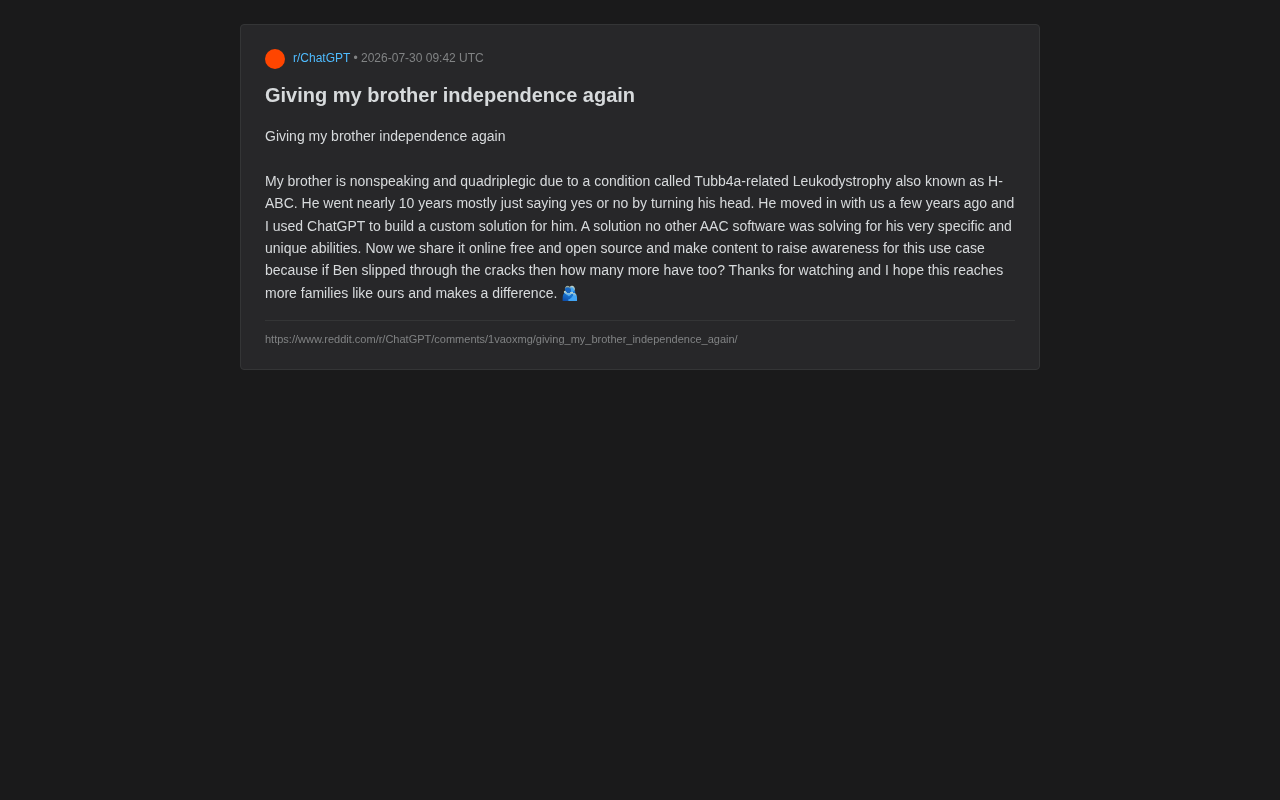
The protagonist of this story is a young man named Ben, who suffers from a rare disease called Tubb4a-related hypomyelination with atrophy of the basal ganglia and cerebellum (H-ABC). This condition has left him nonspeaking and quadriplegic for years. For nearly a decade, his only way to communicate with the outside world was turning his head to indicate "yes" or "no."
H-ABC is an extremely rare hereditary neurodegenerative disease caused by mutations in the TUBB4A gene. This gene encodes β-tubulin 4A, a critical component of the microtubule cytoskeleton in nerve cells. Mutations lead to insufficient myelination of the brain's white matter, along with progressive atrophy of the basal ganglia and cerebellum. Myelin is the lipid layer wrapping nerve fibers, responsible for accelerating nerve signal conduction—when it develops poorly or degenerates, the brain's ability to send commands to various parts of the body becomes severely impaired. Only a few hundred cases are known worldwide, and there is currently no cure. Patients typically develop symptoms in childhood and progressively lose motor and language abilities. The very rarity of this disease ensures that patients can hardly access targeted technical support.
For most people, language and physical movement are the basic channels connecting them to the world. For Ben, both channels were almost entirely sealed off. This means not only extreme dependence in daily life, but also that a living individual's thoughts, emotions, and desires have been trapped for years in a body that cannot express them.
The Limitations of Traditional AAC Software and the Personalization Dilemma
In the field of assistive communication, the industry has long had AAC (Augmentative and Alternative Communication) software. These tools help people with speech disabilities express themselves through icons, word boards, eye-tracking, and other methods.
The history of AAC technology dates back to the 1950s, starting with simple picture exchange systems and letter boards. As computer technology developed, AAC gradually evolved into electronic devices, with representative products including Tobii Dynavox's eye-tracking devices and PRC-Saltillo's LAMP system. Modern AAC systems typically use layered menu structures, where users combine words and sentences through sequential selection. The Core Vocabulary strategy is the current mainstream approach—linguistic research has found that approximately 200-400 high-frequency words cover over 80% of daily conversation content, so systems prioritize these words to improve expression efficiency.
However, Ben's brother (who is also the narrator of this story) discovered a cruel reality: not a single existing AAC software could truly accommodate Ben's unique and specific capabilities. Commercial assistive communication products are typically designed for "typical" disability populations, assuming users have some relatively stable form of input ability—whether finger tapping, eye movement, or voice recognition.
But the physical conditions of rare disease patients vary enormously. Ben's situation was so unique that he fell precisely into the "gap" that no standardized product could cover. This is the typical dilemma of long-tail needs: the market is too small, commercial companies lack the incentive to invest, and individuals are systematically overlooked. The development cost of a single AAC device can reach millions of dollars, while the potential user base might be only a few dozen people—this business equation simply doesn't work under traditional market logic.
How ChatGPT Became an Accelerator for Custom Development
The turning point came after Ben moved in with his brother. This ordinary family member—without a large development team or sufficient R&D budget—made a bold decision: to use ChatGPT to build a customized assistive communication solution for his brother from scratch.
This embodies one of the most disruptive aspects of generative AI: it dramatically lowers the barrier to software development. In the past, building a bespoke software system for a single user required a professional engineering team, lengthy development cycles, and high costs. Now, with AI-assisted programming, an ordinary person with ideas and motivation can transform concepts into functional products.
The fundamental reason ChatGPT and other large language models can serve as "programming accelerators" is that their training data includes massive amounts of open-source code, technical documentation, and programming tutorials. When users describe requirements in natural language, the model can translate them into executable code snippets while providing debugging suggestions and architectural design proposals. This capability essentially transforms "programming" from a professional skill requiring years of systematic study into a creative activity of "requirement expression and iterative verification." For Ben's brother, the greatest advantage wasn't programming ability, but his deep understanding of his brother's needs—and AI precisely eliminated the technical barrier needed to transform that understanding into a product.
From "Yes/No" to True Independent Expression
Although the original post doesn't detail the technical specifics, we can infer that this system was designed with a highly adaptive interaction logic tailored to Ben's limited ability to input through head movements. It transforms extremely limited physical input signals into much richer expressive output through intelligent software-level processing.
This is the core value of AI-assisted communication—using algorithms to compensate for physical limitations. When a person can only express "yes" and "no," how do you enable them to truly "speak"? The answer lies in building efficient selection trees, predictive input, and contextual understanding through software, making every tiny movement carry the maximum amount of information.
From an information theory perspective, a Decision Tree is a layered binary structure where each "yes/no" choice halves the options. Theoretically, N choices can pinpoint a target from 2^N options—meaning just 10 head movements can select from 1,024 options. Predictive input further exploits the high redundancy of natural language: when the first few characters or conversation context are known, the probability distribution of the next word becomes highly uneven, allowing the system to prioritize the most likely expression options and dramatically reduce the actual number of selections needed. Combined with contextual information like time, setting, and conversation history, a well-designed system might need only 5-10 simple head movements to complete a full expression.
For Ben, this means he has finally regained "independence"—no longer passively being asked questions, but able to actively express himself.
Open Source Sharing: Turning One Person's Solution into Help for More Families
The most admirable part of this story is that it didn't stop at "solving our own problem." Ben's brother chose to open-source the solution for free and continues to create content to raise awareness about this use case.
His reasoning is simple yet profound: "If Ben slipped through the cracks, then how many more have too?"
This sentence highlights the universal problem facing rare disease communities and people with severe disabilities. Behind every "special case," there may be a group of people equally overlooked by mainstream products. Through open source, one person's custom solution can potentially evolve into a reusable, improvable community asset, so other families with similar needs don't have to start from zero.
The open-source movement in assistive technology has unique significance. Unlike general-purpose software, the core contradiction in assistive technology is the conflict between "highly personalized needs" and "extremely small market scale." The open-source model, by making source code publicly available, enables any family member, therapist, or volunteer with programming ability to further customize existing solutions. Previous success stories like OpenBCI (open-source brain-computer interface), ARASAAC (open-source graphic symbol system), and Optikey (open-source eye-tracking keyboard) have proven that community-driven accessibility innovation ecosystems can continuously iterate and improve. Ben's brother's project is the latest addition to this ecosystem, representing not just a specific solution but a new paradigm of "everyone can become an assistive technology developer."
The Inclusive Significance of Assistive Technology in the AI Era
From a broader perspective, this case demonstrates the true meaning of AI democratization. We often talk about the "democratization" of AI, but its value shouldn't merely be reflected in helping more people write code or make presentations faster. It should be reflected in allowing technological capabilities to truly reach those corners most in need yet hardest to cover by commercial logic.
When a non-technical family member can use AI tools to build a solution for their loved one that even professional AAC manufacturers failed to provide, what we're witnessing is the enormous humanitarian potential released by the collapse of technical barriers. This model of "the person who best understands the need becomes the developer" may be the most effective path to solving long-tail assistive technology needs—it doesn't depend on commercial profit incentives, but is driven by love, responsibility, and community collaboration.
Conclusion: Technology's Warmth Lies in Who It Serves
Ben's story is moving not because the technology is particularly advanced, but because it clearly answers a fundamental question: Who does technology serve?
At a time when AI capabilities continue to break new ground, we need more reminders like this—the most cutting-edge tools can be used for the most tender purposes. A brother used ChatGPT to restore his sibling's ability to express himself, and through the spirit of open source, passed on the possibility of this rebirth to more families he'll never meet.
This is perhaps what AI should truly look like: not a cold efficiency machine, but a warm force capable of transcending physical barriers and rebuilding the bridges of communication between people. 🫂
Related articles

EmbeddedSass for .NET: A Sass Compilation Solution Without Node.js Dependencies
EmbeddedSass for .NET uses the official Embedded Sass Protocol, enabling .NET developers to compile Sass/SCSS natively without Node.js. Learn how it works and integrates with ASP.NET.

San Francisco to Singapore Time Difference: The Trans-Pacific Routine of Silicon Valley Tech Workers
SF and Singapore are 15-16 hours apart, and frequent travel between them is now routine for tech workers. Explore the time difference challenges, AI industry globalization, and talent flows.

Anthropic Launches Official Claude Code Plugin Directory: A Curated High-Quality Extension Ecosystem
Anthropic launches claude-plugins-official, a curated directory of high-quality Claude Code plugins. Learn about its positioning, core value, and impact on the AI coding ecosystem.