ChatGPT Plus Payment Methods Compared: A Security Guide to Avoiding Pitfalls

A security-focused comparison of three ChatGPT Plus subscription methods for users without supported payment options.
This guide compares three mainstream ways to subscribe to ChatGPT Plus: third-party proxy payment platforms, international credit cards, and mobile in-app purchases. It provides in-depth risk analysis covering account security (Session Token exposure), financial risks (prepaid codes, platform disappearance), and stability concerns, helping users make informed decisions based on their usage patterns and security needs.
Introduction: Why Payment Has Become a Barrier
For users in China, subscribing to ChatGPT Plus/Pro has always been a frustrating process. The core difficulty isn't the monthly subscription fee itself, but rather that OpenAI's payment system doesn't support Chinese domestic payment channels.
OpenAI currently only accepts international credit cards such as Visa and Mastercard issued in the US, Europe, and other regions, along with debit cards from select areas. Their payment processor Stripe performs risk control checks on the consistency between IP addresses, billing addresses, and card-issuing countries. UnionPay cards issued in mainland China, Alipay, and WeChat Pay are all unsupported. This limitation isn't a technical impossibility—it's directly related to OpenAI's regional service policies, compliance requirements, and Stripe's anti-fraud mechanisms.
This leaves many users who want to upgrade to GPT-4 series advanced models stuck at the "last mile."
Recently, numerous tutorial videos have appeared on Bilibili claiming that third-party platforms offer the "simplest, most convenient, and most stable" way to subscribe. This article objectively reviews the current mainstream payment methods, analyzes their pros and cons, and highlights security risks to help readers make informed decisions.
Important Notice: The third-party payment platforms mentioned in this article involve account security and financial risks. This content is purely for informational and risk analysis purposes and does not constitute a recommendation. Readers should exercise caution.
Comparing Three Mainstream ChatGPT Plus Payment Methods
Based on video content, there are currently three main paths to subscribing to ChatGPT Plus, each with distinct cost and experience differences.
Method 1: Third-Party Proxy Payment Platforms
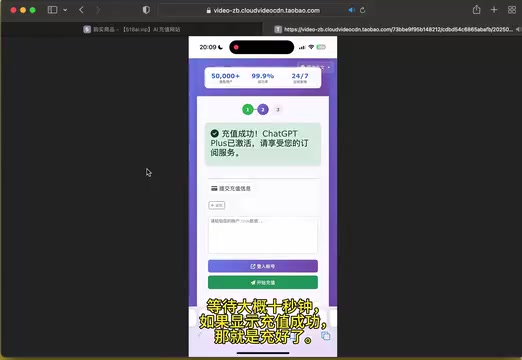
The videos primarily feature third-party proxy payment platforms. Their advertised workflow goes roughly like this:
- Log into your ChatGPT account via browser
- Enter a purchased activation code on the proxy payment website and verify
- Copy account-related data and paste it into the proxy payment website
- Click to start the payment process and wait about 10 seconds
- Return to ChatGPT, refresh the page, and confirm the subscription is active

This method claims to require "no password, only account ID-related information" and promotes "fully automated payment for iOS systems." From an accessibility standpoint, the barrier is indeed low, marketed as beginner-friendly. However, you should be especially wary: the step involving "copying account data and pasting it into a third-party website" very likely involves handing over your account's Session Token or Cookie, which essentially exposes your account's access permissions to an unknown third party.
Session Token is an encrypted credential generated by a web application after user login, stored in browser cookies, used to prove user identity in subsequent requests without repeatedly entering passwords. Once a third party obtains this Token, they effectively gain complete access to the account for its validity period, able to perform almost any user action—including viewing chat history, modifying settings, or even initiating new API calls. Tokens typically have expiration limits (ranging from hours to weeks), but before expiration, the holder has exactly the same permissions as the account's actual owner. This is why security experts repeatedly warn against sharing Tokens or Cookies with any third party.
Method 2: Direct Subscription via International Credit Card
The second method is subscribing directly on OpenAI's official website using an international credit card. The videos acknowledge this approach is "more troublesome" because it involves card application, identity verification, billing address matching, and other steps. Virtual credit cards often come with issuance fees, top-up service charges, and other additional costs.
Virtual Credit Cards are digital payment tools issued by fintech companies that don't require physical cards. Common providers include Depay, Nobepay, Dupay, and the US-based Privacy.com. Users top up via cryptocurrency (such as USDT) or bank transfer, then receive a virtual card with a 16-digit card number, expiration date, and CVV. These cards typically operate on Visa or Mastercard networks and can be used for international online payments. Their advantage is a lower issuance threshold compared to traditional banks, but disadvantages include higher fees (typically 2%-5% top-up fees plus issuance fees), and some virtual cards are prone to triggering risk controls because they're heavily used at the same merchant.
However, from a security perspective, this is the officially recognized legitimate path. Although initial setup is cumbersome, once binding is successful, subsequent renewals are highly automated, and there's no risk of account takeover by third parties. For heavy users with long-term needs, this remains the most worthwhile solution to invest time in.
Method 3: In-App Purchase via Mobile
The third method is through in-app purchases: iOS users top up with App Store gift cards, while Android users use Google Play in-app purchases.
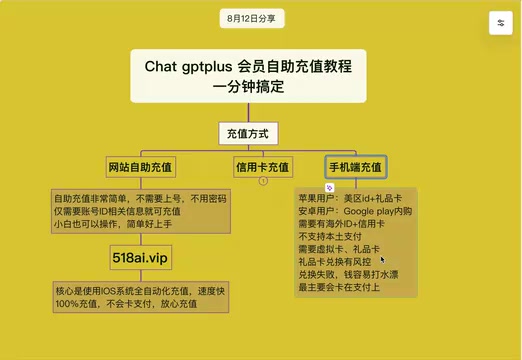
The pain point with this method is the payment step. Since domestic payments are also unsupported, users need to rely on virtual cards or gift cards. The videos mention that gift card redemption carries "blocking" risks—if redemption fails, the money spent may be lost.
Additionally, App Store in-app subscription prices are typically higher than subscribing directly on the official website. Apple charges a 15%-30% commission on in-app purchases (IAP) made through the App Store, commonly known as the "Apple Tax." For subscription services, Apple takes 30% in the first year, dropping to 15% from the second year onward. This means if ChatGPT Plus costs $20/month on the official website, iOS in-app purchase might require approximately $26/month (developers pass the Apple Tax on to consumers). Google Play has a similar commission structure. This is why many subscription services encourage users to subscribe directly on their website rather than through app stores.
Risk Analysis of ChatGPT Proxy Payments: Hidden Concerns Behind Convenience
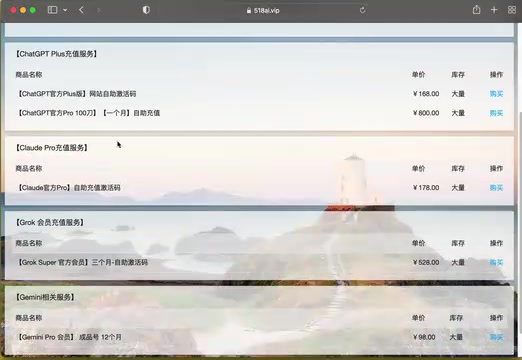
The reason third-party proxy payment platforms can achieve "10-second delivery, 100% success rate" is that they operate large numbers of overseas payment channels and automation scripts at scale. However, these services carry several risks that cannot be ignored:
Account Security Risk
Handing over your account's login credentials (even just a Token) to a third party means they can theoretically access your account at any time, read your conversation history, account information, or even perform other operations. For accounts linked to sensitive data or used for work, this risk requires particular vigilance.
Financial and Compliance Risk
Third-party proxy payments generally use a "prepaid activation code" model—pay first, use later. If the platform disappears or service is interrupted, paid fees are difficult to recover. Furthermore, memberships bulk-activated through unofficial channels may be flagged as abnormal by OpenAI and banned, in which case the payment is equally unprotected.
OpenAI has a multi-dimensional risk control system for abnormal account behavior, including but not limited to: a single payment method linked to numerous accounts, logins from different geographic locations within short timeframes, use of flagged proxy IP ranges, and severe mismatches between payment information and registration information. Once risk control rules are triggered, accounts may face usage restrictions or permanent bans, and paid subscription fees are typically non-refundable. Since 2024, OpenAI has noticeably intensified monitoring of bulk registrations and irregular payment channels, with users of multiple proxy payment services reporting account bans.
Stability Risk
The videos repeatedly emphasize being "the most stable," but proxy payment services are highly dependent on the availability of overseas payment channels. Once OpenAI tightens risk controls or payment channels are blocked, the "stability" of these services collapses instantly—which is why such tutorials need frequent updates with "latest versions."
Practical Recommendations: How to Choose the Right Payment Method
Looking at the big picture, each method has its trade-offs:
- Casual users prioritizing convenience: Third-party proxy payments do have the lowest barrier to entry, but make sure you understand the account and financial risks involved. It's recommended to use an independent account containing no sensitive information, and start with small amounts.
- Long-term heavy users: It's still advisable to invest time in setting up an international credit card or a mature virtual card solution, going through the official subscription route for maximum security and sustainability.
- Occasional users: Consider pay-as-you-go API billing, or choose compliant domestic alternative LLM services. OpenAI's API service uses a per-token billing model where users only pay for actual computational usage. GPT-4o API pricing is approximately $2.5 per million input tokens and $10 per million output tokens. For occasional users, on-demand API calls may be more economical than the fixed $20/month subscription. API payments also require international payment methods, but compared to subscription models, single top-up amounts are flexible (minimum $5), and there are no security concerns like sharing account tokens. There are also compliant domestic API relay service providers offering similar access.
Technical barriers give rise to gray markets, but "the simplest" often also means "the least transparent." Between convenience and security, every user should weigh their options based on how important their account is. There's no free lunch, and there are no shortcuts without risk.
Reminder: Before using any third-party proxy payment service, please fully assess account security and financial risks. Never enter sensitive account information on unknown websites.
Key Takeaways
Related articles

Apple HomeView Hands-On Review: Is the $300 Smart Home Hub Worth It?
Apple HomeView hands-on: a $300 smart home hub with facial recognition for quick account switching, but no App Store or voice recognition. Is the wall-mounted version worth it? Should you buy the first generation?

Meta Muse Wonder Launch: What It Means for Meta's Return to the Frontier AI Race
Meta releases Muse Wonder and WonderFull, benchmarks reach the frontier, community feedback is polarized. An in-depth look at Meta's return to the frontier AI race, its personal agent strategy, and Zuckerberg's different path.

Apple Home Smart Home Lineup Leaked: LG and Schneider Team Up, UWB Door Lock on Board
Apple Home ecosystem gains new LG and Schneider devices: UWB smart lock with proximity unlock, 2.5K dual-camera doorbell, privacy indoor camera, and AirPods-like seamless pairing.