ChatGPT Wallet Feature Launches: AI Shops and Checks Out for You
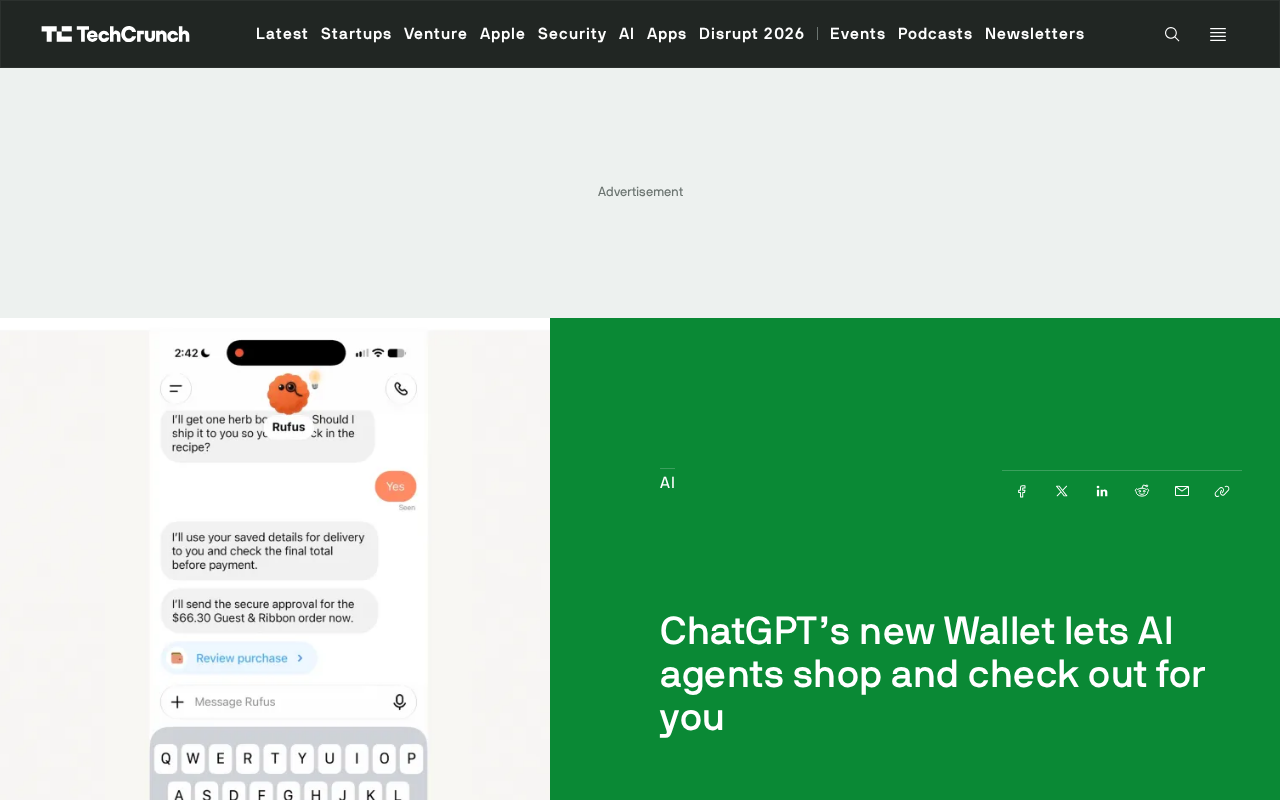
ChatGPT launches Wallet, letting AI agents browse products and check out for U.S. Pro users, opening a new stage of AI-executed transactions.
OpenAI has launched the Wallet feature for ChatGPT, initially rolled out to U.S. Pro subscribers, allowing AI agents to browse products and complete checkout on behalf of users. The article notes that the core challenge is not product retrieval but payment authorization, fault tolerance, and security auditing: agents must act within preset budget and preference boundaries and fall back for confirmation when prices or inventory change. If agent shopping becomes the norm, e-commerce traffic distribution may shift, with SEO and advertising targets partially moving from people to agents and structured data and inventory interfaces becoming more important. Merchant scope, payment linking, and confirmation mechanisms remain undisclosed, so failure cases in the gray-release phase should be viewed with caution.
From Conversation to Transaction: ChatGPT Starts "Spending Money" for Users
OpenAI is pushing ChatGPT from an information assistant toward the transaction execution layer. According to the latest news, ChatGPT has launched a new feature called Wallet, which allows AI agents to browse products and complete checkout on behalf of users. The first group of testers are Pro subscribers in the United States, and it is a limited-scope gray release.
The core of this news is not that "AI can search for products"—that has long been possible—but rather the boundaries of authorization: when the model moves from giving advice to pressing the payment button, issues of trust, risk control, and attribution of responsibility are all pushed to the forefront at once.
Feature Positioning: Limited Gray Release, Clear Signal
According to the original information, ChatGPT Wallet is currently only open to U.S. Pro subscribers and is a small-scale test. This restrained release approach is consistent with OpenAI's long-standing gray-release strategy: first validate the reliability of the payment pipeline and agent decision-making among a small group of real users, then consider expanding the scope.
The precondition of "Pro subscription" is worth noting. It suggests that in the short term this feature is more like a value-added experience for paying users rather than a default capability available to all users. For the e-commerce ecosystem, this is a signal—the AI entry point is becoming a new transaction entry point.
Key Differences in Agent Shopping
Traditional price-comparison plugins or shopping assistants only provide information, and the final payment action is still completed by a human. What makes ChatGPT Wallet different is that it also incorporates the action of "checkout" into the agent workflow, which means the product needs to handle a series of engineering and compliance issues such as payment credential management, order confirmation, and exception rollback.
Payment credential management usually refers to how the agent system securely stores, invokes, and revokes users' payment information. A common approach is to use tokenization technology to replace sensitive data such as bank card numbers with one-time or purpose-limited tokens. When the agent performs checkout, it only passes the token rather than the original card number, thereby reducing the risk of leakage. Authorization scope also needs to be designed, such as per-transaction limits, validity periods, and merchant whitelists, to ensure that the agent can only use funds within the boundaries preset by the user.
Order confirmation and exception rollback involve the agent's state machine management across each stage of the transaction: before placing an order, it needs to confirm the price, quantity, and shipping address with the user or rules engine; after successful payment, if there is insufficient inventory, a price change, or duplicate charge, the system should be able to automatically trigger order cancellation, initiate a refund, or hand the matter over to a human. Such mechanisms require the agent to have auditable operation logs and idempotent transaction interfaces so that it can safely retry or roll back on failure and avoid financial loss.
Why This Step Is Not Simple
Getting AI to complete checkout is not technically difficult because of product retrieval, but because of authorization and fault tolerance. The agent needs to clearly know the price range, shipping information, and return/exchange preferences acceptable to the user, and make judgments or fall back to user confirmation when there are price fluctuations or inventory changes.
Security is equally sensitive. Once automated agents are connected to the payment stage, fraud detection, quota limits, and operation auditing become essential components. The original information did not disclose these details, and this is precisely the part that needs to be validated during the gray-test phase.
Potential Impact on E-commerce and Advertising Models
If agent shopping becomes the norm, the way products are discovered will change: the target of SEO and ad placement may partially shift from "people" to "agents." The importance of structured data, inventory interfaces, and price transparency will further increase. For small and medium-sized merchants, this means they need to adapt to a new traffic distribution logic.
Payment authorization in agent scenarios needs to distinguish between two levels: "the user authorizes the agent to use a payment instrument" and "the agent makes a purchase decision on behalf of the user in a single transaction." The former is usually implemented through OAuth-style token authorization or virtual card numbers, while the latter relies on rules preset by the user (such as budget caps and product category restrictions) or real-time confirmation. If an agent completes a charge without explicit authorization, it may trigger chargebacks and compliance disputes, so the authorization chain must be traceable and revocable.
Fault tolerance emphasizes that the system can remain safe under unexpected conditions. For example, if the product price rises at the moment of checkout, inventory drops to zero, or the payment gateway times out, the agent should pause the transaction and request user confirmation rather than "guessing" the user's intent on its own. Fault-tolerant design also includes guardrails that validate agent outputs to prevent the model from generating erroneous orders due to hallucination.
Security auditing requires recording every browsing, price-comparison, add-to-cart, and payment action of the agent to form a tamper-proof log for later accountability and risk-control modeling. Audit data can also be used to detect anomalous patterns, such as high-frequency ordering within a short period or payments to unfamiliar merchants, thereby triggering manual review or temporary freezing.
Structured data refers to information that describes product attributes, prices, inventory, and reviews in a machine-readable format (such as Schema.org markup and JSON-LD). When shopping agents become traffic entry points, they rely more on structured fields to parse and compare products rather than parsing human-readable marketing copy. If merchants lack standardized structured data, they may be missing from the agent's candidate list or ranked lower.
Inventory interfaces and price transparency are equally critical. Agents need real-time access to inventory status and final tax-inclusive prices to make reliable decisions; if hidden fees or dynamic pricing are not exposed through interfaces, the agent may misjudge and abandon the transaction. Therefore, e-commerce optimization for agents (sometimes called Agentic Commerce Optimization) is gradually becoming a new topic after SEO, requiring merchants to open standardized product and fulfillment data.
Treat Early Signals with Caution
The amount of publicly available information is currently limited: it has not disclosed which merchants are supported, how payment methods are linked, or what the confirmation mechanism for agent decisions is. It is too early to treat these gaps as known conclusions. What is truly worth tracking are the failure cases exposed during the gray-release phase—erroneous orders placed by agents, misjudgments of price, and refund disputes—which will define the actual boundaries of such features.
From an industry perspective, ChatGPT Wallet marks the entry of AI assistant competition into the "execution rights" stage. Whoever can safely turn advice into action will occupy a more forward position in the transaction chain. Whether this step can be taken steadily depends on the balance the product finds between convenience and controllability.
One-line Summary
ChatGPT launches the Wallet feature, allowing AI agents to browse products and check out on behalf of U.S. Pro users, opening a new stage of AI-executed transactions.
Paragraph Summary
OpenAI has launched the Wallet feature for ChatGPT, initially rolled out in a gray release to U.S. Pro subscribers, allowing AI agents to browse products and complete checkout on behalf of users. The article points out that the core challenge of this feature lies not in product retrieval, but in payment authorization, fault tolerance, and security auditing: agents need to act within the budget and preference boundaries preset by users and fall back for confirmation when prices fluctuate or inventory changes. If agent shopping becomes the norm, e-commerce traffic distribution logic may change, with SEO and ad placement targets partially shifting from people to agents, and the importance of structured data and inventory interfaces rising. At present, the merchant scope, payment linking, and confirmation mechanisms have not been disclosed, and failure cases exposed during the gray-release phase should be viewed with caution.
Related articles

Gemini 4 Neon Review: Benchmark Scores Rival Carbon, API Pricing and Quota Breakdown
Google Gemini 4 Neon is now live, benchmark scores closely tracking Carbon, API pricing 3/15 at twice Hydrogen's rate. This article compiles Bilibili creator testing: Neon can replace 90% of Carbon scenarios, AntiGravity quota consumption is only one-third of Carbon, plus subscription channel restrictions and 2API ban risks.

Gemini 4 Helium Coming Soon? Signals of Google Loosening Subscription Restrictions
Google team member hints releases will continue; community speculates Gemini 4 Helium (Flash Lite) may be next. Subscription ban controversy gets a response as product lead says "Soon," suggesting restrictions may be lifted. This article covers Gemini developments, OpenAI Coding Agent and risk management, Doubao real-time audio-video API, and compute business dynamics.

AI-Assisted React Development in Practice: Optimizing a Video App and Handling Errors
A 14-year veteran developer demonstrates AI-assisted React video app optimization: compressing video from 80MB to 5MB (~94%) via ImageKit, plus reliable error handling and retry mechanisms. Includes planning, code understanding, and verification methods for working with AI.