Checkstyle User Guide: A Comprehensive Look at the Automated Java Code Style Checker

A comprehensive guide to using Checkstyle for automated Java code style enforcement.
This article provides an in-depth look at Checkstyle, a mature open-source tool for automating Java code style checks. It covers how Checkstyle uses AST-based analysis, supports Google and Sun coding standards out of the box, and offers highly configurable rules. The guide also explains integration with build tools and CI/CD pipelines, and offers practical advice for teams adopting Checkstyle to maintain consistent, high-quality codebases.
What Is Checkstyle
In an era where team collaboration has become the norm in software development, consistent code style directly impacts a project's maintainability and collaboration efficiency. Checkstyle was created to address this exact pain point — it's a development tool dedicated to helping Java programmers write code that conforms to specific coding standards.
As a mature open-source project, Checkstyle has accumulated over 9,000 stars on GitHub (Stars: 9094), with 4,190 forks and 78 new stars added in a single day. These numbers reflect the sustained demand for code standardization tools within the Java ecosystem.
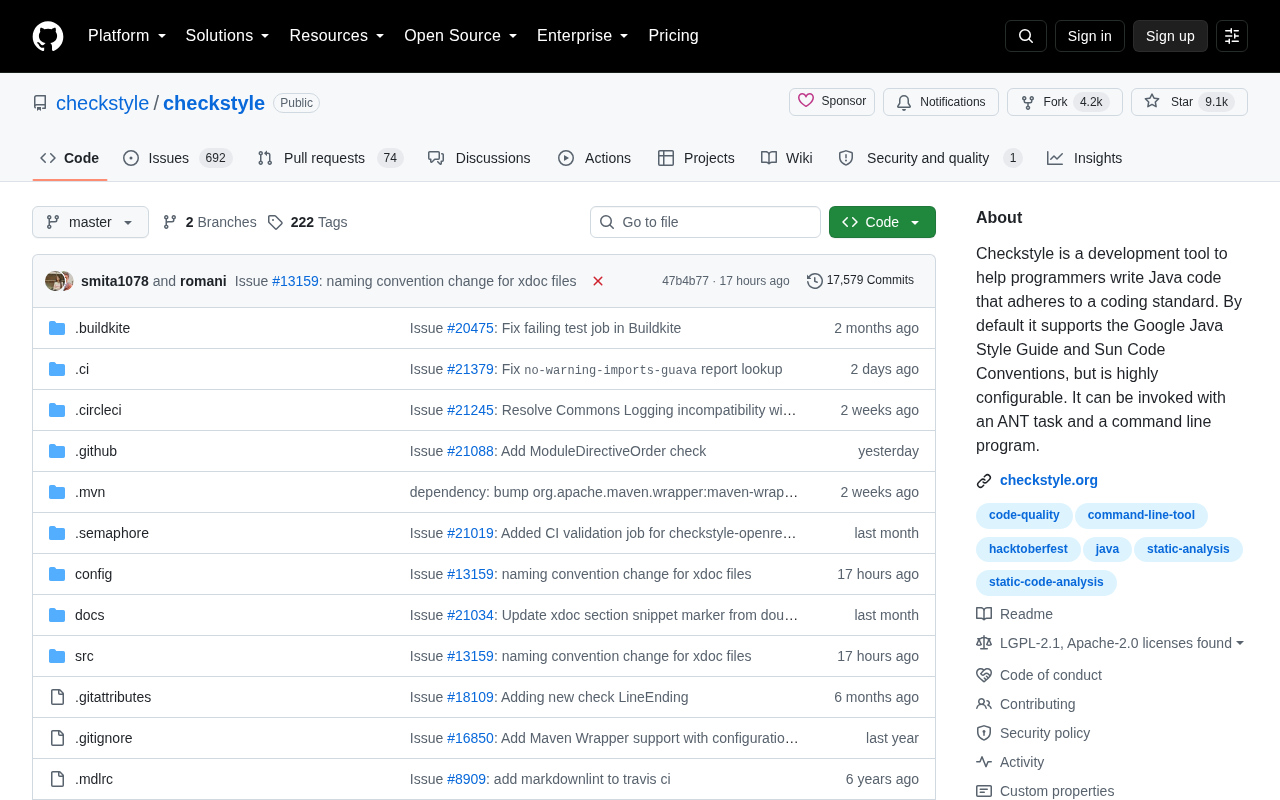
Checkstyle comes with built-in support for two widely recognized coding standards: the Google Java Style Guide and Sun Code Conventions. The Google Java Style Guide was developed internally at Google and made public in 2014. It's known for its strict formatting requirements and clear readability guidelines, such as requiring 2-space indentation and a 100-character column width limit. Sun Code Conventions, on the other hand, were published in 1997 by Sun Microsystems — the company that created Java — making them one of the earliest official coding standards for the Java community. Although Sun has since been acquired by Oracle, these conventions are still followed by many legacy Java projects. The two standards differ on specific details like indentation width and brace placement. Checkstyle can flexibly switch between them via different configuration files, providing out-of-the-box support regardless of which style your team prefers.
Core Features and How Checkstyle Works
AST-Based Code Analysis Engine
At its core, Checkstyle relies on Abstract Syntax Tree (AST) parsing. When analyzing a Java source file, Checkstyle first uses the ANTLR (Another Tool for Language Recognition) parser to convert the source code into an AST. An AST is a tree-structured representation of source code where each node represents a syntactic construct — such as a class declaration, method invocation, or variable assignment. Every check rule in Checkstyle is essentially an AST Visitor that traverses specific nodes of the syntax tree and determines whether they comply with the defined standards. This AST-based architecture enables Checkstyle to perform precise structural analysis rather than simple text pattern matching. Developers can even write custom Check classes using Checkstyle's API to implement team-specific inspection logic.
Checkstyle falls under the category of Static Code Analysis tools. Static analysis refers to the technique of parsing source code's syntactic structure to identify potential issues without executing the program. Unlike dynamic analysis (which requires running the program), static analysis can catch problems during the coding phase at minimal cost. In the Java ecosystem, static analysis tools form a comprehensive toolchain: Checkstyle focuses on coding style and formatting conventions, SpotBugs (formerly FindBugs) focuses on identifying potential program bugs, PMD targets bad practices and potential errors, and SonarQube provides a comprehensive code quality management platform that can integrate all of the above. Each tool has its own focus, and in practice they are typically used in combination to achieve well-rounded code quality assurance.
Highly Configurable Check Rules
Checkstyle's greatest strength lies in its high degree of configurability. While it ships with built-in Google and Sun standards, development teams can fully customize check rules based on their own coding habits and project requirements.
This flexibility spans multiple dimensions:
- Naming conventions: Style checks for class names, method names, and variable names
- Indentation and formatting: Indentation rules, whitespace usage, and line-break strategies
- Import statement management: Import ordering and detection of unused imports
- Javadoc comments: Comment completeness and format compliance
- Code complexity control: Method length limits and cyclomatic complexity thresholds
Cyclomatic Complexity is a metric worth understanding in depth. Proposed by Thomas J. McCabe in 1976, it measures the number of independent paths through a program. Simply put, every additional branching structure in a method — if, for, while, switch-case, etc. — increases the cyclomatic complexity by 1. A method with a cyclomatic complexity of 1–10 is generally considered well-structured; 10–20 warrants attention; and anything over 20 indicates overly complex code that should be refactored. Methods with high cyclomatic complexity are not only harder to understand and maintain but also significantly increase testing difficulty — achieving full path coverage requires at least as many test cases as the cyclomatic complexity value. Checkstyle monitors this metric through its CyclomaticComplexity check rule, helping developers control complexity growth early on.
Developers can write XML configuration files to precisely define which rules to enable or disable, as well as the severity level for violations (warning or error).
Multiple Integration and Invocation Methods
Checkstyle offers flexible integration options, primarily including:
- ANT task: Seamless integration into ANT-based build workflows, automatically running code checks during the compilation phase.
- Command line program: Direct invocation via the command line, convenient for scripting and automation.
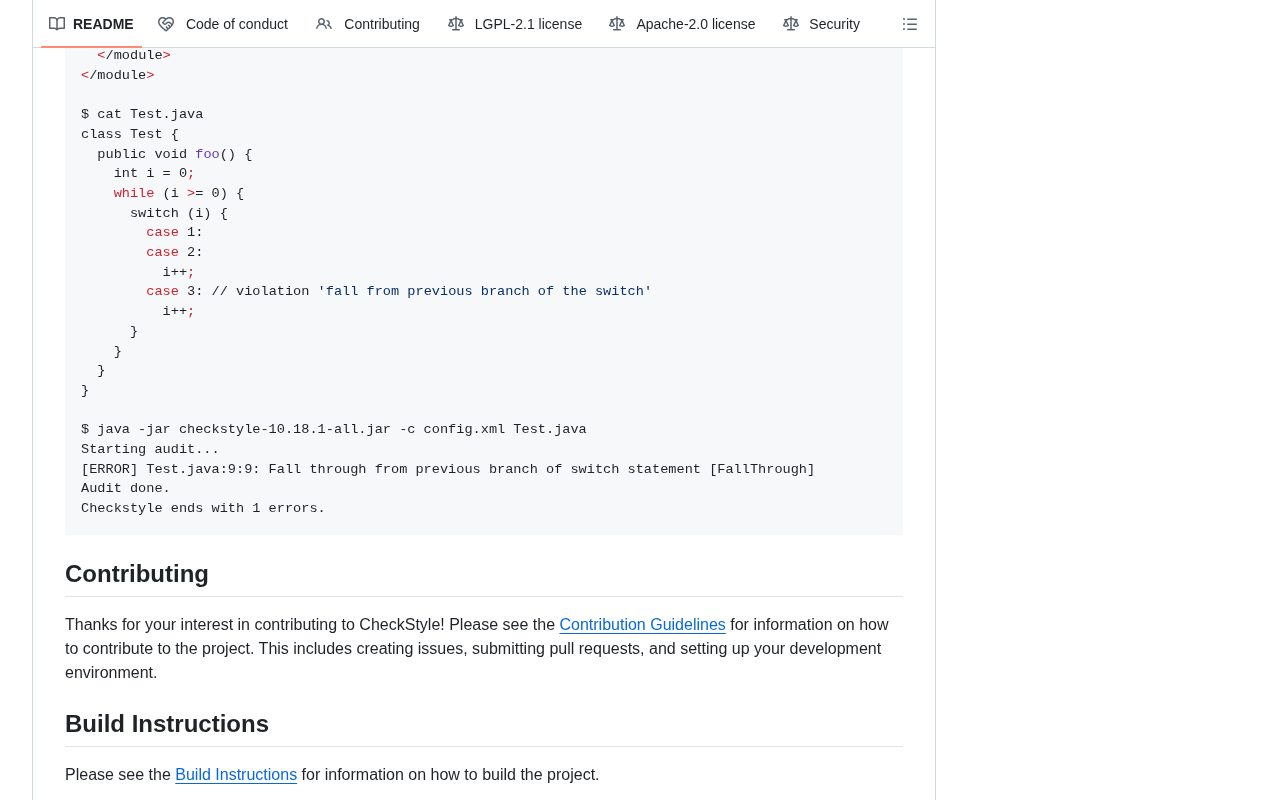
Beyond these two basic invocation methods provided officially, Checkstyle is widely integrated in practice with mainstream build tools like Maven and Gradle, as well as IDEs like IntelliJ IDEA and Eclipse, further lowering the barrier to adoption.
Why Java Projects Need Code Style Checking
Improving Readability and Team Collaboration Efficiency
A unified code style significantly reduces communication overhead among team members. When everyone follows the same indentation, naming, and structural conventions, reading someone else's code becomes as natural as reading your own. This is especially critical in large-scale projects or teams with frequent personnel turnover.
Automatically Catching Low-Level Errors and Code Smells
Checkstyle doesn't just check stylistic issues — it can also identify potential code hazards. For example, unused imports, empty catch blocks, and overly long methods are often breeding grounds for bugs. Automatically intercepting these issues early in development effectively improves code quality.
Reinforcing an Engineering Standards Culture
Integrating Checkstyle into CI/CD pipelines creates an automated quality gate. Any commit that violates the standards gets blocked, ensuring code repository cleanliness at an institutional level and preventing the spread of the "broken window effect."
The "Broken Window Theory" originally comes from criminology, proposed by James Q. Wilson and George L. Kelling in 1982: if a broken window in a building goes unrepaired, soon all the other windows will be broken too. Software engineering masters Andrew Hunt and David Thomas introduced this theory to software development in their classic book The Pragmatic Programmer: when the first piece of non-conforming code appears in a codebase and no one corrects it, other developers will think, "Since there's already non-conforming code, one more instance won't matter," ultimately causing code quality to deteriorate rapidly. By setting up quality gates in CI/CD pipelines, Checkstyle essentially repairs the problem "before the first window is broken," fundamentally curbing the spread of code rot.
CI/CD (Continuous Integration/Continuous Delivery) is a core practice in modern software engineering. Continuous integration requires developers to frequently merge code into the main branch, with each merge triggering automated builds and tests. Integrating Checkstyle into this workflow means every code commit automatically undergoes standards checking. A common practice is to add a Checkstyle check step in the pipelines of platforms like Jenkins, GitHub Actions, or GitLab CI, with defined thresholds: when violations exceed the threshold, the build fails and the Pull Request cannot be merged. Some teams also leverage SonarQube's Quality Gate feature to evaluate Checkstyle results alongside other quality metrics (such as code coverage and security vulnerability counts), forming a multi-dimensional quality management system.
Checkstyle Implementation Practices and Configuration Recommendations
For Java teams, adopting Checkstyle is an engineering practice with an excellent cost-to-benefit ratio. Here are some practical recommendations:
- Start with lenient rules: When introducing Checkstyle to an existing project, begin by enabling a small set of core rules and gradually tighten them. Avoid generating a massive wave of warnings all at once, which can create team resistance.
- Unify the configuration file and put it under version control: Commit the Checkstyle configuration file to the code repository to ensure all developers and CI environments use exactly the same rules.
- Use IDE plugins for real-time feedback: Let developers see style hints while coding rather than waiting until the build phase to discover issues, drastically shortening the feedback loop.
- Bind it to the build process for enforcement: Make the Checkstyle check a mandatory step in Maven or Gradle builds, giving code standards real enforcement power.
Conclusion
As a long-standing and mature code style checking tool in the Java ecosystem, Checkstyle has become the go-to solution for many teams seeking to safeguard code quality — thanks to its built-in support for the Google Java Style Guide and Sun Code Conventions, high configurability, precise AST-based analysis capabilities, and flexible integration options. Its nearly 10,000 stars and continuously growing attention validate its value in the field of automated code review.
As software engineering increasingly emphasizes disciplined processes and standardization, static code analysis tools like Checkstyle are no longer optional — they are foundational infrastructure for building high-quality, sustainably maintainable codebases. Working in concert with tools like SpotBugs, PMD, and SonarQube, Checkstyle plays an irreplaceable role in the quality assurance framework of Java projects.
Key Takeaways
Related articles

Uber Deploys ChatGPT Work Company-Wide: AI in the Workplace Enters the Scaled Implementation Phase
Uber deploys ChatGPT Work to 30,000+ employees, extending it from engineering to all roles. We analyze its expert-engineer pairing, end-to-end automation, and questions of AI control and power concentration—insights for scaling AI in the workplace.

Shift at Midnight Hands-On: When "ID Verification" Becomes Alien Hunting
Shift at Midnight blends ID verification with horror survival in a four-player co-op game. We break down its inspection mechanics and chaotic humor.

Zelensky Recounts the Outbreak of War: I Need Ammunition, Not a Ride
Zelensky recalls the first day of war in a YouTube interview: farewell to family, rejecting Biden's evacuation offer with "I need ammunition, not a ride," and how Bucha shaped his stance on compromise and peace talks.