What Is Hermes Agent? An Always-On AI Agent That Grows With You

Hermes Agent is an always-on AI agent deployed on a VPS that grows with use.
Hermes Agent is an "always-on agent" running 24/7 on a VPS, reachable via WhatsApp, Telegram, Discord, and voice. It handles shopping lists, fitness plans, calendar scheduling, and daily scheduled briefings—trivial but continuous tasks. Its key differentiator is growth over time: the more you use it, the deeper its memory of your preferences and context. Similar to OpenClaw but focused on long-term memory, it takes a self-hosted route versus managed products like OpenAI dots, Claude Duet, and X Grokbot, trading convenience for controllability and data autonomy.
What Is Hermes Agent? An Always-On AI Agent That Grows With You
Most people still picture an AI Agent as something you give a task to that finishes and stops—like using AI to write a piece of code or generate a report. But a different class of Agent is moving away from that model: instead of completing a specific task for you, it lives on a server around the clock, always online, waiting for your messages, and gradually building up its understanding of you through use. Hermes Agent is a representative product of this approach.
What Is an "Always-On" Agent?
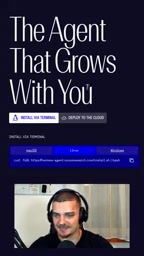
According to a YouTube channel's introduction, Hermes Agent belongs to the category of "always-on agents." Unlike cloud-based coding tools built for specific tasks such as software development, its defining feature is continuous operation—running 24/7 without interruption, with users able to stay in touch with it through multiple channels.
The significance of this form factor is that the Agent is no longer a tool that needs to be "woken up," but more like an assistant that is always online. Deployed on a VPS, it handles things for you in the background—able to push information proactively and respond instantly when you send a message.

VPS (Virtual Private Server) is key to understanding how Hermes Agent is deployed. VPS uses virtualization technology to divide a physical server into multiple isolated virtual instances, each with its own operating system, IP address, and resource allocation. Users rent them monthly and configure them as needed. Compared with shared hosting, a VPS provides root access and full environment control; compared with a dedicated physical server, it costs far less. For an always-on Agent, a VPS is nearly an ideal host: it can stay powered on for long periods, has a fixed public address for receiving message pushes, can freely install dependencies and run background services, and doesn't tie up the user's own computer. The trade-off is that users must handle system updates, security hardening, and backups themselves—one of the reasons permission boundaries are emphasized later.
Channels and Use Cases
Hermes Agent's interaction entry points are quite diverse. The video's author mentions connecting it to WhatsApp, Telegram, and Discord, as well as talking to it by voice; although the specifics of phone access aren't made clear, voice chat through Discord is confirmed to work.
At the feature level, the author lists several typical uses:
- Life management: managing shopping lists, planning fitness routines
- Calendar coordination: granting access to calendars so it can take part in scheduling
- Scheduled tasks: for example, pushing a daily morning stock market briefing
What these scenarios share is that they are "trivial but continuous"—they don't require large blocks of one-off compute, but rather long-term, always-on companionship-style handling. This is exactly where an always-on Agent shines.

Scheduled tasks (cron jobs) are the technical foundation that lets an always-on Agent "work proactively." Cron originates from Unix systems, using expressions like 0 8 * * * to describe recurring schedules such as "run at 8 AM every day," with the system daemon triggering scripts or commands on time. Modern Agents typically wrap this in a friendlier scheduling layer, letting users set plans like "push a morning stock market briefing every day" in natural language or through a UI. This brings an easily overlooked distinction: ordinary conversational AI can only passively wait for questions, whereas an always-on Agent with scheduling capabilities can start on plan, invoke tools, generate results, and push them to designated channels without anyone waking it. For this reason, capabilities like calendar access and message pushing need to work with a scheduling system to truly deliver an "around-the-clock" experience.
"Grows Over Time": Hermes's Core Differentiator
The feature Hermes Agent emphasizes most is that it grows with use. A phrase repeated in the video is "it grows with you": the more you use it, the more it understands your preferences, habits, and context, and its capabilities improve accordingly.
To understand this positioning, OpenClawAd makes a useful reference. The author notes that Hermes is essentially similar to OpenClaw but centers on "growing with you." In other words, beyond baseline capabilities like always-on operation and tool integrations, Hermes makes long-term memory and accumulated personalization its core selling point.
This points to a key question: the value of an always-on Agent largely depends on whether it can build up a "context asset" about the user through long-term interaction. If every conversation starts from scratch, the point of being online 24/7 is largely diminished; but when it remembers your skills, preferences, and history, response quality compounds over time.
Long-term memory is a different matter from an ordinary conversation's context window. An LLM's context window is valid only within a single session and is cleared when the session ends; long-term memory requires externalizing key information into storage—common approaches include vector databases (converting past interactions into embedding vectors for semantic retrieval), structured preference profiles, and readable/writable memory files. Before each response, the Agent retrieves relevant memories and injects the results into the prompt, thereby maintaining knowledge of the user across sessions, weeks, or even months. The hard part is deciding "what to remember and what to forget": recording everything brings noise and cost, while recording too little loses personalized value, so memory selection, compression, and update strategies often reveal product differentiation more than storage itself.
Comparison with Managed Products
Always-on Agents aren't Hermes's direction alone. The video mentions that more managed, paid versions have emerged, such as OpenAI's dots, Claude's Duet, and X's Grokbot.
These products share the same idea: an always-on Agent with access to many tools that works for you in the background—either acting proactively or responding to your messages with full context and learned skills. Differences lie more in ecosystem lock-in, deployment model, and growth-mechanism design. Hermes chooses to emphasize self-hosting (deployed on a VPS) and growing over time, while big-tech products tend to fold the experience into their own platforms.

For users, this means a choice: accept the convenience and ecosystem integration of a big-tech managed solution, or choose a self-deployed solution for greater controllability and data autonomy. Hermes clearly stands on the latter side.
Who Is This Kind of Agent For?
An always-on Agent isn't a must-have for everyone. If your needs are occasional, one-off heavy tasks, traditional tools or cloud coding assistants are sufficient. But if you want an assistant that is always online, remembers you, and proactively does work on a schedule—and you're willing to maintain a VPS yourself—then products like Hermes Agent are worth watching.
One caveat: handing sensitive entry points like calendars and messaging channels to an always-on Agent requires thinking through permission boundaries and data security in advance—this is the other side of self-hosting versus managed solutions.
Related articles

Gemini 4 Neon's Comeback: How Google's 'American Doubao' Shipped Five Models in Two Weeks
Google shipped five models in two weeks. Gemini 4 Neon ranks third globally and first on the coding agent leaderboard, at half the cost of Opus 5.5. A Bilibili creator breaks down the three-layer comeback story: regulatory relief, sparse MoE architecture, and in-house TPUs—plus Carbon promo savings tips and AntiGravity quota rules.

Building AI Animated Videos with Claude Code: A Hands-On Local Toolchain Guide
A hands-on demo of using Claude Code with local open-source tools like Kokoro and Remotion to generate AI videos with narration, animation, and music in minutes. Workflow, efficiency gains, and limitations analyzed.
Chess.com Crosses Over as a Gaming Giant: Classic Games Platform Goes Live
Chess.com launches Classic Games platform with 10 new classic games including Backgammon, Go, Mahjong, and Sudoku, expanding from a chess platform to a comprehensive gaming hub.