Gemini 4 Neon's Comeback: How Google's 'American Doubao' Shipped Five Models in Two Weeks

Google shipped five models in two weeks; Gemini 4 Neon beats Opus 5.5 in tests at half the cost, but still has weak spots.
The article reviews Google's two-week blitz of five models—OMNI 1.2, Flash, Carbon, Hydra, Nil—plus world model Genie 4. A Bilibili creator's tests show Nil winning 16 of 19 official comparisons, hitting 61 points for third globally on the independent composite leaderboard, first on the coding agent leaderboard, and halving per-task cost versus Opus 5.5, with 4K image generation and 3D updates as highlights; however, Opus still narrowly wins hardcore code tests, and Nil consumes about 15% more tokens. The comeback is attributed to three layers: regulatory review exemption, sparse MoE variant-switching, and 7th-gen TPU cost reduction. The article also offers selection advice—Carbon for overnight long tasks during the promo, Nil for daytime, Pro subscription is enough—and AntiGravity cost-control rules: hard-code Hydra dispatch and limit model switches.
Google released five models in two weeks, going from being mocked as the "American Doubao" to ranking third globally on the performance charts—Gemini 4 Neon's turnaround has been impressive. A Bilibili creator said after hands-on testing that this "isn't blind hype," but the data does put real pressure on Opus 5.5.
Five Releases in Two Weeks: Google Finally Stopped Rationing
Over the past two weeks, Google—despite GTA6 dominating the trending topics—dropped five models in one go: OMNI 1.2, Flash, Carbon, Hydra, and Nil, plus the world model Genie 4. Nil, which launched just the day before yesterday, was described by the creator as "grinding Cloud Opus 5.5 into the dirt."

The creator ran the same prompt through Nil to generate a 4K four-panel grid of melting frost on grass, straight from code. The light transmission and reflections were "not a bit inferior to Opus, nor to any 3D asset." The official demos also flexed: hand-crafted Goran-style skiing from raw code #10200, 500,000 spreadsheet formulas, and a major 3D update released the same day.
Test Data: Nil Wins 16 Categories, But Opus Didn't Lose Everything
The creator ran the official 19-category comparison: Nil won 16, Opus won 2, and Sore won 1. On the independent composite leaderboard, it hit 61 points for third place globally, with token speed twice as fast as Carbon. It ranked first on the coding agent leaderboard at 59 points, with per-task cost literally halved versus Opus 5.5. In version-round testing, Nil reached 95.2% while Opus managed only 66.8%.
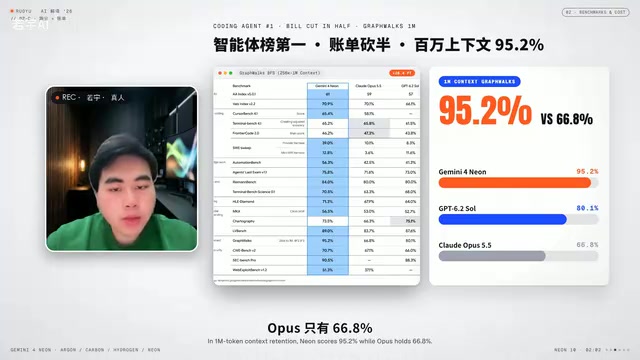
That said, the creator admitted that Opus still narrowly wins on several hardcore code tests shown on screen. And Nil has a bit of a "token-hungry" problem—the same prompt consumes about 15% more tokens than Carbon.
The Three Layers Behind the Comeback: Regulation, Architecture, and Chips
The first layer is a bit darkly comedic. In June, Aesthetic's Fable and Metals were so powerful that they drew the attention of the US government—the Commerce Department imposed temporary export controls, the White House brought in safety assessment agencies, and pre-release reviews took up to 30 days. According to overseas media, only Google's Gimna3 proactively asked whether it should undergo joint review that year; the answer was no need. Google also signed onto the assessment mechanism in May, but page 9 of Nil's model card explicitly states there were no cross-major-change-domain thresholds, exempting it from re-running the full review suite.

The second layer is written into the model itself. From Argon to Carbon, then to the adapted Metals and Nil, a single sparse MoE model family switches variants on demand. Hassabis calls it "alchemy," but it's more accurate to say they've stepped onto the RSI treadmill.
The third layer is in-house silicon. The 7th-gen TPU pays no NVIDIA tax—some analysts say its inference cost-performance leads by as much as 50%, and even Aesthetic is buying Google's CPUs. Paired with their own AntiGravity, the same Nil code-repair task jumped from 12.8% to 39% in testing—a threefold increase. Security has been beefed up too: indirect prompt injection attacks achieved a 0% breach rate against the entire Precision 4 family.
Sparse MoE (Mixture of Experts) is a mixed-expert architecture: the model contains multiple parallel "expert" subnetworks, and each inference only activates a small subset (e.g., Top-2 routing), rather than calling all parameters like a dense model. This keeps per-inference compute low even with a massive total parameter count, balancing capability and inference cost. Google's evolution from Argon to Carbon, Metals, and Nil is exactly this: one sparse MoE foundation sliced into different variants via different expert capacities and routing strategies, enabling rapid iteration of products with distinct positioning under a similar training regime.
RSI (Recursive Self-Improvement) refers to AI systems participating in improving the next generation of themselves (e.g., generating training data, writing training code, optimizing architecture and evaluation), creating a cycle of generational acceleration. Hassabis uses "alchemy" to describe model iteration, while "stepping onto the RSI treadmill" means the iteration cadence increasingly depends on the model's own output rather than pure human tuning. This is the organizational and technical precondition for Google shipping five models in two weeks—but it also raises concerns that safety evaluation and review cadence can't keep up.
Indirect Prompt Injection refers to attackers hiding malicious instructions in external content the model reads (web pages, documents, emails, code comments, tool return values, etc.) rather than directly in user input. If the model treats this content as instructions while executing a task, it may leak data or invoke tools to perform dangerous actions. The article's mention of "0% breach across the entire Precision 4 family" means that on a given generation of precision test sets (4 scenario types), Nil achieved zero breakthroughs against these injection vectors, indicating targeted hardening at the tool-calling and content-isolation layers. For users building agents with AntiGravity, this metric matters more for production security than raw code pass rates.
How to Choose: Carbon's Promo Price Is an Easter Egg, But Don't Force Ultra
The official price sheet hides an Easter egg expiring November 30: Carbon's regular price is $4/$20, but it's on promo at $2/$10 until month's end—cheaper than Nil's $3/$15. So for the next 10 days, hand long overnight tasks to Carbon and review in the morning; switch to Nil for daytime errands during the day, and don't rush to change subscriptions. The $19.9 Pro plan already includes Nil and 5TB of cloud storage—no need to force an Ultra upgrade.

But fair warning: AntiGravity without tuning is genuinely a quota black hole. The creator gave two rules: Swarm inherits the current large model by default and will secretly fall back to older models, so hard-code dispatch to Hydra only, give each person an independent directory, and after dispatch check logs—use AUX straight-line mode to draw only once; don't insert drawings during execution, and don't switch models more than three times, because each switch clears the cache and drops hit rate from 92% to 81%, making costs four to five times higher.
The creator finally turned the models into a clickable elemental ladder, with price and speed visible at a glance—both rules and ad stickers are in the pinned comment. Still deciding between AUX 5.5 and switching to NEO tonight? See you in the comments.
KV Cache and cache hit rate are core variables in LLM inference cost. During generation, the model caches key-value pairs for processed context; if a subsequent request hits the same prefix, there's no need to recompute, greatly reducing latency and cost. Once you switch models or change the context prefix, the cache is invalidated and must be recomputed, causing hit rate to plummet. The article's "hit rate drops from 92% to 81% per model switch, costs four to five times higher" stems exactly from this. In practice, you should keep models fixed, stabilize system prompts and directory structures, and minimize switches—the same cost logic behind the rules "hard-code Hydra dispatch only" and "independent directory per person."
Related articles

What Is Hermes Agent? An Always-On AI Agent That Grows With You
Hermes Agent is an always-on AI agent running on a VPS, reachable via WhatsApp, Telegram, and Discord. It manages lists, calendars, and scheduled tasks and grows with use.

Building AI Animated Videos with Claude Code: A Hands-On Local Toolchain Guide
A hands-on demo of using Claude Code with local open-source tools like Kokoro and Remotion to generate AI videos with narration, animation, and music in minutes. Workflow, efficiency gains, and limitations analyzed.

Chess.com Crosses Over as a Gaming Giant: Classic Games Platform Goes Live
Chess.com launches Classic Games platform with 10 new classic games including Backgammon, Go, Mahjong, and Sudoku, expanding from a chess platform to a comprehensive gaming hub.