Chess Elo Ratings and AI's Economic Impact: Why the Tipping Point May Be Near
Chess Elo curves reveal why AI's economic shock will arrive suddenly, not gradually.
Using decades of chess engine Elo ratings as a mental model, this article analyzes why AI's economic impact has remained limited: AI capability is still climbing below the human threshold. But history shows the transition from "matched" to "surpassed" is brutally fast once that threshold is crossed. The author argues we're already near this critical zone, and that a "business as usual" future would require either a technical plateau or strong regulatory intervention — with the latter deemed more plausible.
A Linear Curve and Its Hidden Warning
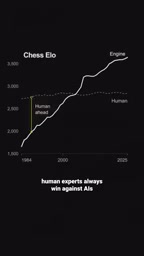
If you plotted chess engine Elo ratings from the 1980s to today, you'd see a nearly perfect linear upward trend. Over several decades, machine play steadily climbed from amateur level all the way to crushing the world's top human players. The curve looks unremarkable at first glance — but it hides a pattern that everyone tracking AI's economic impact should take seriously.
What matters isn't the smoothness of the curve itself. It's the violent discontinuity that occurs where the curve intersects human capability. For a long stretch, human experts could reliably beat AI. Then, past a certain threshold, the situation reversed almost instantly — human experts could barely win at all. The transition window between "always winning" and "never winning again" was remarkably brief.
Elo rating is a statistical scoring system designed by Hungarian-American physicist Arpad Elo, originally for chess and now widely used across competitive domains and AI benchmarking. The core idea: match results dynamically update both players' scores, with stronger players gaining fewer points for beating weaker ones and vice versa, until scores converge to reflect true skill levels. In AI research, the Elo framework allows cross-system performance comparisons and tracks a single system's capability over time — giving the abstract notion of "AI strength" a quantifiable, comparable representation. It's precisely this quantitative framework that allows the moment when "AI meets human capability" to be pinpointed on a timeline, rather than left as a vague qualitative description.
Linear Capability Growth — Why the Economic Shock Hasn't Arrived Yet
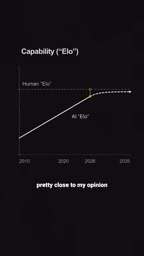
A frequently asked question: if AI capability keeps growing, why has its real-world economic impact remained limited? The explanation offered here is compelling — AI's Elo score is rising, but it's climbing slowly relative to the human baseline.
In other words, as long as AI "strength" remains below the range of human capability, it can't independently complete most economically valuable tasks, so its impact on productivity and employment stays limited. This slow relative climb masks a potential cliff-edge change ahead. Economic impact isn't released linearly as capability grows — it concentrates at the moment capability crosses the human threshold.

We're Already Close to the Crossover Point
The most striking implication of this framework: by the speaker's assessment, we're already quite close to the threshold zone where AI begins to cross human Elo scores. Chess history tells us that once you enter this zone, the transition from "roughly matched" to "comprehensively surpassed" happens with startling speed.
Applied to economic tasks more broadly, this suggests AI's substantive economic impact may not arrive gradually like a slowly heating pot — it may emerge suddenly within a relatively narrow time window. The current sense that "AI isn't that capable yet" may simply be the last calm before the crossover.
What Would "Business as Usual" Actually Require
For those imagining that everything will still look normal by 2035, the speaker argues there are only two technically plausible paths.
The first is technological: the AI capability curve happens to asymptote — flattening out just before crossing the human threshold, suddenly stopping growth right at the critical point. The speaker isn't optimistic about this scenario. Given current trends, we're already close to the crossover, making the coincidence of "stopping just at the doorstep" seem unlikely.
The second is regulatory: some powerful, dramatic constraints are imposed on AI that artificially prevent its capabilities from fully flowing into economic activity. Interestingly, the speaker views this regulatory path as more realistic than a technical slowdown in any "business as usual" scenario. In other words, if the future world looks largely unchanged by AI, it's more likely because humanity actively hit the brakes — not because the technology stopped on its own.

The Value and Limits of This Analogy
Using chess Elo to reason about AI's broader economic impact is an intuitive and powerful mental model. It captures two core insights: capability growth can be smooth while impact is released discontinuously; and human performance benchmarks represent a threshold that, once crossed, is difficult to reverse.
Of course, the analogy has its limits. Chess is a closed-rule, single-domain game with a clear objective, while the real economy consists of countless heterogeneous tasks, each with a different "human Elo threshold" at different crossover points. Real-world AI economic impact is more likely the cumulative effect of many Elo curves each crossing their respective thresholds at different times — not a single wholesale transformation.
Even so, this framework warns us against being lulled by the current appearance of limited AI impact. Behind the linear capability growth lies a nonlinear shock. The real question may not be "will AI bring dramatic change" — it may be "will we use regulation to secure a buffer before the crossover arrives."
It's worth adding that the limitation of "task heterogeneity" is already addressed by established frameworks in economics. Labor economists like David Autor have proposed the Task Model, which breaks jobs into independently measurable tasks and distinguishes routine from non-routine tasks, and cognitive from physical ones. Within this framework, AI's economic impact does look more like the "many Elo curves crossing thresholds at different times" described here — highly standardized tasks like accounting and text classification have lower thresholds and are crossed earlier, while tasks requiring contextual judgment and interpersonal coordination have higher thresholds and are crossed later. This means the distribution of economic impact across industries and occupations will be highly uneven. Some roles may experience a chess-style sudden reversal within years, while others remain relatively stable. Policymakers will face a staggered sequence of multiple shocks — not a single historic moment.
Related articles
What Is Cursor? Core Differences Between This AI Coding Tool and Traditional IDEs
What is Cursor? This guide explains the AI-native code editor built on VS Code, how it compares to traditional IDEs, and its integration with Claude, DeepSeek, and Gemini.
Coze 3.0 Beginner's Guide: A Complete Overview of Agents and AI Applications
A beginner's guide to Coze 3.0: covering agents, AI applications, workflows, and plugins on ByteDance's AI platform, plus a comparison with Dify.

Setting Up the DeepSeek Harness Environment: A Complete Guide to Node.js Installation and Configuration
A beginner-friendly guide to setting up the DeepSeek Harness environment: Node.js installation, Add to PATH, redirecting npm global and cache directories, and configuring system environment variables.