China's First Frontier AI Export Controls Take Effect, Leaving Enterprises Facing Compliance Audit Challenges

China's first frontier AI export controls create three parallel regulatory regimes with the EU and US, testing enterprise agent audit capabilities.
China's Ministry of Commerce Announcement No. 48 establishes export controls on frontier AI models and training data for the first time, forming the world's third independent AI regulatory regime alongside the EU AI Act and the US executive order. The three frameworks differ in model availability, data routing requirements, and cross-border restriction standards, so the same agent workflow may trigger different compliance obligations in different regions. The article highlights the core contradiction: model calls happen in milliseconds while compliance review cycles lag, and most production agent deployments cannot answer basic audit questions after the fact, such as which model was called, what data was touched, and whether restricted jurisdictions were involved. Companies can reduce risk by establishing model call logging standards, tracking data lineage, and shifting compliance checks earlier. Compliance capability is becoming infrastructure for agent deployment.
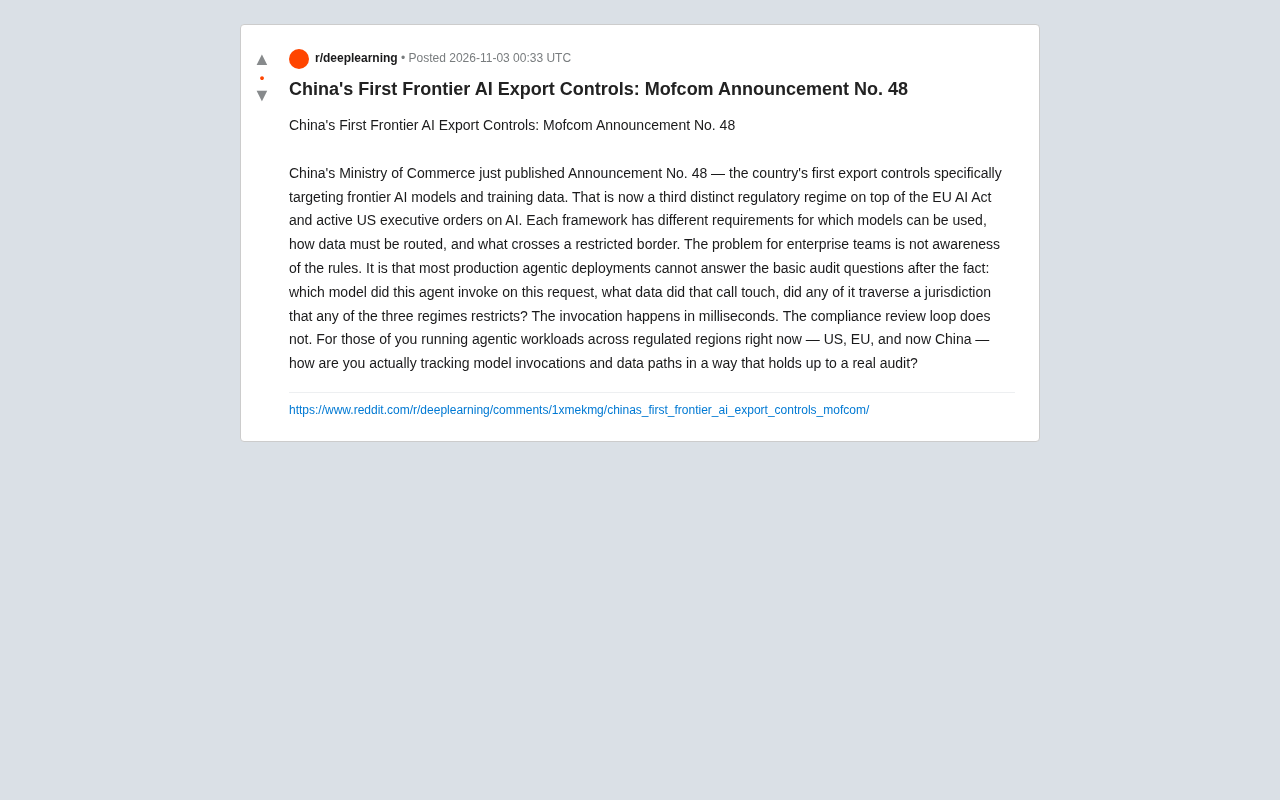
China's Ministry of Commerce has issued Announcement No. 48, establishing export controls on frontier AI models and training data for the first time. This means that, following the EU AI Act and the current US executive order, a third independent global AI regulatory regime has officially taken shape. For multinational companies, the real challenge is not a lack of understanding of the rules, but that agent deployments in production environments cannot answer basic audit questions after the fact: Which model did this request call? What data did that call touch? Did any data flow through the jurisdiction of any restriction under the three countries' regulatory frameworks?
Three Regulatory Regimes in Parallel, Each with Different Compliance Logic
According to discussion in the Reddit community, China's Ministry of Commerce Announcement No. 48 is the first export control measure specifically targeting frontier AI models and training data. Previously, the EU AI Act classified and regulated AI systems by risk level, while the United States imposed restrictions on AI technology exports through executive orders. The three frameworks differ in their focus on the scope of model availability, data routing requirements, and cross-border restriction standards, and companies cannot cover all regions with a single compliance solution.
The direct consequence of this fragmented landscape is that the same agent workflow may trigger different compliance obligations in the United States, the EU, and China. Companies need to track model provenance, data flows, and jurisdictions at the same time, while traditional compliance review processes often lag behind technology calls.
The EU AI Act's Risk-Based Classification Framework
The EU Artificial Intelligence Act (AI Act) was formally adopted in 2024 and uses a four-tier classification based on risk level: unacceptable risk (such as social scoring systems, which are directly prohibited), high risk (such as AI in healthcare, recruitment, and critical infrastructure, which must meet strict compliance assessments and CE marking), limited risk (such as chatbots, which must fulfill transparency obligations), and minimal risk (such as spam filtering, which is largely free of additional constraints). For general-purpose AI models (GPAI), the Act also has separate provisions requiring technical documentation, copyright compliance statements, and summaries of training data. The core logic of this framework is "risk determined by use" rather than "controls determined by model scale," which is fundamentally different from China's announcement, which focuses on frontier model exports, and the US executive order, which emphasizes technology export security. As a result, companies cannot simply apply a single template.
The US Executive Order Path for AI Export Controls
US export restrictions on AI rely mainly on executive orders and the Export Administration Regulations (EAR) of the Department of Commerce's Bureau of Industry and Security (BIS), rather than a unified AI-specific law. The October 2023 executive order and subsequent updates focus on export controls for advanced computing chips and AI model weights, defining the controlled scope through performance thresholds (such as total computing power) and constraining technology transfer through "deemed export" rules. Its starting point is national security and foreign policy, not the risk classification of AI systems. This means that the same model may trigger an export license in the United States due to computing power thresholds, require a risk-level assessment by use in the EU, and require a determination of whether it falls under the frontier model export catalogue in China, with the trigger conditions for all three being independent of one another.
Millisecond-Level Calls Meet Slow Compliance: Where Are the Audit Breakpoints?
The core contradiction raised in the original post deserves attention: model calls happen in milliseconds, while compliance review cycles are much slower. When agents execute tasks across multiple regulated regions, after-the-fact audits need to reconstruct the complete chain of each call, including model identity, data exposure scope, and cross-border paths.
Most production-grade agent deployments currently cannot automatically generate this kind of audit trail. Logging usually stops at the request level and lacks model-level labeling and data lineage tracking. Once regulators demand evidence, teams can only rely on manually piecing together fragmented information, and both efficiency and accuracy are difficult to guarantee.
What Is Data Lineage?
Data lineage refers to the full-chain record that tracks data from generation, processing, and transfer to consumption, answering "where did this data come from, what processing did it go through, and where did it go." In AI agent scenarios, data lineage needs to be refined to the datasets read by each model call, storage locations, transmission paths, and jurisdictions of residence. Unlike traditional data catalogues, lineage tracking in AI call scenarios faces challenges of high concurrency, short lifecycles, and cross-cloud and cross-border operation: a single agent task may trigger dozens of model calls within seconds, each involving different context assembly and retrieval-augmented generation (RAG) data sources. Without automated lineage collection, it is almost impossible to reconstruct the complete path after the fact. This is also the fundamental reason why teams often can only rely on manually piecing together fragmented information when regulators demand evidence.
Three Things Companies Can Start Doing
Faced with three parallel regulatory frameworks, companies are not without options. They can reduce compliance risk in three directions.
First, establish model call logging standards. Enforce recording of model identifiers, versions, and providers in the agent call chain to ensure that every request can be traced back to a specific model.
Second, track data lineage. Record the datasets and storage locations touched by each model call, especially cross-border data transmission paths, so that it is possible to quickly determine whether restricted jurisdictions were involved.
Third, shift compliance checks earlier. Rather than relying on after-the-fact audits, embed lightweight compliance markers at the time of the call so that audit trails are generated automatically rather than manually supplemented.
According to discussion in the original Reddit post, some teams are already exploring observability solutions for cross-regional agent workflows, but audit tools specifically for AI export controls remain a blank space. With three regulatory regimes in parallel, compliance capability is becoming infrastructure for agent deployment rather than an ancillary feature.
The Engineering Meaning of Shift-Left Compliance
"Shift-left compliance" borrows the idea of "shift-left testing" from software engineering and refers to moving compliance validation earlier from post-release or audit time to runtime when the call occurs, or even to the design stage. In agent architectures, specific practices include: embedding a policy engine at the model gateway layer to determine in real time whether a call is compliant based on model identifiers, data labels, and target jurisdictions; attaching data classification tags during prompt assembly so that cross-border transfers automatically trigger alerts or blocks; and recording tamper-proof call credentials at the orchestration layer. Compared with after-the-fact audits, the shift-left approach turns compliance costs from "manual evidence gathering" into "automatically generated evidence," but the premise is that the company has already established a unified model registry and data classification system; otherwise, the policy engine lacks a basis for judgment. At present, open-source observability tools (such as OpenTelemetry's AI semantic conventions) are evolving in this direction, but a policy library specifically covering the export control rules of the three countries remains a blank space.
One-line Summary
China has established export controls on frontier AI models for the first time, forming three parallel regulatory regimes with Europe and the United States and testing enterprises' agent audit capabilities.
Paragraph Summary
China's Ministry of Commerce Announcement No. 48 establishes export controls on frontier AI models and training data for the first time, marking the formation of the world's third independent AI regulatory regime after the EU AI Act and the US executive order. The three frameworks differ in the scope of model availability, data routing requirements, and cross-border restriction standards, and the same agent workflow may trigger different compliance obligations in different regions. The article points out that the core contradiction is this: model calls happen in milliseconds, while compliance review cycles lag behind, and most production-grade agent deployments cannot answer basic audit questions after the fact, such as "which model was called, what data was touched, and whether restricted jurisdictions were involved." Companies can reduce risk by establishing model call logging standards, tracking data lineage, and shifting compliance checks earlier. Compliance capability is becoming infrastructure for agent deployment.
Related articles

Full AI Comic Drama Workflow with WorkBuddy: 8 Steps from Zero to Final Cut
A complete eight-step WorkBuddy workflow for making AI comic dramas: topic planning, script and storyboard, image assets, video generation, voiceover, editing, and publishing, plus WorkBuddy's expert-skill mechanism and tips for summoning experts one by one. Suitable for beginners.

Codex Practical Tutorial: From Installation to Multi-Agent Collaboration
Based on a Bilibili Codex practical tutorial, this article systematically covers installation and configuration, CLI interaction, slash commands, AGENTS.md architecture, the MCP protocol, multi-agent collaboration, and enterprise plugin development, helping developers understand engineering usage of AI Agents.

AI Agent Practical Guide: Building an Enterprise-Grade Agent from Scratch
A beginner-friendly guide to AI Agents: the difference from traditional programs, the perception-decision-action loop, technical evolution, the enterprise tech stack (LLM, tool calling, memory, RAG), and use cases.