Circular Financing in the Age of Compute Scarcity: The AI Bubble Debate and Nvidia's Ecosystem Strategy
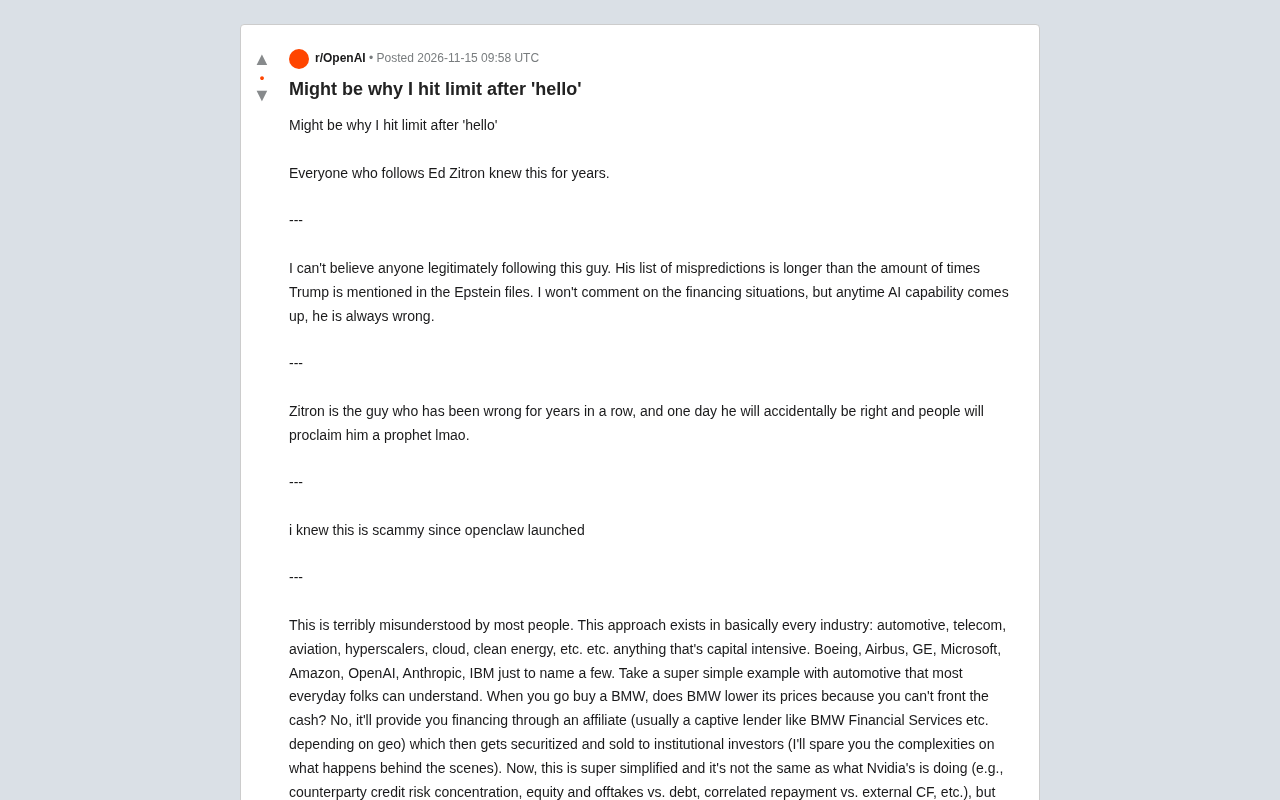
Reddit debate: Is Nvidia's supplier financing a Ponzi scheme or standard practice in a capital-intensive industry?
The article centers on a Reddit debate about Nvidia's financing model: is its "supplier-supported demand" approach—funding customers while selling GPUs—a Ponzi scheme or mature capital-intensive practice? Supporters cite auto finance and the 1990s telecom bubble, noting the tools aren't new but Nvidia's sovereign-scale combination is; opponents worry about idle GPUs, counterparty risk concentration, and disclosure. Consensus: the risk lies in concentration, not the tools.
Title
Circular Financing in the Age of Compute Scarcity: The AI Bubble Debate and Nvidia's Ecosystem Strategy
Meta Description
Starting from a Reddit debate, this piece unpacks Nvidia's circular financing model: is it standard practice in a capital-intensive industry, or a new form of AI bubble? Comparing it to the telecom bubble of the 1990s, it sorts out the real risks and disagreements around supplier-supported demand.
Article Content
A Reddit post titled "Might be why I hit limit after 'hello'" carried a self-deprecating tone—blocked by a usage limit right after typing a single greeting. Yet the comment section unexpectedly unfolded into a high-quality debate about AI capital structure, Nvidia's financing model, and the "AI bubble" thesis. The core disagreement is simple: Nvidia injects capital into customers while selling them cards, and this "supplier-supported demand" approach—is it a Ponzi scheme or standard practice in a capital-intensive industry?
Where the Controversy Begins: Ed Zitron and the "Perma-Bear" Voice
The post initially took aim at well-known tech commentator Ed Zitron. The poster implied that it is precisely this kind of "AI bubble" narrative that makes people wary of such circular financing structures. But the comment section immediately split into two camps.
One camp argued that Zitron has long been bearish on AI capabilities and has repeatedly missed on his predictions, so his views have lost any reference value. The other camp pointed out that he himself admits he cannot judge the specific financing arrangements and is only questioning AI capabilities themselves.
There is actually an often-overlooked distinction here: questioning whether AI capabilities are exaggerated and questioning whether AI capital structure is healthy are two different questions. Conflating them makes the discussion easily slide toward personal attacks rather than factual analysis.
The Key Argument: This Is Just Standard Practice in a Capital-Intensive Industry
The most informative long reply in the comment section came from a user who claimed familiarity with financial structures. His core argument: Nvidia's approach exists in all capital-intensive industries—automotive, telecom, aviation, cloud computing, clean energy.
He used auto finance as an analogy—you go to buy a BMW, and BMW doesn't cut the price just because you can't pay in full. Instead, it lends you money through its captive finance company and then securitizes that loan and sells it to institutional investors. This is a form of "supplier-supported demand creation."
What's really worth noting is his rebuttal of the "1990s telecom bubble" analogy. Back then, vendors like Lucent and Cisco artificially manufactured growth in an early era when internet demand did not yet exist; Nvidia, by contrast, is deploying capital at a time when compute is severely scarce, subsidizing ecosystem building with high gross margins.
His conclusion: none of the financial instruments Nvidia uses are new, but using them in combination at sovereign scale is what's unprecedented. The risks are real, but far less than the 1990s telecom bubble, and all are clearly disclosed in financial statements.
The Essential Difference Between Circular Financing and Traditional Supplier Finance
That said, he also acknowledged that Nvidia's approach is not entirely the same as BMW Financial Services—it involves structural issues such as concentration of counterparty credit risk, equity and offtake agreements rather than pure debt, and highly correlated repayment sources. These differences are precisely what bubble theorists worry about most.
In other words, this model is not a "new invention," but the concentration of its risk exposure deserves ongoing attention.
Concentration of counterparty credit risk refers to the fact that when a supplier supports customers' purchases of its own products through financial arrangements, its recoveries depend heavily on the solvency of a small number of customers. If these customers fall into financial distress at the same time, the supplier faces cascading default risk. In Nvidia's case, its customers are highly concentrated among a few hyperscale cloud providers and AI startups, and these counterparties' credit conditions are closely tied to the AI investment cycle. Once industry conditions reverse, risk converges rapidly rather than dispersing.
An offtake agreement is a contract stipulating that a buyer will purchase a certain quantity of products in the future under specified conditions. In the AI compute sector, such agreements are often used to back the future revenue of data centers or GPU clusters, thereby supporting financing. Unlike pure debt, an offtake agreement's repayment source depends on the cash flow the project generates in the future; if actual demand falls short of expectations, performance pressure is transmitted directly to the financing structure.
Asset securitization refers to the process of packaging assets that lack liquidity but have predictable cash flows (such as loans, receivables, lease contracts) into securities that can be sold in capital markets. In auto finance, BMW Financial Services packages auto loans and sells them to institutional investors, thereby recovering funds early, transferring risk, and expanding lending capacity. The instrument itself is neutral; its risk depends on the quality and transparency of the underlying assets. If Nvidia adopts a similar structure by securitizing customer receivables or lease contracts, it is essentially also monetizing future cash flows early—but if the underlying assets are concentrated in AI compute-related projects, their risk correlation would be significantly higher than that of diversified auto loans.
Another Voice: GPUs in Warehouses and the "Confirmed Conspiracy Theory"
Not everyone was convinced. One commenter pointed out directly: given all the reports of GPUs piling up in warehouses, this financing logic looks suspicious. Others questioned whether such financial engineering could ultimately become a cash machine for specific interested parties.
The most intriguing comment was about graphics card prices—the author smiled wryly that his next GPU would most likely still cost a hefty sum, that all this financial knowledge was of no help to him, and that it was just one more "confirmed conspiracy theory that makes you look like a lunatic."
This sentiment is very representative: no matter how brilliant the discussion of macro capital structure, for ordinary consumers there is only one takeaway—hardware is still expensive, and usage limits still arrive without warning.
A Rational View: The Risk Lies Not in the Tools but in Concentration
Bringing this debate back to a verifiable level, a few points of relative consensus can be distilled:
- Supplier-supported demand is a mature practice in capital-intensive industries and is not inherently equivalent to fraud;
- Nvidia's singularity lies in the simultaneity of scale and tool combination, not in the tools themselves;
- The key difference from the 1990s telecom bubble is that compute demand is real and supply is scarce today;
- Disagreements center on the concentration of counterparty risk, rumors of idle GPUs, and whether disclosure is transparent enough.
For ordinary users, perhaps the most practical takeaway from this discussion is: the next time you hit a "blocked by a limit right after saying hello" message, what lies behind it is not just one company's pricing strategy, but an entire compute capital cycle that is being redesigned.
Sovereign scale here refers to the volume of financing and capital deployment reaching the level of national sovereign wealth funds or national-level infrastructure investment. Nvidia simultaneously employs equity injections, offtake agreements, debt guarantees, securitization, and other tools, with individual transactions often running into billions or tens of billions of dollars. This scale makes its financial arrangements systemically important far beyond ordinary supplier finance. If compute demand experiences a cyclical downturn, the impact could ripple across the entire AI industry chain and capital markets, not just one company's balance sheet.
One-line Summary
Reddit debate: Is Nvidia's supplier financing a Ponzi scheme or standard practice in a capital-intensive industry?
Paragraph Summary
The article centers on a Reddit debate about Nvidia's financing model. The core disagreement: Nvidia provides funding support to customers while selling GPUs, and this "supplier-supported demand" approach—is it a Ponzi scheme or a mature practice in a capital-intensive industry? Supporters reference auto finance and the 1990s telecom bubble, arguing the tools themselves are not new and that Nvidia's singularity lies in combining multiple tools at once at sovereign scale, with compute demand real and supply scarce today. Opponents worry about rumors of idle GPUs, concentration of counterparty risk, and disclosure transparency. The article ultimately distills a consensus: the risk lies not in the tools themselves but in concentration and correlation, and the most direct experience for ordinary users remains expensive hardware and usage limits.
Related articles

No Coding Required: He Shipped an App Store App by 'Cutting Features' and Nitpicking with AI
A game designer with zero frontend/backend skills shipped a dual-platform App Store app with AI—not via one-click generation, but by cutting scope and nitpicking like a demanding client.

What Is Harness Engineering? From Concept Origins to Enterprise-Level Agent Implementation
What is Harness Engineering? This article traces the concept's origins and analyzes enterprise-level Agent requirements for tool call fault tolerance, data security, tenant isolation, and memory gaps.

Coze in Practice: A Three-Tier Agent Classification and a Multi-Agent Collaboration Guide
A Bilibili tutorial breaks down the multi-agent collaboration toolchain into three categories: building platforms like Coze Studio and Dify, Agent software like Claude Code, and development frameworks like LangChain—plus a Coze demo of industry templates, three-platform interoperability, local Agent integration, and the trade-offs of credit consumption.