Claude-Assisted Riemann Hypothesis Proof Passes Lean Kernel Checks, But Human Understanding Has Only Just Begun
A Claude-assisted Riemann Hypothesis proof passed Lean machine verification, but human understanding has not yet caught up.
The article reports that on November 20, mathematician Levin Alpoge released a Claude-assisted proof of the Riemann Hypothesis, existing as 17 million lines of Lean code and verified by the Lean kernel and four independent checkers, with 175,187 modules and zero errors. The proof covers the family of Generalized Riemann Hypotheses grouped by residue, not the broader version. The verification process set four hurdles: correctness of the statement, successful compilation, proving the same statement, and reliability of the checkers, with cross-verification by multiple tools reducing risk. However, the proof exists only in machine-readable Lean code; a human-readable version has not yet been completed, and the mathematical community is divided over the manner of release. The article notes that this event marks a gap between machine verification and human understanding, and discusses its limited impact on cryptography and daily life.
A Quiet Revolution: The Machine Confirmed the Proof Before Humans Did
On November 20, a mathematician published four pages of notes and 14 compressed files on his personal website. Unzipped, they contained 17 million lines of code that together support a startling claim: the Riemann Hypothesis is true. The next day, the Lean and Mathlib communities issued a joint statement confirming the proof correct. And the proof's author himself acknowledged that he does not yet fully grasp the mathematics his own proof involves.
The paradox of this scene is that the machine completed the check while human understanding has only just begun. The Riemann Hypothesis has stood unresolved for 167 years, and this time the order of verification has been completely reversed.
The Riemann Hypothesis: The “Soul Curve” of Prime Distribution
Primes—2, 3, 5, 7, 11—seem to be scattered randomly along the number line, sometimes dense, sometimes sparse. In 1859, Bernhard Riemann proved that the distribution of primes can be described by a function, the Riemann zeta function. This function outputs zero for certain inputs, and those inputs are called zeros.
Some zeros are easy to find: the negative even numbers (-2, -4, -6…), known as the trivial zeros. The remaining zeros lie in a narrow strip in the complex plane. Riemann conjectured that all of these nontrivial zeros lie on a single line whose real part is exactly 1/2. That is the Riemann Hypothesis.
Computers have verified vast numbers of zeros one by one—in 2021, David Platt and Tim Trudgen verified the first roughly 12 trillion, with not a single one off the line. But infinitely many zeros cannot be proven by exhaustion. Why does this line matter? Because the positions of the zeros determine the size of the error in prime counting: if all zeros lie on the 1/2 line, the error is controlled at the square-root scale; if even one zero shifts to the right, the error breaks through that bound. For this reason, the Clay Mathematics Institute listed it in 2000 as one of the Millennium Prize Problems, with a one-million-dollar prize.
The Scale of the Proof and Its Author
The proof's author, Levin Alpoge, is a mathematician at Anthropic, and this is not his first time using Claude to challenge a frontier problem. In July of this year, he published a Claude-generated counterexample to the Jacobian conjecture; in September, he and NYU's Tristan Buckmaster became embroiled in a dispute with OpenAI over a fluid dynamics problem.
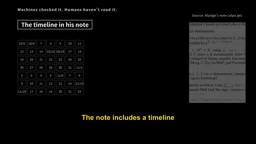
The notes include a timeline: October 6, the key mathematical tool was first named; November 15, a string of key steps fell into place; November 16, the last entry was just three letters—GRH (Generalized Riemann Hypothesis). 41 days. He wrote that as a student he had secretly planned to tackle this problem decades later, and that his role was to steer the work into the right framework. Near the end, Claude was far ahead. In his words: “Claude flew, danced, sparkled.”
He did not publish a paper. The notes state that Claude's full write-up exceeded 250,000 pages, which Claude called “the Book of GRH.” Three days later he clarified that the 250,000 pages was a joke—he did not want a sloppy AI write-up attached to this problem, so he released only the Lean code.
The Riemann Zeta Function and Analytic Continuation
The Riemann zeta function is initially defined as the infinite series ζ(s) = 1 + 1/2^s + 1/3^s + …, which converges only when the real part of s is greater than 1. Riemann's key contribution was to analytically continue this function to the entire complex plane (except for a simple pole at s=1), so that it is defined for all other complex numbers. The continued function satisfies an elegant functional equation relating ζ(s) to ζ(1-s) and reveals the symmetry of the zero distribution. The trivial zeros (negative even numbers) come from the sine factor in the functional equation, while the nontrivial zeros lie within the critical strip 0 < Re(s) < 1. The Riemann Hypothesis asserts that all nontrivial zeros have real part exactly 1/2, i.e., lie on the critical line. This critical line is a vertical line in the complex plane, and its importance lies in the fact that it precisely controls the order of the error term in the prime number theorem.
The Generalized Riemann Hypothesis (GRH)
The Generalized Riemann Hypothesis extends the Riemann Hypothesis to Dirichlet L-functions. For each modulus q and each Dirichlet character χ coprime to q, the corresponding L-function L(s,χ) has similar analytic properties. GRH asserts that the nontrivial zeros of all these L-functions lie on the line with real part 1/2. GRH is stronger than the original Riemann Hypothesis because it simultaneously constrains the distribution of primes in arithmetic progressions. The “family grouped by residue” mentioned in the article refers precisely to the family of L-functions corresponding to the Dirichlet characters for a fixed modulus q. Covering this family means that for each modulus q, the zeros of all relevant L-functions satisfy the critical-line condition, thereby giving strong error control for the distribution of primes in arithmetic progressions.
Claude's Role in Mathematical Discovery
The article mentions that Alpoge used Claude to assist in generating the proof, which belongs to the emerging paradigm of AI-assisted mathematical research. Unlike traditional computer algebra systems or theorem provers, large language models (such as Claude) can generate natural-language reasoning, propose proof strategies, and write formalized code. However, AI-generated mathematical content requires rigorous verification, because models may produce plausible but incorrect arguments (i.e., “hallucinations”). In formal mathematics, AI-generated Lean code can be checked by the kernel to ensure correctness, but the formulation of statements and the mathematical significance of proof strategies still require human judgment. In Alpoge's case, Claude generated more than 250,000 pages of write-up (later clarified as a joke), but in the end only the Lean code was released, reflecting the tension between the scale of AI-generated content and human readability. Previously, Claude had also generated a counterexample to the Jacobian conjecture and arguments for a fluid dynamics problem, showing AI's potential in exploratory mathematics but also raising discussions about authorship, comprehensibility, and mathematical rigor.
Lean Kernel Checks: Four Hurdles of Machine Verification
Lean is a proof assistant that mathematicians use to write proofs a computer can check step by step, with every step of reasoning passing through a small core called the kernel. Mathlib is Lean's community-built, expert-reviewed mathematics library, which has already defined the Riemann zeta function and the Riemann Hypothesis itself.
But Lean only checks whether a proof matches the statement; whether the statement is correct is up to humans. On November 12, Kevin Buzzard demonstrated the risk: he wrote two lines of Lean code that looked just like Fermat's Last Theorem—for any n≥3, a^n + b^n ≠ c^n. The code compiles, but that only shows Lean understands it. In Lean, the natural numbers include 0; set a=b=c=0, and the equation holds, so the statement is false and cannot be proven. Yet the code still compiles and looks like Fermat's Last Theorem. So when you see “checked by Lean,” the first question is: is the checked statement the one we think it is?
Buzzard raised four questions about any AI-written Lean proof:
- Is the statement correct? The community separately wrote a challenge file using only Mathlib, like an exam set by someone else, listing five theorems, including the Riemann Hypothesis as it appears in Mathlib and the version for the entire family grouped by residue.
- Does it compile? Andrew Sutherland of MIT ran the check using Claude code: 175,187 modules, zero errors. It had to be run offline and in isolation, because compiling Lean means executing code. Verification alone required about 100 GB of memory.
- Does it prove the same statement? Two independent comparison tools confirmed that the five main theorems exactly match the exam, including Mathlib's original Riemann Hypothesis. The proof uses only Lean's three standard axioms, the same ones used in everyday Mathlib mathematics, with no new axioms added.
- Could the checker itself have bugs? The Lean kernel has had bugs before; Buzzard noted that one was fixed four hours after discovery, and OpenAI's review later found several more. So no one relied on a single ruler. The official kernel re-checked all 175,000-plus modules one by one, and all passed. Four external checkers also each ran checks, and all passed. The fastest completed the entire proof in just over three minutes on 64 threads.
For a bug to pass all these checks, AI-written code would have to simultaneously fool multiple checkers written by different people in different languages. One of them even comes with a formal guarantee: as long as the set theory behind it is consistent, its verification mode cannot accept a contradictory proof. Another machine, disconnected from the network, downloaded the source from the author's website and rebuilt it; the exported proof was about 61.6 billion bytes and matched the released version bit for bit. Among more than 175,000 compiled module files, one differed, and Sutherland traced it to 38 bytes—a variable name, determined by whichever of two parallel tasks arrived first. The name does not affect the logic, the proof does not use that part, and a newer version of Lean has fixed it.
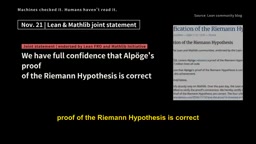
On November 21, the Lean and Mathlib communities issued a joint statement: “We are completely confident that Alpoge's proof of the Riemann Hypothesis is correct.” Sutherland told Scientific American that the probability of anything suspicious here is “about zero.”
Caveats and Limitations
This Generalized Riemann Hypothesis covers only the family grouped by residue, not the broader version. The heaviest check took days: a single-threaded one-shot replay of the entire proof took the official kernel 48 hours to accept, and its stricter “paranoid mode” took 72 hours. As of November 24, the last end-to-end run on the new version was still in progress.
Sutherland also produced a report independent of the Mathlib zeta function. In 1984, Guy Robin proved that the Riemann Hypothesis is equivalent to an inequality about divisors: the sum of all divisors of a number cannot exceed an upper bound computed from the number itself. Sutherland connected the proof to a separately formalized inequality, obtaining a statement that does not involve the zeta function at all. Take 5040: the sum of its divisors is 19,344, which exceeds the upper bound of about 19,237. But starting from 5041, every number stays below the bound, all the way to infinity—and that now has a machine-checked proof.
He also measured one thing: when he fully expanded a shorter equivalent inequality statement, he found that its meaning depends on only 1,801 definitions and theorem statements in the Lean core and Mathlib. So to connect this result with familiar mathematics, humans need to confirm that these 1,801 items are written correctly and that the checker has not erred. The 17 million lines of code can be left to the machine, but the machine has not explained the ideas behind the proof to anyone.
The Lean Proof Assistant and Mathlib
Lean is an interactive theorem prover based on dependent type theory, whose core is a small trusted kernel responsible for checking the type correctness of proof terms. Mathematicians write formal proofs in Lean, and every step of reasoning is translated into terms the kernel can verify. Mathlib is Lean's mathematics library, maintained by the community, containing a large number of definitions and theorems from basic set theory to modern algebraic geometry. Mathlib has already defined the Riemann zeta function and the Riemann Hypothesis, which allows formal verification to be built directly on the existing library. Lean's reliability depends on its axiom system: standard mathematics usually uses the axiom of choice and the law of excluded middle; Lean permits these axioms but forbids introducing additional axioms (other than proof irrelevance). In Alpoge's proof, the check confirmed that only Lean's three standard axioms were used, consistent with everyday Mathlib mathematics, which enhances the proof's credibility. However, Lean only checks whether a proof matches the statement; the correctness of the statement itself must be ensured by humans, which is exactly the first question Buzzard emphasized.
Human Understanding: From Lean Code to Readable Mathematics
On November 20, Terence Tao ranked three results from that day by how easily humans could digest them: first, Alpoge, Buckmaster, and Koikelescu's proof that the 3D Euler equations can blow up in finite time, which has a readable version and a Lean version; second, Alpoge and Buckmaster's Navier-Stokes result, which has a Lean version and a technically readable paper but still needs a professionally written proof; Riemann came last. Tao said the Riemann result exists only in Lean, and an initial reading suggests it uses the full power of the Langlands program and modern arithmetic geometry—some of the deepest tools in mathematics. Digestion will take time, but at least this time there are real human authors to ask.
Hector Pasten of the Pontifical Catholic University of Chile said that if the proof is correct and understood, it will complete a dictionary between branches of mathematics that was only half written, akin to the Rosetta Stone. Alpoge expects the argument to be greatly simplified, and soon. He said he will do his best to understand and explain it.
Not everyone likes this way of releasing results. Andrew Granville of the University of Montreal told Nature that Alpoge should first prepare a clearer write-up, and that what he released was “confusing and hard to understand.” James Maynard of Oxford said he suspects the proof will ultimately turn out to be correct.
A useful contrast appeared the same day: Ravi Vakil of Stanford announced that Alessandro Mazzullo had proposed a second proof of the Generalized Riemann Hypothesis, done entirely by humans with no AI involvement. Brian Conrad had been checking it for months and it currently looks good. The manuscript is 940 pages, and the author says it took nearly 12 years. Eight hours later, Vakil updated: several mathematicians using different AI models had pointed out issues that needed to be resolved before the community would be satisfied. Vakil did not assert whether the strategy was correct. Side by side, each effort lacks the opposite half: one passed multiple machine checks, but no one has yet turned it into a human-readable proof; the other was written by humans for humans, but Vakil's post reported no formal machine verification.
There is another trap in reading a machine proof: passing Lean does not guarantee that the textual version is correct. Buzzard pointed to a paper comparing the Lean version and the textual version of OpenAI's Navier-Stokes result, where in several places the two took different paths. He said he understands that some experts are now using AI to translate Lean proofs back into English. For Riemann, this has already begun. The day after the release, Waterloo mathematician Michael Rubenstein used Claude, Codex, and Gemini to help generate an explanatory draft. A second version appeared the next day, 265 pages, covering only the zeta function, and explicitly stating that its core inequality is not proven therein—the key input still comes directly from Lean.
Real-World Impact and the Future
Will this change daily life? Scientific American says not immediately. Testing whether a number is prime is a different problem from factoring a large number. The Generalized Riemann Hypothesis helps with the former but offers no shortcut for the latter. Online banking and encrypted communications will not be broken because of this. The million-dollar prize will not be paid out soon either: Clay's rules require publication in a qualifying outlet, a wait of at least two years after publication, and general acceptance by the global mathematical community—all three are required.
Sutherland sees a larger impact. He calls this a historic moment, a triumph for humanity, a day worth celebrating. Although digestion will take time, he says, perhaps the most important step in the proof was building a machine that can think. Alpoge says at the start of his notes that it feels natural to see this as an endpoint, and that for him it is the loss of a guiding light. But he says what he saw along the way convinced him that this is the dawn of something greater. Every completed machine check has passed. What remains is for humans to turn this formal proof into mathematics that can be understood and explained to others.
One-line Summary
A Claude-assisted proof of the Riemann Hypothesis passed Lean machine verification, but human understanding has not yet caught up.
Paragraph Summary
The article reports that on November 20, mathematician Levin Alpoge released a Claude-assisted proof of the Riemann Hypothesis, existing as 17 million lines of Lean code and verified by the Lean kernel and four independent checkers, with 175,187 modules and zero errors. The proof covers the family of Generalized Riemann Hypotheses grouped by residue, not the broader version. The verification process set four hurdles: correctness of the statement, successful compilation, proving the same statement, and reliability of the checkers, with cross-verification by multiple tools reducing risk. However, the proof exists only in machine-readable Lean code; a human-readable version has not yet been completed, and the mathematical community is divided over the manner of release. The article notes that this event marks a gap between machine verification and human understanding, and discusses its limited impact on cryptography and daily life.
Related articles

Claude Designs Scorpion Venom-Neutralizing Proteins: With 17 Binders, How Far Are We From an Antidote?
Anthropic's Claude helped design scorpion venom-neutralizing proteins: only 17 of 211 candidates passed, multi-target coverage failed, and channel function and animal testing remain absent.

Fitting a 27B Model into 5.9GB: Ternary Bonsai 2.5 Fixes Its Agent Weaknesses
Prism ML releases Ternary Bonsai 2.5: a 27B model in just 5.9GB, with ternary quantization compressing weights to 1.76 bits. The new version focuses on fixing Agent capabilities, raising Tao3Bench Verify to 75.6 and Upworld from 51.2 to 90.5, hitting 291 tokens/s on a single A700, open-sourced under Apache 2.0.

GPT-6-Designed Proteins Validated in Lab; ERNIE 5.5 Preview Open-Sourced
GPT-6 designed proteins using reasoning and code alone, with lab binding evidence across five targets; Baidu open-sourced ERNIE 5.5 Flash Preview under Apache 2.0 with 280B parameters and 1M context.