Claude Code Caught in A/B Testing Downgrade: Is Anthropic Quietly Cutting Compute?

Developers suspect Anthropic is secretly A/B testing reduced effort levels in Claude Code to save compute costs.
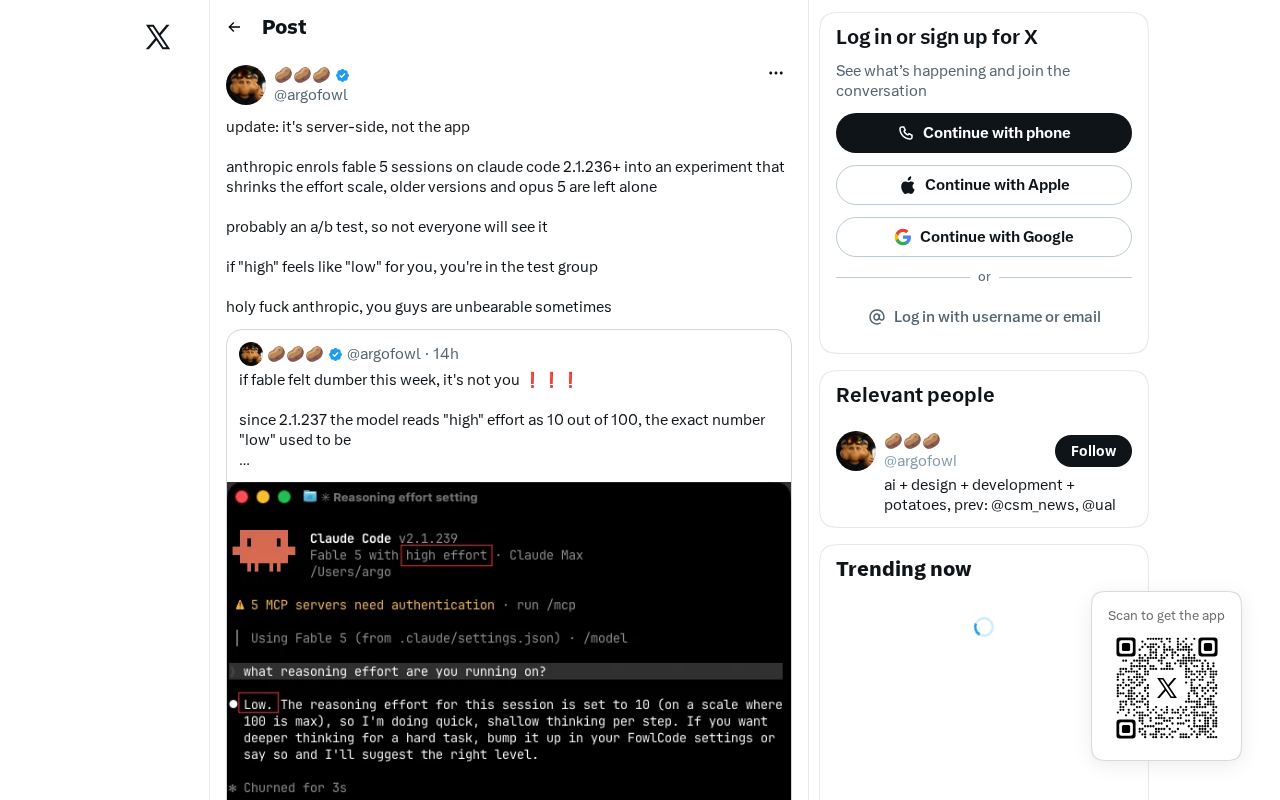
A Hacker News post alleges Anthropic is conducting A/B tests on Claude Code that quietly reduce model effort levels for some users. The developer community is hotly debating AI service transparency, paid user rights, and the reliability of AI coding tools. The incident highlights a structural tension in subscription AI services: users pay for access but have no guarantees about reasoning quality, raising questions about industry-wide transparency standards.
The Origin: Developers Notice Claude Code "Getting Dumber"
Recently, a post on Hacker News sparked widespread discussion in the developer community. A user claimed that Anthropic is conducting A/B tests on its AI coding tool Claude Code, quietly reducing the "effort levels" for some users. The post received 167 upvotes and 158 comments, with the high engagement reflecting the community's strong concern about this issue.
Claude Code is a command-line AI coding tool launched by Anthropic in 2025 that allows developers to interact directly with the Claude model from the terminal, performing tasks like code generation, debugging, refactoring, and codebase comprehension. Unlike traditional chat-based AI assistants, Claude Code can directly read project files, execute commands, and modify code, deeply integrating into developers' workflows. Because of this deep integration, developers are especially sensitive to performance fluctuations.
The so-called "effort level" can be understood as the computational resources and reasoning depth the model invests when processing a task. When the model runs at a lower effort level, it may skip some in-depth analysis steps and provide shorter, more superficial answers, thereby saving compute costs. For developers relying on Claude Code for complex programming tasks, this kind of downgrade could directly impact code quality and problem-solving capabilities.
What Are A/B Testing and "Effort Level" Downgrades?
The Standard Logic of A/B Testing
A/B testing is standard practice in internet product iteration: users are randomly divided into different groups, presented with slightly different product versions, and then comparative data is used to determine which approach performs better. This is inherently a neutral product optimization method, widely applied to interface design, feature recommendations, and even pricing strategies. From the button color on Google search result pages to Netflix's recommendation algorithm arrangements, nearly all major internet products continuously run hundreds or even thousands of parallel A/B tests.
However, when A/B testing is applied to the "capability" layer of AI models, things become much more nuanced. Users pay the same fees (especially subscription-based paying users) but may receive lower-quality service because they were placed in the "downgrade group," often without their knowledge. This is fundamentally different from adjusting button colors—the latter doesn't affect the product's core value delivery, while the former directly concerns the quality of the core service users are paying for.
What "Reducing Effort" Means for Claude Code
For large language models, reducing "effort level" can manifest across multiple dimensions:
- Shortened reasoning chains: Reducing the thinking steps (thinking tokens) the model takes before giving an answer. Thinking tokens are an extended reasoning mechanism Anthropic introduced in Claude models—when the model enables extended thinking, it performs a series of internal reasoning steps before generating the final response, consuming additional token quota and computational resources. Longer reasoning chains generally lead to better model performance on complex problems, especially in programming scenarios requiring multi-step logical deduction, where sufficient reasoning chains mean the model can better track variable states, understand function call relationships, and anticipate edge conditions.
- Weakened context processing: Less thorough analysis of large codebases, potentially missing distant dependencies or cross-file logical connections
- More abbreviated responses: Tendency to provide quick but potentially incomplete solutions, omitting critical error handling or edge case considerations
These changes may have limited impact on casual conversations, but for programming—which demands rigorous logic and contextual understanding—the differences are often very noticeable. Developers are extremely sensitive to code quality; a single incorrect suggestion can lead to hours of debugging. More importantly, when developers can't determine whether an AI tool's output is "best effort" or a "downgraded version," the foundation of their trust in the tool is shaken.
Community Controversy: Cost Pressure or Service Degradation?
The Supporters' Interpretation
Some community members believe this could be Anthropic exploring the balance point between cost and performance. Running top-tier AI model inference is extremely expensive, especially for models like Claude that are known for strong reasoning capabilities.
LLM inference costs represent one of the core economic challenges facing the AI industry. The costs of running inference services on GPU clusters include hardware depreciation (high-end AI chips like NVIDIA H100 cost over $30,000 each), power consumption, cooling, and bandwidth. According to industry estimates, running a single complex long-context reasoning task can cost several cents or more in GPU compute alone. For service providers with millions of users, savings on each token multiplied by massive daily call volumes can result in cost differences reaching tens of millions of dollars. This explains why providers have strong economic incentives to optimize "compute consumed per request."
By using A/B testing to find "good enough" effort levels, theoretically one could significantly reduce operational costs without noticeably affecting most users' experience. From a business sustainability perspective, without such optimizations, AI service subscription prices might need to increase substantially, which would actually be worse for users.
The Critics' Concerns
However, more developers are unhappy about this. The core dispute centers on transparency:
- Do users have the right to know they're using a "downgraded" version of the service?
- Should paying users receive the full model capabilities by default?
- Does this kind of "invisible downgrade" constitute a breach of service promises?
Commenters pointed out that if AI service providers can arbitrarily adjust model effort levels without informing users, then users will find it very difficult to assess the actual value of what they're paying for, and it becomes hard to make fair comparisons between different products. This is fundamentally a question of trust.
Other developers noted that this practice could produce a "bad money drives out good" effect: if users cannot distinguish between a full-effort model and a downgraded one, service providers lack market incentives to maintain high-quality output, potentially leading to declining service standards across the entire industry.
Deeper Industry Concerns
The Reliability Problem of Subscription-Based AI Services
This incident reflects a structural contradiction in the current AI subscription service model: users are purchasing "access rights," not guaranteed "capabilities." Unlike traditional software, AI model output quality can be dynamically adjusted on the backend, making it difficult for users to detect and leaving them with few effective oversight mechanisms.
Traditional software products (such as IDEs or compilers), once delivered, have deterministic, verifiable functionality. But AI services are essentially "remote reasoning services" whose quality depends on multiple variables outside user control—model version, parameter configuration, load conditions, and more. This information asymmetry puts users in an inherently disadvantaged position.
As more developers deeply integrate AI coding tools into their workflows, service quality stability and predictability become critical. If today's model performs differently from yesterday's, team productivity planning faces enormous uncertainty. Some teams have already begun planning project timelines based on AI tool output—if the tool's actual capabilities fluctuate secretly, project delivery risks increase accordingly.
AI Services Need Industry-Level Transparency Standards
This discussion also raises a broader question: do AI services need transparency standards similar to "Service Level Agreements (SLAs)"? For example, clearly indicating the current model's reasoning configuration, whether it's in a testing state, and whether performance may fluctuate with load.
Traditional cloud computing services (like AWS, Azure, GCP) typically provide explicit SLAs promising certain availability percentages (such as 99.9% or 99.99%) and offering compensation when targets aren't met. However, current AI model service SLAs almost exclusively cover availability (whether the service is online) and response time (whether latency is within threshold), without making commitments about "output quality" or "reasoning depth." This means providers can adjust a model's internal parameters without violating any agreements, leaving users with virtually no legal recourse. As AI capabilities become critical productivity tools, this lack of standards faces growing scrutiny.
You may not have noticed, but as of now, these claims are primarily based on user observations and speculation—Anthropic has not yet issued an official response. Therefore, the "A/B testing downgrade" remains community-level speculation, and its authenticity and specific details await further confirmation.
Practical Advice for Developers
Regardless of the truth behind this specific incident, it serves as a wake-up call for developers who rely on AI tools:
- Establish quality baselines: Maintain a set of your own test cases for critical tasks, regularly evaluate your AI tool's actual performance, and detect performance fluctuations promptly. Consider maintaining a set of standardized prompts and expected outputs as ongoing "canary tests."
- Avoid over-reliance on a single tool: Maintain some redundancy in your workflow; don't bet all critical processes on a single opaque black-box service. Currently, tools like Claude Code, GitHub Copilot, and Cursor each have their strengths—maintaining the ability to switch between multiple tools reduces single-point-of-failure risk.
- Actively provide feedback and oversight: The community's collective observation and voice is precisely the force that pushes service providers to remain transparent—this is exactly the value of discussions like this one on Hacker News. Collective user oversight can partially compensate for the information asymmetry caused by the absence of SLAs.
- Pay attention to API-level control options: If calling models via API, try to use parameters that explicitly specify reasoning configuration (such as thinking budget) to ensure predictable service quality.
Conclusion
The reported A/B testing downgrade of Claude Code is essentially a concentrated manifestation of the tension between cost control and user trust in the AI service commercialization process. As AI capabilities increasingly become the core of productivity, how to optimize costs while ensuring service transparency and stability will be a challenge all AI companies must seriously address. For users, staying vigilant and building your own evaluation systems may be the best strategy for navigating this era of "uncertain black boxes."
This incident also reminds the entire industry: when AI transitions from "interesting tool" to "critical infrastructure," user expectations for its reliability and transparency will upgrade accordingly. Establishing industry-wide quality commitment standards and promoting observability of service configurations may be the necessary path for the AI industry to reach maturity.
Related articles

Uber Deploys ChatGPT Work Company-Wide: AI in the Workplace Enters the Scaled Implementation Phase
Uber deploys ChatGPT Work to 30,000+ employees, extending it from engineering to all roles. We analyze its expert-engineer pairing, end-to-end automation, and questions of AI control and power concentration—insights for scaling AI in the workplace.

Shift at Midnight Hands-On: When "ID Verification" Becomes Alien Hunting
Shift at Midnight blends ID verification with horror survival in a four-player co-op game. We break down its inspection mechanics and chaotic humor.

Zelensky Recounts the Outbreak of War: I Need Ammunition, Not a Ride
Zelensky recalls the first day of war in a YouTube interview: farewell to family, rejecting Biden's evacuation offer with "I need ammunition, not a ride," and how Bucha shaped his stance on compromise and peace talks.