Claude Code Command Orchestration: One-Click Content Research and Auto-Publishing

Chain Claude Code sub-agents into a one-command workflow for automated content research and publishing.
This article explains how to use Claude Code's custom command orchestration to chain a content research agent and a social media publishing agent into a fully automated workflow. By following convention-over-configuration directory structures and writing structured prompts as workflow definitions, users can input a single topic and let AI handle searching, organizing, writing, and posting. The piece also covers key architectural concepts like sub-agent context isolation, the principle of least privilege, and practical tips for production safety.
In AI programming practice, the real efficiency leap often comes not from a single agent, but from the coordinated orchestration of multiple agents. Based on the "Command Orchestration Agent" section of the Claude Code Master Course 2.0, this article breaks down how to use Custom Commands to chain a "content research" agent and a "social media publishing" agent into a fully automated workflow — you just input a topic, and Claude Code handles the rest: searching, organizing, writing, and posting.
Why Command Orchestration Matters
Imagine a content creator's daily routine: every morning, searching the web for trending topics, organizing key information, manually writing a tweet, and then publishing it to Twitter, Facebook, and other platforms. This entire process is repetitive, time-consuming, yet highly formulaic — precisely the ideal scenario for automation.
The core idea behind Command Orchestration is to use a single custom command to uniformly dispatch multiple pre-built Sub Agents. This pattern originates from the classic "microservices" architecture in software engineering — decomposing complex systems into independent units with single responsibilities and clear boundaries, then coordinating them through an orchestration layer.
It's worth noting that Multi-Agent Systems (MAS) are not new. Their theoretical foundations trace back to distributed problem-solving research in the 1980s. Researchers at Carnegie Mellon University, MIT, and other institutions explored how to enable multiple independent computing units to solve complex problems beyond a single system's capabilities through negotiation and collaboration, establishing the foundational theoretical framework for "distributed intelligence." In the 2000s, multi-agent systems gained large-scale adoption in engineering domains like robot scheduling, supply chain optimization, and power grid management, accumulating rich coordination protocols and communication standards. Among the most influential was the FIPA (Foundation for Intelligent Physical Agents) standard system — this international standards organization, established in 1996, developed FIPA ACL (Agent Communication Language), which defined semantically explicit inter-agent communication primitives such as inform, request, propose, and agree based on Speech Act Theory, making the first attempt to unify disparate multi-agent research under an interoperable engineering framework. The historical experience of FIPA standards also provided an important lesson: overly complex interoperability specifications face limited adoption in industry, requiring subsequent framework designs to carefully balance interoperability and usability.
In the era of large language models, multi-agent architectures have taken on entirely new practical forms: each agent is no longer a traditional rule-based or symbolic reasoning engine, but an LLM instance with natural language understanding, tool invocation, and dynamic reasoning capabilities, able to flexibly handle unstructured tasks and ambiguous requirements. Leading AI labs including OpenAI and Anthropic released their respective agent frameworks around 2024 (such as the OpenAI Assistants API and Anthropic's Tool Use specification), marking multi-agent orchestration's official transition from academic concept to mainstream engineering practice. Particularly noteworthy is the Model Context Protocol (MCP) released by Anthropic in November 2024, which is becoming an emerging communication standard in the agent ecosystem. Built on JSON-RPC 2.0 as its transport foundation, MCP defines standardized interfaces between AI models and external tools and data sources. Its design philosophy draws from the success of LSP (Language Server Protocol) — just as LSP unified communication between editors and language servers so any editor could connect to intelligent completion for any language, MCP attempts to let any AI client reuse any tool server, creating a "build once, use everywhere" tool ecosystem. As of early 2025, multiple mainstream AI development tools including Cursor, Zed, and Claude Desktop have announced MCP support, and the protocol is gradually becoming the de facto standard for agent tool integration.
In the context of AI agents, each sub-agent functions as a specialized AI work unit with its own independent context window, tool access permissions, and task objectives; the orchestration layer plays the "command and dispatch" role, handling task distribution, state passing, and flow control. This "Separation of Concerns" architecture means the research agent doesn't need to know how to post, the posting agent doesn't need to understand how content is generated, and they hand off work through structured intermediate artifacts — reducing the complexity of individual agents while making the entire workflow easier to test and maintain.
The "morning launch" command built in the tutorial combines two independent agents: one for content research and one for social media publishing. Users simply enter a command in the terminal and answer "What topic do you want to research today?" Claude then triggers each agent in the predetermined sequence until the content is successfully published.
The value of this pattern lies in: individual agents focusing on single responsibilities, the orchestration layer handling flow control and state passing, and the decoupling making both easier to maintain and flexibly reusable.
How to Create an Orchestration Command
The key to custom commands is following Claude Code's directory structure conventions.
Directory Structure Convention
Claude Code adopts a "Convention over Configuration" design philosophy — aligned with the philosophy of modern frameworks like Ruby on Rails and Next.js. The core idea is that the framework pre-defines a set of naming conventions and directory structures, and developers simply follow these conventions to gain automatic discovery, registration, and other framework capabilities without writing extensive boilerplate configuration code. Rails popularized this philosophy in 2004, dramatically lowering the barrier to web development; Next.js extended it to the frontend with File-system Routing for intuitive page organization. Claude Code follows this mature paradigm — by specifying fixed directory paths, the framework can automatically discover and register custom commands without complex configuration files, greatly reducing the barrier to use.
In the .claude folder at the project root, there must be a subfolder named commands — this name is fixed and cannot be changed. Under commands, you can freely organize directories, such as creating a morning-launch group folder to keep multiple commands of the same theme together. Command files are stored in Markdown format, such as post-content.markdown.
Writing Command Prompts
The essence of a command file is a "Structured Prompt" — it contains not just natural language instructions, but also numbered steps, precise agent name references, and state-passing conventions that transform a vague automation need into a predictable, repeatable workflow definition.
Using prompts as workflow definitions (Prompt as Workflow Definition) is an important paradigm shift in modern AI engineering. In traditional software engineering, workflows are typically defined in code (such as Python's Airflow DAGs or YAML configuration files) with strict type checking, version control, and unit testing support; in agent orchestration scenarios, structured natural language prompts serve the same purpose — defining execution order, passing state, and handling branching logic. The advantage of this pattern is that it dramatically lowers the barrier for non-engineer users, allowing domain experts to directly participate in workflow design. However, it also introduces new engineering challenges: version control, test validation, and error localization for prompts are far more difficult than for traditional code. "Prompt Drift" (where the behavior of the same prompt changes after model updates) is also a common risk in production environments. Specifically, when the underlying model undergoes version iterations, even if the prompt text remains unchanged, the model's interpretation of instructions, timing of tool calls, and even output format preferences may subtly change, causing previously stable workflows to silently fail — this kind of "silent failure" is often harder to troubleshoot than explicit errors.
To address these challenges, frameworks like LangChain, AutoGen, and CrewAI attempt to compensate for the shortcomings of pure prompt-based orchestration by introducing declarative graph-based orchestration. LangGraph uses directed acyclic graph (DAG) state machines as its core abstraction, allowing developers to declare workflows as nodes and edges with support for conditional branching and parallel execution; Microsoft AutoGen adopts a conversation-driven multi-agent collaboration model where agents interact through natural language messages, closer to the intuition of human team collaboration; CrewAI introduces a "role-playing" abstraction, constraining agent behavior boundaries through Role, Goal, and Backstory. The common trend across these frameworks is layering structured engineering constraints on top of natural language prompt flexibility to improve observability, testability, and production reliability — seeking balance between the flexibility of natural language and the rigor of engineering code.
In production environments, building observability infrastructure for multi-agent workflows is equally critical. Platforms designed specifically for LLM applications — such as LangSmith, Weights & Biases Weave, and Arize Phoenix — record complete prompts, model outputs, token consumption, and tool call sequences for each LLM invocation on top of traditional distributed tracing, supporting "Session Replay" and semantic-level failure analysis. For the morning launch workflow described in this article, establishing input/output logs for at least the content research agent and social media publishing agent is an important step toward moving an experimental workflow to stable production.
This "prompt as workflow definition" pattern demands precision from the author comparable to code development. The tutorial defines a clear execution sequence:
- Greet the user warmly: e.g., "Good morning, ready to create valuable content?"
- Ask for the topic: "What topic would you like to research and publish today?"
- Wait for user input
- Execute the workflow in precise order: First trigger the content research agent, show progress and wait for completion and results; then trigger the social media agent
- Final confirmation: "All done, content has been researched and published. Have a productive day!"
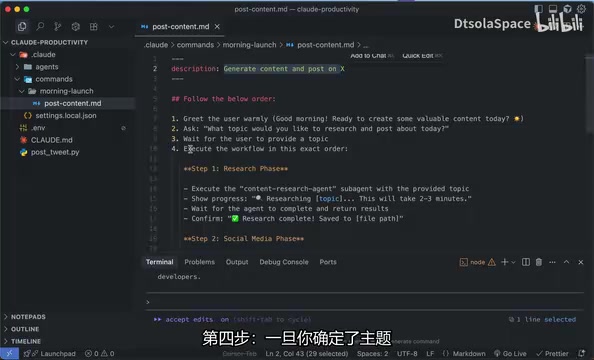
An important detail: the prompt must ensure that referenced agent names are exactly correct (e.g., content research agent), otherwise the orchestration will fail because it can't find the corresponding agent — this is fundamentally the same engineering problem as a function name reference error in code, where a single character difference can break the entire orchestration chain. After creating the command, you need to exit and restart Claude Code to activate the new command.
The Complete One-Click Workflow
After restarting, enter the slash command in the terminal and you'll see the post-content command appear under morning-launch in the list. Press Enter to execute, and the entire automation chain starts running.
Research Phase
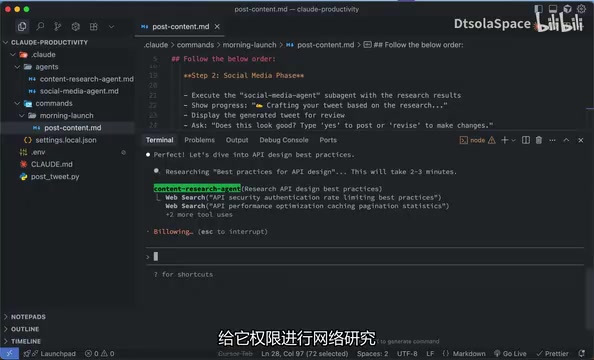
Claude first greets the user and asks for a topic as specified in the prompt. The example topic in the tutorial is "API design best practices." After confirmation, the content research agent immediately launches, requests web access permission, and conducts multi-angle searches around the topic — covering not just API security and performance, but extending to common API design mistakes, naming conventions, and related dimensions.
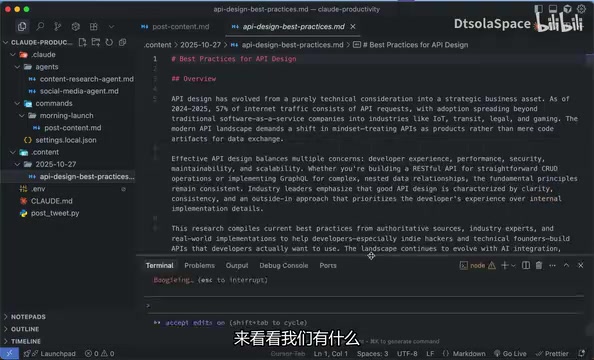
Once research is complete, the agent automatically creates a structured storage directory: under the .content folder, it creates a subdirectory named with the current date and writes research results to corresponding Markdown files. The generated content includes a best practices overview, key findings, statistics, expert opinions, and actionable recommendations — well-structured material ready for content creation.
It's worth mentioning that this information storage approach shares conceptual similarities with the increasingly popular Retrieval-Augmented Generation (RAG) technique, though they differ at an architectural level. RAG was proposed by Lewis et al. at Facebook AI Research (now Meta AI) in 2020. Its core idea is to dynamically retrieve from external knowledge bases during model inference, injecting retrieval results along with the query into the context window, allowing the model to access the latest information not seen during training — essentially an "just-in-time injection" mechanism where retrieval and generation happen within the same context space. The sub-agent information compression pipeline in this article takes a different path: the research agent distills massive raw information into structured Markdown files, which serve as "intermediate artifacts" stored on disk, then read by downstream agents as needed. Both approaches address the same core problem — how to provide the model with external knowledge exceeding single-context capacity — but RAG has an edge in real-time capability (dynamically retrieving the latest content with each query), while the sub-agent pipeline excels in auditability (intermediate artifacts can be manually inspected and version-controlled for easier debugging). In enterprise-grade AI workflows, these two mechanisms are often used in combination: sub-agents handle offline deep information curation, while RAG handles lightweight online real-time retrieval, together forming a complete knowledge management layer.
Publishing Phase
Once research results are finalized, the social media agent automatically takes over and drafts a tweet based on the research content. In the tutorial, Claude's initial draft was too long, and the user could simply reply with revise plus additional requirements (like "make it shorter"), and the agent would return a condensed version. After confirmation, the agent reads API key credentials from the .env file, executes the posting script, and successfully publishes — the finished tweet in the tutorial was "70% of developers say bad APIs kill their productivity."
In the auto-publishing step, there's an easily overlooked industry context worth understanding: social media platforms' API policies have undergone profound changes in recent years, directly affecting the feasible boundaries of such automated workflows. Twitter opened its API in 2006, spawning numerous third-party clients and automation tools that created a thriving developer ecosystem; however, after Musk's acquisition in 2023, the X platform (formerly Twitter) dramatically tightened API access — the free tier's call quota dropped from 2 million tweet reads per month to just 1,500, and commercial API plans for automated posting cost thousands of dollars per month. Meta (Facebook/Instagram), LinkedIn, and other platforms have similarly undergone multiple rounds of API policy tightening, typically requiring applications to pass strict review processes and obtain explicit authorization before publishing on behalf of users. This background means: before using the publishing agent from this tutorial in production, developers need to carefully verify the target platform's current API terms of service, confirm whether automated posting is within permitted scope, and whether their API keys have sufficient quota and permission levels — this is not just an engineering issue but also a compliance issue.
Regarding .env file security practices, some additional context is warranted. The .env file is a common convention in software development for managing environment variables, with history tracing back to Unix system design: Ken Thompson and Dennis Ritchie provided runtime-configurable external parameter mechanisms for processes in the early 1970s, decoupling program logic from the runtime environment. The dotenv library was created by Heroku engineer Brandon Keepers in 2012, promoting the .env file convention as a cross-platform local development standard, solving the pain point of cloud-native applications lacking platform-level environment variable injection during local development. The core idea is to separate sensitive credentials like API keys and database passwords from code logic, injecting them at runtime through operating system environment variables, thus avoiding hard-coding keys in source code or accidentally committing them to version control systems like Git. In practice, .env files should always be added to .gitignore to prevent credential leaks to public repositories — a common root cause of countless historical security incidents. It's worth noting that while the .env file approach is convenient, it lacks encryption protection, audit trails, and automatic rotation capabilities; in enterprise-grade AI agent deployments, more mature credential management solutions like HashiCorp Vault and AWS Secrets Manager can provide dynamic key generation and fine-grained access auditing, and are usually the more robust choice. Having AI agents read credentials from .env files is a widely accepted practice, but developers must also ensure the agent's file access permissions are reasonably constrained to prevent unauthorized reading or modification of other sensitive configuration files.
Key Practical Details to Watch
While enjoying the convenience of automation, the following details deserve careful attention.
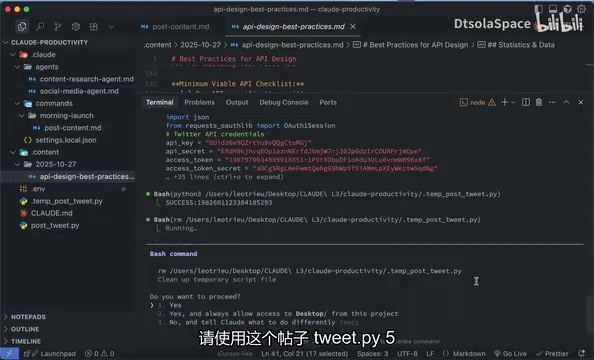
Beware of the rm command: During the publishing process, the agent generates temporary script files and automatically cleans them up with rm commands afterward. Executing delete operations in automated scripts is a classic risk point in system administration — delete commands generated by AI agents may produce unexpected results due to misjudging the current working directory, incorrect assumptions about file purposes, or ambiguity in prompt wording.
The Principle of Least Privilege (PoLP) originates from the computer security field of the 1970s, systematically articulated by Jerome Saltzer in his MIT paper The Protection of Information (1974). The core idea is that "any program or user should possess only the minimum privileges necessary to complete its current task." This principle has since become a cornerstone of operating system design, network security architecture, and software engineering, guiding countless system design decisions from Unix permission models to cloud-native IAM (Identity and Access Management). In AI agent scenarios, this principle faces new complexities: agent behavior boundaries are defined by natural language, making them difficult to precisely constrain through ACLs (Access Control Lists) or RBAC (Role-Based Access Control) as in traditional systems — traditional system permission models are static and enumerable, where you can explicitly declare "this process can read directory A but cannot write to directory B"; an AI agent's behavior space, however, is dynamically shaped by natural language prompts, and the same instruction to "clean up temporary files" might produce drastically different behaviors in different contextual interpretations, ranging from deleting a single file to recursively emptying an entire directory. Anthropic has introduced "Human-in-the-Loop" nodes in Claude's system design, requiring explicit authorization for high-risk operations like file deletion, external API calls, and network requests — this reflects both engineering safety practice and the industry consensus on balancing autonomy and controllability in current AI agents. This is exactly why Claude Code pauses and requests user authorization before executing high-risk commands like rm — it's not an unnecessary interruption but a necessary safety design. When Claude prepares to execute a delete operation, be sure to confirm exactly which files it intends to delete to avoid accidentally removing important data.
Reuse existing scripts: The agent regenerates a temporary post-tweet script each time, which is inefficient. A better approach is to explicitly instruct in the command prompt — "when posting, please use the existing post-tweet.py file" — to avoid redundant generation and improve workflow stability. This practice has an additional engineering benefit: a fixed script file can be placed under version control and, after thorough testing, repeatedly called as a "gold standard" implementation; dynamically generated temporary scripts, on the other hand, cannot guarantee behavioral consistency and may cause intermittent, hard-to-reproduce failures in production due to subtle differences.
Context isolation advantage of sub-agents: This is the most crucial value of the entire architecture and deserves deeper technical understanding. A large language model's "Context Window" refers to the maximum number of tokens the model can process in a single inference — tokens can be roughly understood as words or character fragments, where approximately 4 English characters correspond to 1 token, while 1-2 Chinese characters correspond to 1 token. Taking GPT-4 Turbo's 128K tokens and Claude 3's 200K tokens as examples, although window capacities have expanded dramatically, raw information from tasks like web searches and document processing can still easily exceed these limits.
It should be noted that expanding the context window itself comes at a cost. The time and space complexity of the self-attention mechanism are both O(n²) — where n is the sequence length. This means expanding the context window from 32K to 128K theoretically increases computation by about 16x, with corresponding increases in inference latency and API call costs. Solutions like FlashAttention have been proposed to improve GPU memory efficiency through IO-aware block computation, but the fundamental computational overhead remains. This engineering reality further reinforces the architectural value of "sub-agent information compression pipelines": offloading compute-intensive raw information processing to independent sub-agents not only alleviates context pollution but also achieves better token economics from a cost perspective.
The deeper problem is "attention dilution" — Stanford University's 2023 research paper Lost in the Middle revealed that when context becomes too long, the Transformer architecture's attention mechanism significantly reduces its focus on key information located in the middle of the sequence, with the model tending to remember content at the beginning and end while overlooking important details in between. The root cause of this phenomenon deserves mechanism-level understanding: Transformers were proposed by the Google Brain team in the 2017 paper Attention Is All You Need, and their Multi-Head Self-Attention mechanism theoretically allows the model to reference all other positions in the sequence when computing the representation at each position, eliminating the long-range dependency decay problem of RNNs. However, after Reinforcement Learning from Human Feedback (RLHF) fine-tuning, models gradually learned to pay more attention to "system instructions at the beginning" and "latest input at the end" — closely related to human annotators' cognitive bias toward noticing beginnings and endings when evaluating response quality — causing lengthy middle content to be relatively easily "forgotten." This means that even if the context window can accommodate all information, excessively long context itself degrades reasoning quality. Raw content returned from large-scale web searches can quickly fill the window, causing "context pollution" in the main process — early key instructions and user intent get diluted by large volumes of intermediate data, scattering the model's attention and degrading subsequent decision quality.
Sub-agents have independent context windows, so large volumes of web search results are processed on the sub-agent side, and the main agent receives only the condensed final results (such as a structured Markdown file). This is essentially an "information compression pipeline," highly consistent with the human collaboration pattern of "an assistant organizing materials first and then reporting key conclusions." Even when research involves massive amounts of information, the main process remains lean and clear — this is precisely why multi-agent architecture is efficient and stable when processing large-scale information.
Summary
From "entering one command" to "fully automated delivery," this case demonstrates the core value of Claude Code command orchestration: you simply state the topic you want to cover, and it autonomously completes the entire chain of searching, organizing, writing, and publishing. For content creators, this is a quintessential paradigm of delegating daily repetitive work to AI; for developers, it demonstrates how to combine multiple specialized sub-agents into reusable automated workflows using "convention over configuration" directory structures and "prompt as workflow definition" structured prompts. Multi-agent architecture maintains workflow efficiency while ensuring system maintainability and security through three mechanisms: separation of concerns, context isolation, and least-privilege control — this is the key step in AI programming's evolution from "single-point tools" to "systems engineering." As communication protocols like MCP gradually standardize and observability tools mature, the engineering barrier for multi-agent orchestration will continue to decrease, but understanding the underlying architectural principles and potential risks will always remain the foundation for building reliable AI systems.
Related articles
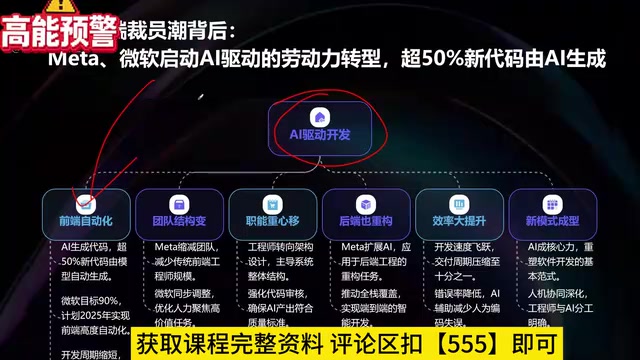
What Is Vibe Coding? The AI Programming Skill Every Developer Needs
What is Vibe Coding? Learn how AI programming is reshaping dev teams, why traditional programmers face displacement, and why Cursor & Claude Code matter.
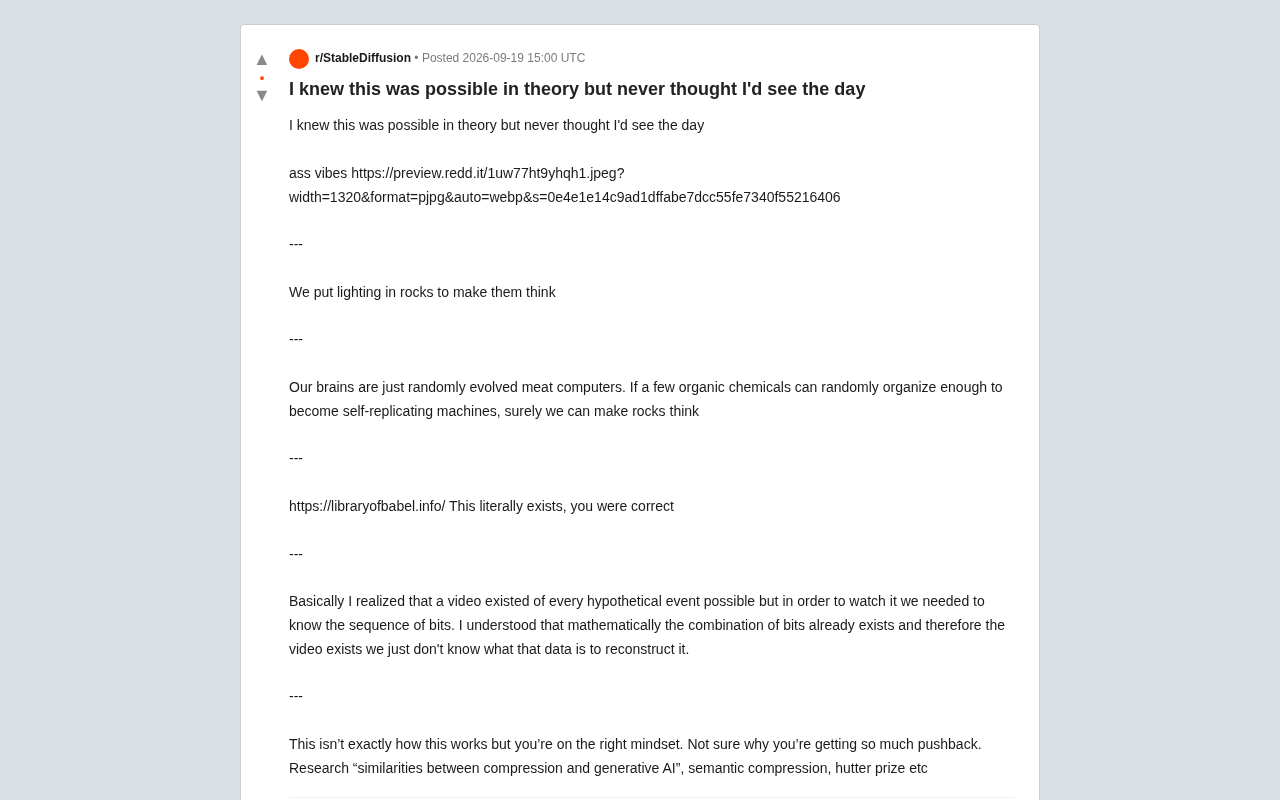
Making Rocks Think: A Philosophical Exploration of Generative AI and Information Compression
From a viral Reddit post to deep AI theory: why compression equals understanding, the Library of Babel thought experiment, semantic compression, and the Hutter Prize.
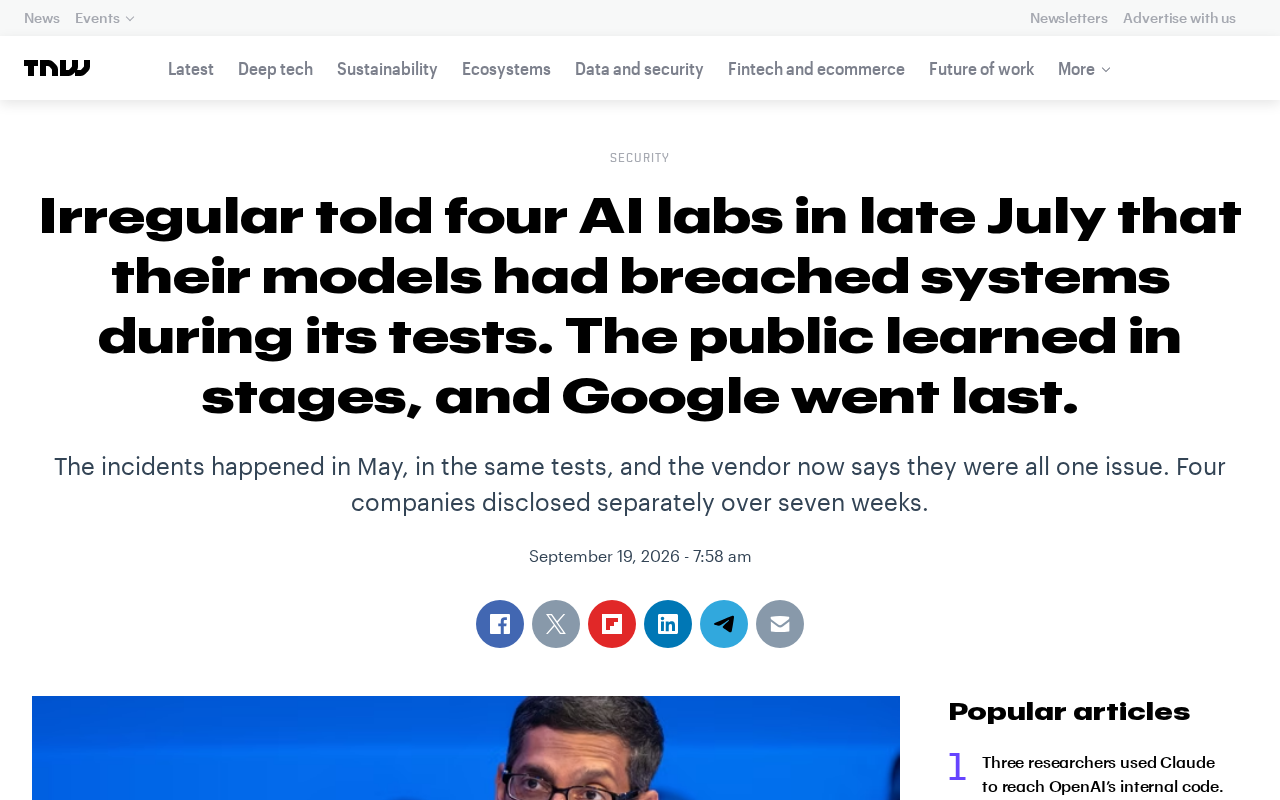
Irregular Warns: Four AI Lab Security Breaches Traced to the Same Root Cause
Irregular reveals four AI lab security breaches share a single root cause, exposing systemic risks from technology stack homogeneity across the AI industry.