Claude Code + Skills in Action: Auto-Generate Production-Ready Test Cases in 10 Minutes

How Claude Code + Skills automates production-ready test case generation in under 10 minutes.
A developer breaks down a Claude Code + Skills automation solution that turns requirement documents into production-ready test cases. By splitting the workflow into three independent Skills—requirement splitting, test point extraction, and case generation—the entire process takes under 10 minutes, far outpacing manual writing.
How AI Is Reshaping Test Case Design
Test case design has long been one of the most time-consuming and experience-dependent tasks in software testing. In the traditional approach, test engineers must read through requirement documents line by line, break down functionality, extract test points, and then manually write test cases covering various boundary and exception scenarios. Completing a full requirement document often takes days or even weeks.
Recently, a Bilibili creator shared a hands-on solution based on Claude Code + Skills, achieving one-click generation of production-ready test cases directly from requirement documents through customized Skills. According to the demo, the entire process takes less than 10 minutes—at least doubling the efficiency compared to manual work. This article breaks down the core ideas and implementation logic behind this approach.
Core Idea: Breaking the Testing Workflow into Three Skills
The essence of this solution lies in the fact that it doesn't aim to complete everything in a single call. Instead, it decomposes the complex task into three independent Skills, forming a controllable pipeline.
Users simply issue one command—"Please use this Skill to generate test cases for the requirement document"—and Claude Code automatically parses the intent and executes the preset workflow in stages:
- Stage 1: Split the requirement document
- Stage 2: Extract test points
- Stage 3: Generate test cases
The benefits of this staged design are obvious: each step has a single responsibility and produces verifiable results, effectively avoiding the context loss or logical drift that LLMs tend to exhibit during long tasks. The demo requirement document contained nine chapters, with chapters three through six being the core requirements. The AI was able to accurately identify and process them one by one.
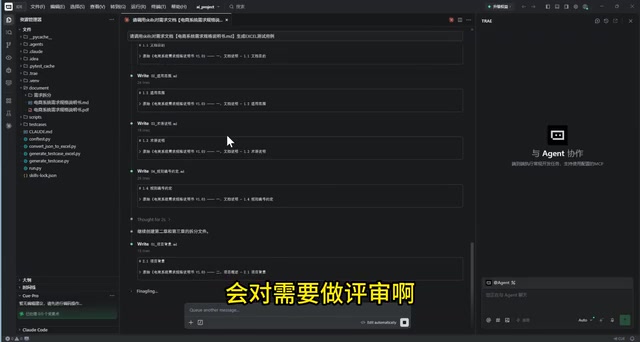
Stage 1: Splitting the Requirement Document Verbatim
The core requirement of the first Skill is to split by chapter, verbatim—no additions, no omissions.
This point is crucial. Many AIs tend to "outsmart" themselves by adding or removing content when processing requirements, but testing scenarios have strict demands for the completeness and traceability of requirements. Therefore, this Skill explicitly stipulates: add no requirements, remove no requirements, and perform no premature extraction—only pure structured splitting.
Requirement Review and Flagging
While splitting, the Skill leverages AI to automatically review the requirements, with a focus on flagging any unclear or ambiguous statements. This is equivalent to performing a quality check at the source, laying the foundation for subsequent test point extraction.
In the demo, the nine chapters were split into nine folders. Each split requirement file contains:
- Original location markers (e.g., "Chapter 3, Section 3.1") to ensure traceability
- Module overview (an overall description of the functional module)
- Functional rules (access roles, page information, etc.)
- Conditions, exceptions, and boundaries
- Acceptance criteria
Text Conversion of Tables and Images
The most technically demanding aspect is handling tables and flowcharts within the document. LLMs struggle to directly understand this kind of rich-media content, so this Skill requires converting requirements in table or image format uniformly into text descriptions. Once converted to text, the LLM's understanding becomes clearer and more accurate, which directly determines the quality of subsequent test point extraction.
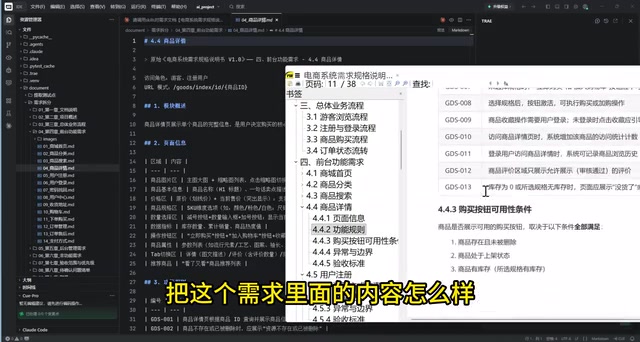
Stage 2: Intelligently Extracting Test Points
The second Skill is responsible for extracting test points from the split requirements.
Automatically Filtering Out Non-Requirement Content
The AI does not extract test points from every chapter. In the demo, chapters one and two contained only documentation notes and overviews—classified as non-requirement content—which the AI automatically skips, extracting only from chapters containing actual requirements. This reflects the Skill design's clear definition of what constitutes a "valid requirement."
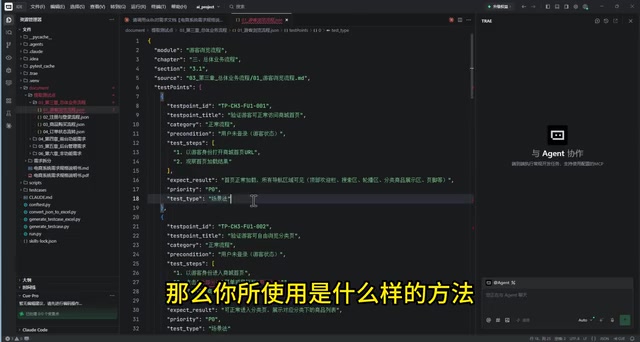
Structured Test Point Format
Each extracted test point uses a uniform structured format (JSON), containing the following fields:
- Associated module and chapter
- Test point title (e.g., "Verify guest access to the mall homepage")
- Status and operation steps
- Expected result
- Priority
- Test design method used
Each test point clearly indicates "which method it is based on," making the test case design process well-grounded rather than a black-box output. After test point extraction is complete, another automatic review is performed, forming a second quality checkpoint.
Stage 3: Generating Production-Ready Test Cases
The third Skill invokes the "Export Test Cases" function, transforming structured test points into complete, executable test cases.
Complete Test Case Fields
The generated test cases include the following elements:
- Test case title
- Test type
- Priority
- Preconditions
- Test data
- Operation steps
- Expected results
- Corresponding test point (ensuring traceability)
- A reserved manual review column
The design of the manual review column is particularly pragmatic—it acknowledges that AI-generated cases still require human oversight, rather than assuming the output is flawless by default.
Test Case Quality: One Requirement Yields Multiple Cases
The creator compared the original requirements with the generated results. Taking the first feature in Chapter 3, "Guest Browsing Flow," as an example, the AI generated a total of eight test cases:
- Verify guest normally accessing the mall homepage
- Category browsing
- Search functionality
- Product detail viewing 5–8. Login-guidance flows for cart, favorites, checkout, and user center
What was originally just one or two sentences of description in the requirement document was broken down into multiple test cases covering normal flows, boundary scenarios, and exception guidance. The creator rated this as reaching a "production-ready level, even better than manual writing."
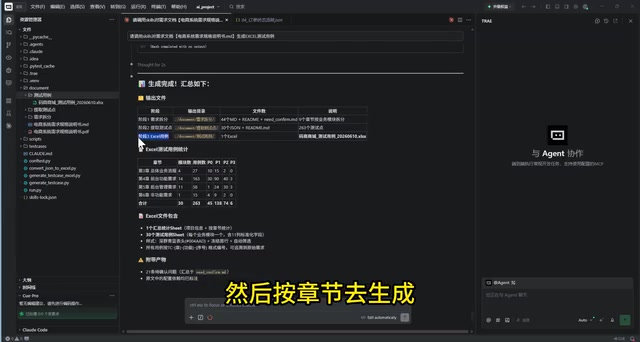
Efficiency Comparison and the Value of This Solution
From requirement document to complete test cases, the entire process takes less than 10 minutes. By the creator's estimate, completing the same amount of work manually would take at least several days—an efficiency gain far exceeding a mere doubling.
What's Truly Worth Learning From This Solution
From an engineering perspective, the value of this solution goes beyond just "saving time"—it lies more in its methodology:
- Task decomposition: Breaking a complex goal into three controllable, verifiable Skills is an effective engineering approach to coping with the instability of LLMs.
- Traceability: Every layer of output retains original location markers, forming a complete chain from requirement → test point → test case.
- Rich-media preprocessing: Converting tables and images to text is a key step in improving the LLM's comprehension accuracy.
- Multi-layered review mechanisms: Requirement review, test point review, and the manual review column together build a multi-layered quality assurance system.
Conclusion
The combination of Claude Code + Skills demonstrates AI's potential for real-world deployment within vertical workflows. It doesn't rely on a single all-powerful prompt to solve every problem; instead, through skill orchestration, it solidifies professional experience into reusable automated workflows. For test engineers, this means being freed from tedious test case writing to focus their energy on review and strategy design—which may well be the true value of AI-assisted testing.
Related articles
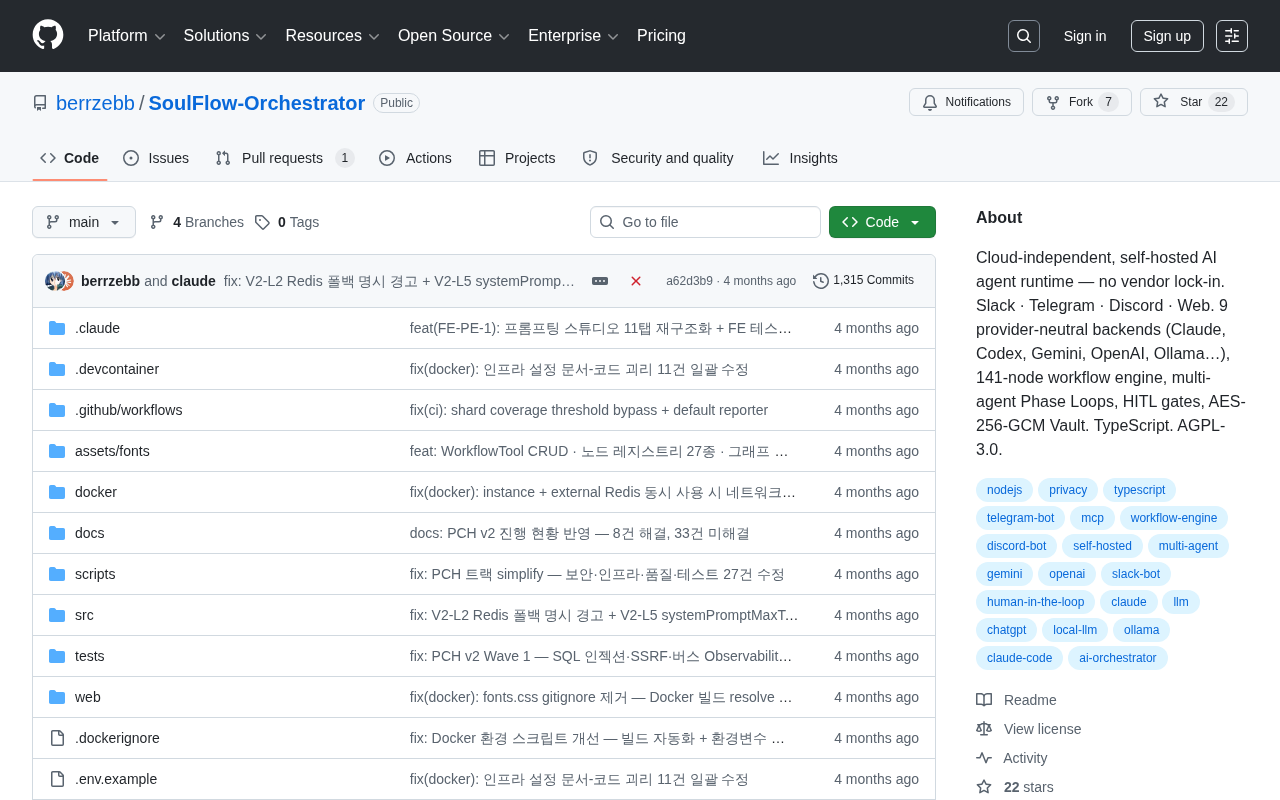
SoulFlow-Orchestrator: A Self-Hosted, Vendor-Lock-In-Free AI Agent Runtime
SoulFlow-Orchestrator is an open-source, self-hosted AI agent runtime with no vendor lock-in. Supports 9 neutral backends (Claude, OpenAI, Ollama), 141-node workflow engine, multi-agent loops, and HITL gates.
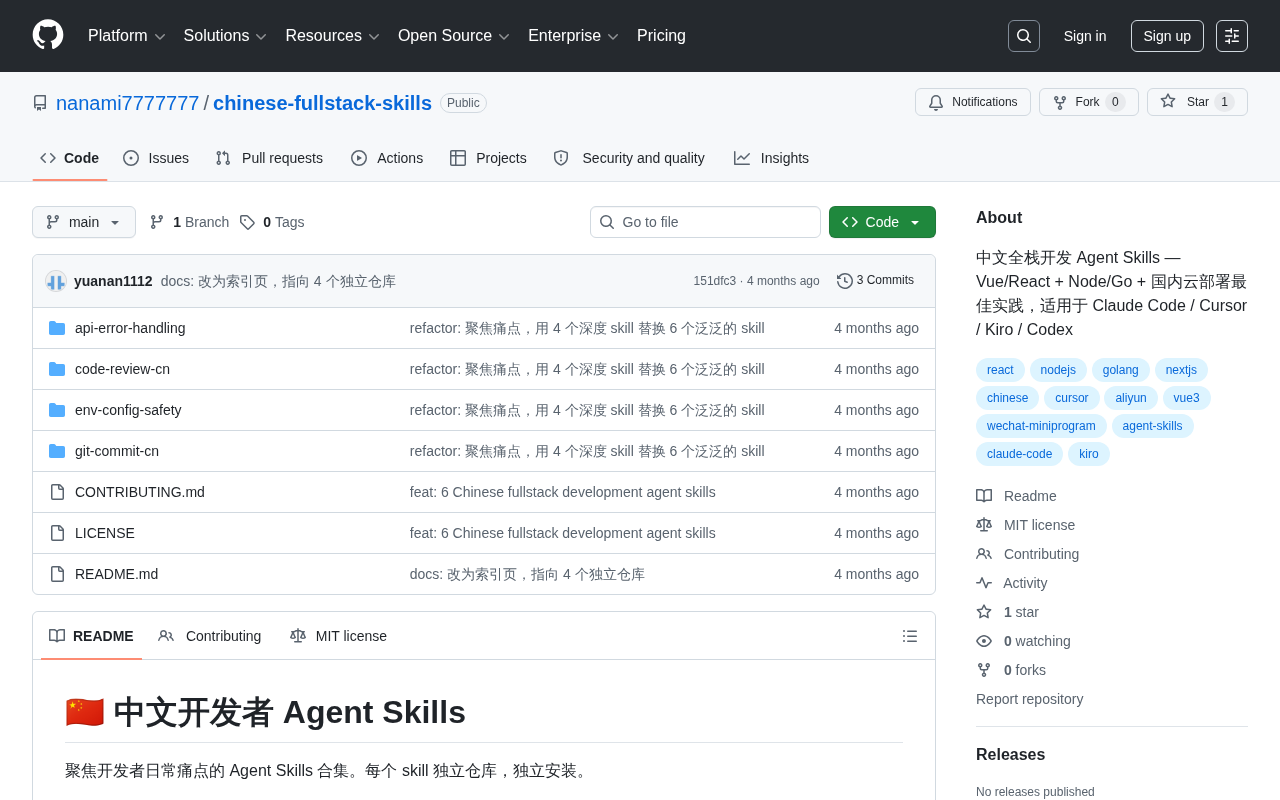
Chinese Full-Stack Agent Skills: A Skill Library Tailored for Domestic AI-Assisted Development
chinese-fullstack-skills is an Agent Skills library for Chinese full-stack development, covering Vue/React, Node/Go, and domestic cloud deployment best practices. Compatible with Claude Code, Cursor, Kiro, and Codex.
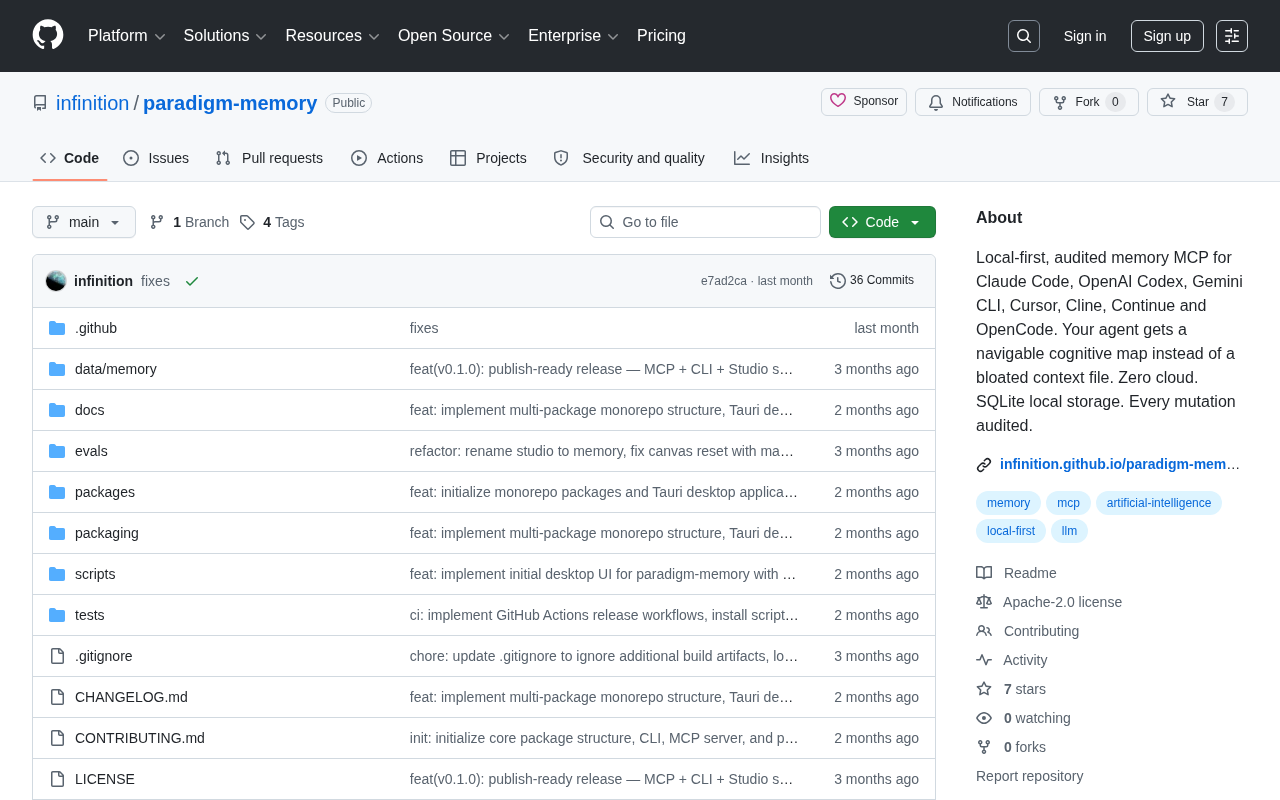
Paradigm Memory: A Local-First Memory System for AI Coding Assistants
paradigm-memory is a local MCP memory tool for Claude Code, Cursor, and Cline. It uses SQLite local storage, zero cloud, full audit trails, and a navigable cognitive map instead of bloated context files.