Claude Code Software Factory Template: A New Paradigm for AI Programming

Claude Code software factory templates shift AI programming from scattered conversations to reusable engineering pipelines.
A Show HN project called "Lights-on software factory boilerplate for Claude Code" on Hacker News, though not highly upvoted, points to the trend of engineering AI programming. Such templates use preset rule files, command scripts, and workflow definitions to transform Claude Code from a scattered-conversation assistant into a "production line" that outputs code according to fixed procedures. Their core value lies in turning implicit engineering conventions into explicit configuration, improving consistency and predictability. The article also notes the real challenges: over-constraint may weaken AI flexibility, and templates themselves require continuous maintenance. For developers, embedding AI into a stable, maintainable engineering process is becoming a new competitive advantage for team-level adoption.
From "Point Assistance" to "Software Factory": Claude Code Templates Garner Attention on HN
A Show HN project titled "Lights-on software factory boilerplate for Claude Code" appeared on Hacker News. Although it didn't generate much discussion (5 points, 0 comments), it points to a forming trend: building reusable engineering templates around Claude Code, moving AI programming from scattered conversations toward "software factory"-style assembly-line work.
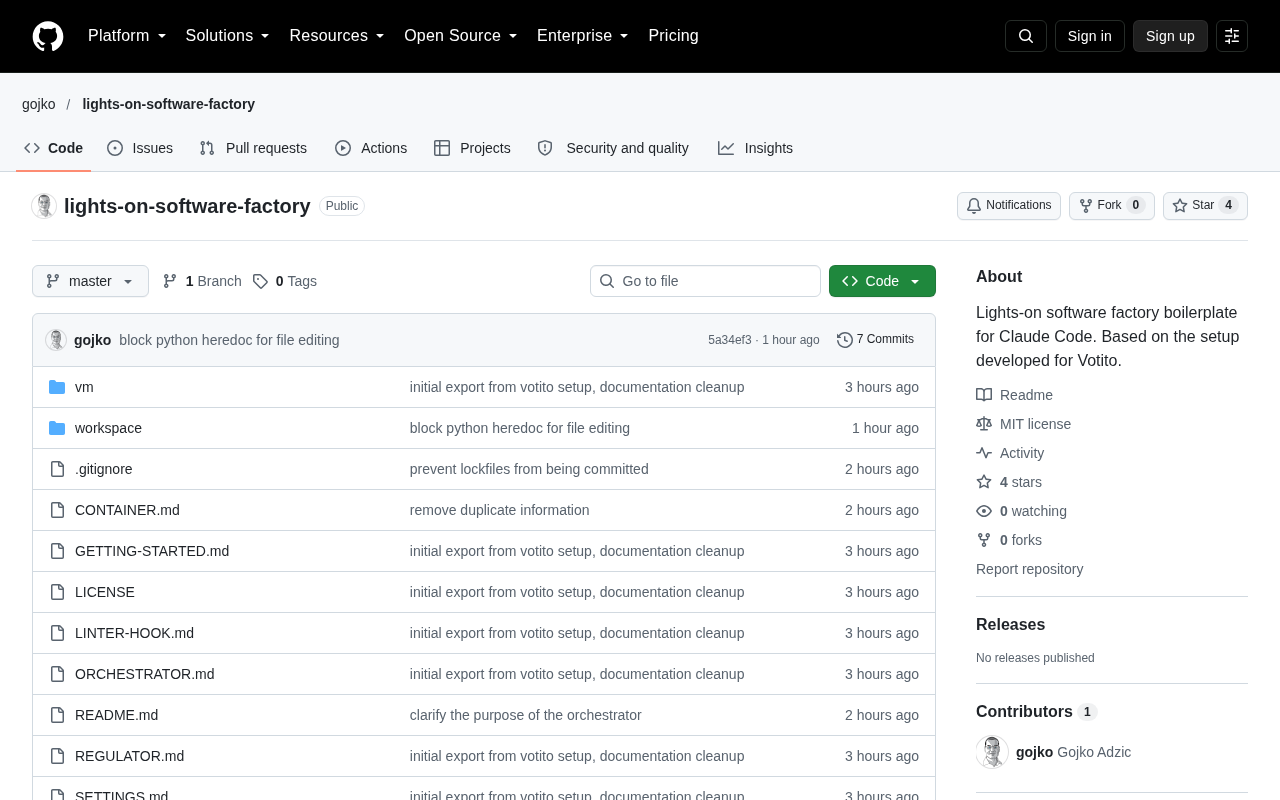
The core idea behind this kind of boilerplate isn't complicated—pre-orchestrating code generation, testing, review, deployment, and other stages into instruction sets and directory structures that Claude Code can execute. Developers only need to fill in business logic, and the rest of the "factory assembly line" runs automatically. It attempts to answer a question: now that AI can write code, how should we organize the way it writes code?
What Is a "Software Factory" Template?
The term "software factory" isn't new—it originally referred to mass-producing software through standardization and modularization. In the context of Claude Code, it takes on a new meaning: using a set of preset rule files, command scripts, and workflow definitions to transform Claude Code from "an assistant that can write code" into "a production line that outputs code according to fixed procedures."
A typical software factory template usually contains several layers. The bottom layer is project specifications, telling Claude Code the project's directory conventions, code style, and dependency management approach; the middle layer is task workflows, such as "write tests before implementing" and "must run lint after changes"; the top layer is quality gates, letting AI self-check before committing. This layering makes AI behavior predictable and reproducible, rather than re-exploring from scratch in every conversation.
Claude Code is a command-line AI programming tool launched by Anthropic. Unlike web-based chat, it's embedded directly in the developer's terminal environment and can read and write project files, execute shell commands, run tests, and perform git operations. This "agentic" capability enables it not only to generate code snippets but also to autonomously complete multi-step tasks. Because of this, Claude Code's behavior is highly dependent on in-project context—including rule files like CLAUDE.md, directory structure, and available commands. Templating practices leverage this mechanism by pre-placing instruction files and workflow scripts in the project root, constraining Claude Code's autonomy within predictable engineering standards, thereby transforming a "general assistant" into a "project-specific developer."
Why Claude Code Needs "Templates"
Developers who use Claude Code directly have probably all had similar experiences: the same requirement, a different conversation window, and the resulting code structure might be completely different. The problem isn't model capability but the lack of stable contextual constraints. The value of templates lies in turning "implicit conventions" into "explicit configuration."
For teams, this is especially critical. When multiple people share a set of Claude Code templates, AI-generated code follows unified architectural patterns and naming conventions, reducing the burden of code review. For individual developers, templates act like an "engineering habits checklist," helping avoid structural problems that AI might plant during rapid generation.
Judging from the frequency of Show HN projects like this on HN, the community is spontaneously exploring the layer of "engineering AI programming." Discussion of pure prompt techniques is declining, replaced by attention to workflows, templates, and automation pipelines.
Boilerplate in traditional software engineering refers to preset directory structures, configuration files, and base code at project startup, on which developers fill in business logic to avoid building from scratch. The "software factory boilerplate" in Show HN follows this form, but the preset content extends from build tool configuration to AI behavior specifications: in addition to conventional files like package.json and tsconfig, it includes instruction sets guiding Claude Code on how to write tests, how to commit, and how to self-check. Unlike traditional scaffolding tools like Yeoman or create-react-app, this kind of boilerplate constrains not the compilation output but the AI's decision-making process—it's both a code starting point and an AI work manual.
Real Challenges of the Templating Approach
It's important to view software factory templates calmly—they're not a silver bullet. Claude Code's behavior is affected by model version, context length, and project complexity, and what templates can constrain is limited. Overly detailed rules may cause AI to "follow the book" and lose the ability to adapt flexibly, especially when facing non-standard requirements.
Another challenge is maintenance cost. Templates are themselves code and need continuous updates as projects evolve. If templates diverge from actual engineering practices, they create additional cognitive burden. This is why such projects currently appear mostly in "boilerplate" form—providing a starting point rather than an endgame, trimmed by users as needed.
Context length is key to understanding the boundaries of template effectiveness. Large language models can process a limited number of tokens in a single inference, and each time Claude Code executes a task, it needs to put rule files, relevant source code, command output, and more into the context window together. The more detailed the rules in a template, the more context they consume, leaving less space for actual code and reasoning, and the model may miss key information or ignore some instructions. This is why template design requires trade-offs: rules should be concise and layered, placing high-frequency constraints in the most prominent positions rather than piling up all engineering details. As model context windows expand, this limitation will ease, but "information density" will always be an engineering problem template designers must face.
Implications for Developers
This Show HN project hasn't generated much discussion, but the direction of exploration it represents is worth attention. The capability boundaries of AI programming tools are expanding rapidly, and the "way of using" built around tools is becoming a new competitive advantage. Knowing how to write prompts is only the starting point; embedding AI into a stable, maintainable engineering process is the watershed for team-level adoption.
For developers currently using or considering adopting Claude Code, it's worth starting with a small template: clearly define the project structure and quality check rules, observe AI's performance under constraints, and then gradually expand. A software factory won't be built overnight, but every template is a screw on the assembly line.
One-line Summary
Claude Code software factory templates shift AI programming from scattered conversations to reusable engineering pipelines.
Paragraph Summary
A Show HN project called "Lights-on software factory boilerplate for Claude Code" on Hacker News, though not highly upvoted, points to the trend of engineering AI programming. Such templates use preset rule files, command scripts, and workflow definitions to transform Claude Code from a scattered-conversation assistant into a "production line" that outputs code according to fixed procedures. Their core value lies in turning implicit engineering conventions into explicit configuration, improving code consistency and predictability. The article also notes the real challenges of the templating approach: over-constraint may weaken AI flexibility, and templates themselves require continuous maintenance. For developers, embedding AI into a stable, maintainable engineering process is becoming a new competitive advantage for team-level adoption.
Related articles

Altman Declares: The Cybersecurity Crisis Is Unsolvable and There Are Too Many Vulnerabilities to Patch
OpenAI CEO Sam Altman publicly admits he can't fix all security vulnerabilities and that the cybersecurity crisis will keep worsening. This article analyzes the industry reality behind this statement: exploding software complexity, the double-edged sword of AI, and the need to shift security paradigms from "zero vulnerabilities" to resilient defense.

Product Hunt Launches Visual Launch Editor, Saying Goodbye to Tedious Form Filling
Product Hunt launches a Visual Launch Editor with in-place editing for name, tagline, gallery, and maker info, auto-saved drafts, and a checklist to guide creators.

Zelensky Speaks: How We Held Kyiv Against 200,000 Russian Troops
Zelensky recalls the early Russia-Ukraine war: 200,000 Russian troops drove on Kyiv while Ukraine's main forces were in the east. He explains how mobilization grew the army from 200,000 to 800,000 and how Kyiv and Chernihiv oblasts were recaptured.