Claude Code + Spacesheep: How Developers Can Keep Up with AI-Generated Code

Building a visual understanding loop with Claude Code and Spacesheep to cope with AI code generation outpacing human reading.
The article introduces a YouTube creator's anxiety over AI-generated code outpacing line-by-line reading, and his strategy of shifting to a higher-level holistic understanding. Using the visualization tool Spacesheep connected to Claude Code via the MCP protocol, he builds a complete workflow from concept discussions and interactive documentation to PR reviews with decision timelines. The demo uses a semantic router as a case study, from mapping the DecisionIndexer structure to implementing GLiNER 2.5 locally and presenting before-and-after comparisons with benchmark metrics.
AI-generated code is outpacing humans' ability to read it line by line. How can engineers avoid becoming "outsiders" in their own projects? A YouTube creator shares his "understanding loop" built with Claude Code and the visualization tool Spacesheep—spanning concept discussions, interactive documentation, and PR reviews with timelines—in an attempt to regain a sense of control over the codebase amid rapid development.
When Code Generation Outpaces Reading Speed
The creator opens by raising a widespread anxiety: engineering has changed so fast over the past few years that what we can build is almost limitless, but the problem follows—how do engineers track what is being built? How do they keep learning?
His assessment is candid: we can't deeply understand every detail the way we would when typing code line by line, but perhaps we can understand better at a higher, more holistic level. This "holistic understanding" isn't a compromise but a learning strategy adapted to the new pace. The core component supporting this strategy is what he repeatedly calls "non-boring documentation"—visual, dynamic, interactive docs that integrate with project management tools like Linear and Jira, and support interactive PR reviews.
Spacesheep: A Visualization Tool That's Hard to Define
Spacesheep is hard to describe in one sentence because it's so versatile. The video shows how others use it: some build 3D browser games in it, others use it to explore interactive visualizations of chip design. This creator uses it to serve his own development workflow: starting from the planning stage, he repeatedly discusses different approaches with the AI agent connected to Spacesheep—first understanding the concept, then building the plan.
He shows a small plan for a semantic router: making it faster, more scalable, and more reliable, and able to integrate with decision models. The plan itself is quickly drafted, but the demonstration that follows is the main event—implementing a local alternative to JEV for the semantic router using Spacesheep.
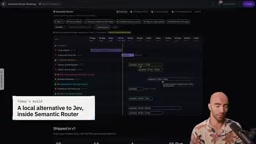
Step 1: Mapping the Code Structure with Claude Code
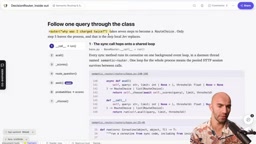
The demo starts with Claude. He first confirms that Spacesheep's MCP (Model Context Protocol) is authenticated, then kicks off the planning process. The first task is to understand the existing DecisionIndexer class in the semantic router—the foundation to subclass and reuse when building a local JEV decision component.
His request to Claude is deliberate: he asks for interactive, visual documentation that conveys information as quickly and fluidly as possible; for code snippets of the most critical components with explanations, so he can get a feel for the codebase's texture without directly reading the code; and for the structure of important methods. He specifically emphasizes including the context of "why this information is needed"—since he's developing a local JEV support class—so Claude can tailor the output to the goal.
MCP (Model Context Protocol) is an open protocol launched by Anthropic in late 2024 to establish a standardized context exchange channel between LLM applications and external data sources and tools. It uses a client-server architecture: hosts like Claude Code act as clients, while tools like Spacesheep are exposed as MCP servers, declaratively listing callable tools, readable resources, and reusable prompt templates so the model can invoke them on demand during a conversation. Compared with writing a separate plugin for each tool, MCP's value lies in protocol unification—once an AI agent authenticates, it can operate across multiple services. The repeated mention of "MCP is authenticated" refers to establishing this trusted connection, enabling Claude to create documents and invoke built-in agents directly within Spacesheep without copying and pasting between windows.
Back-and-Forth with the Built-in Agent
After receiving the documentation, he doesn't passively accept it. Claude suggests replacing a method in decision_router, and he immediately questions: "Is this really what I want?" So he asks the built-in agent in Spacesheep directly: the indexing router mounts encoders from different providers, so why don't decision models use the same approach? He admits he isn't sure of the answer either—it could go the encoder route, or each decision model could have its own decision router.
While waiting for the reply, he continues reading the documentation, mapping the full chain from input query to decision output: calling the routing method, running async code, entering the scoring logic, executing the ask method. He points out that the part of ask that interacts with JEV—client session, state, model, question list—is the key that the local JEV needs to replace, while the parameters and return shape remain unchanged. The documentation also correctly identifies the naming conventions for decision types (choice, null, score), as well as the logic for sorting by score and supporting different routing thresholds.
His advice to viewers is direct: if you're building something, you should deeply understand it. Visualization works for him, but everyone's approach differs, and it's worth trying yourself.
From Model Selection to Local Implementation
The next step is determining the model options for the local JEV. He originally wanted to use the GLiNER decision model because it's open source, but along the way he discovered a misconception: the GLiNER he thought could run locally isn't actually open source. So he turns to GLiNER 2.5 (about 340 million parameters), considering this scale entirely feasible on ordinary consumer hardware, depending on torch, transformers, and peft, and integrating via the GLiNER2 local library.
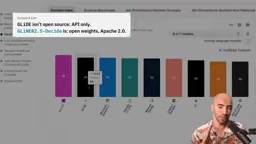
He mentions that he usually runs a few experiments and a spike to verify feasibility first, then compares results across approaches—visualizing these results in Spacesheep is especially useful. However, for the sake of video pacing, this time he goes straight into the build and review phase.
GLiNER (Generalist and Lightweight Named Entity Recognition), mentioned in the article, is a class of lightweight models for general-purpose named entity recognition. Its hallmark is using a bidirectional Transformer encoder to process entity types and text simultaneously, so there's no need to train a separate model for each entity type—making it suitable for deployment in resource-constrained environments. GLiNER 2.5 continues the "small parameters, multi-task" approach, and its roughly 340 million parameters allow it to run on consumer GPUs or even Apple Silicon. The dependencies mentioned—torch (deep learning framework), transformers (Hugging Face model loading and inference library), peft (Parameter-Efficient Fine-Tuning, commonly using methods like LoRA to train only a small number of additional parameters to adapt to downstream tasks)—form a typical local inference plus lightweight fine-tuning stack. It's important to distinguish: "open source" means the weights and code are accessible, while "can run locally" depends on VRAM, compute, and inference framework support—the two are not equivalent, which is exactly why the creator discovered his misconception.
Review Documentation: Timeline and Code Changes
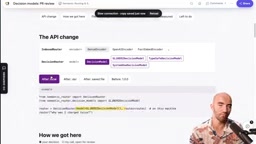
After the build, he shows what the review documentation looks like. It contains the subclass structure: the local GLiNER2DecisionModel; before-and-after examples—previously going directly through JEV's type-safe routing, now the model is passed as a decision model into the decision router, a substantive change; and a decision timeline that he particularly likes, recording key decisions like "why not mount decision models the encoder way" and "decision models as a separate package."
Code changes are also presented directly in the document, allowing quick browsing of the decision router changes and the special tokens in the GLiNER2 codebase. The benchmarking section is marked as "outside the main codebase, will monitor but lower priority." The documentation also includes metrics: running the GLiNER 2.5 model on MPS performs well, with an average p50 of 21.1 milliseconds. However, he explicitly states that more benchmarks are needed before considering the approach viable.
A decision timeline is a lightweight practice for recording architectural decisions, which can be seen as an interactive variant of Architecture Decision Records (ADRs). Traditional ADRs record "context—decision—consequences" as Markdown files, but they often lag behind the code and are hard to search; a timeline embeds key trade-offs in chronological order into visual documentation and links them to the corresponding PRs and code diffs. Entries like "why not mount decision models the encoder way" and "decision models as a separate package" are typical forms of such decisions: they don't describe what the code does, but explain why it was done that way and which alternatives were abandoned. In scenarios where AI rapidly generates code, such records are especially critical—the code itself can be regenerated, but the constraints and trade-off rationale at the time aren't automatically preserved in the code, and the timeline fills exactly this lost context.
This Isn't the End, but an Evolving Workflow
At the end of the video, the creator repeatedly emphasizes that he "doesn't have all the answers." This workflow is still evolving rapidly, and Spacesheep is just one component, not the whole. He plans to explore more components and methods in future videos.
For developers, the value of this case isn't in replicating the specific toolchain, but in the stance it demonstrates: in an environment where AI agents take on more and more coding work, proactively design processes for "maintaining understanding"—use visualization to reduce cognitive load, structured documentation to carry decision context, and interactive review to replace passive acceptance. Code can be generated, but understanding must be deliberately maintained.
One-line Summary
Building a visual understanding loop with Claude Code and Spacesheep to cope with AI code generation outpacing human reading.
Paragraph Summary
The article introduces a YouTube creator's anxiety over AI-generated code outpacing line-by-line reading, and his strategy of shifting to a higher-level holistic understanding. Using the visualization tool Spacesheep connected to Claude Code via the MCP protocol, he builds a complete workflow from concept discussions and interactive documentation to PR reviews with decision timelines. The demo uses a semantic router as a case study: first mapping the DecisionIndexer structure with Claude Code, then repeatedly discussing approaches with the built-in agent, choosing GLiNER 2.5 to implement the decision model locally, and finally presenting before-and-after comparisons, a decision timeline, and benchmark metrics in the review documentation. The author emphasizes that this workflow is still evolving, and its core value lies in proactively designing mechanisms for "maintaining understanding."
Related articles

FDE Forward Deployed Engineer: The New Species of AI Implementation and Practical Pathways
What is an FDE Forward Deployed Engineer? This article breaks down FDE's origins, its fundamental difference from outsourcing, the cost logic that spawned it in the AI era, and the capability advancement path from Agent development to fine-tuning and reinforcement learning, plus common bottlenecks and budget realities of enterprise fine-tuning implementation.

A Practical Guide to Fine-Tuning MobileNetV2 and Layer Freezing
A deep dive into layer freezing strategies for MobileNetV2 fine-tuning: training only the head, freezing shallow layers while fine-tuning deep ones, and layer-wise learning rates—plus BatchNorm handling and learning rate pitfalls.

LangGraph Retry Safety in Practice: Idempotency, Approval Gates, and Compensation Handlers
Drawing on a Reddit workshop, we break down three LangGraph production patterns: idempotent state machines to avoid duplicate side effects on retry, human approval gates for high-impact decisions, and compensation handlers to undo completed steps—plus small-encoder routing and Wilson interval evaluation.